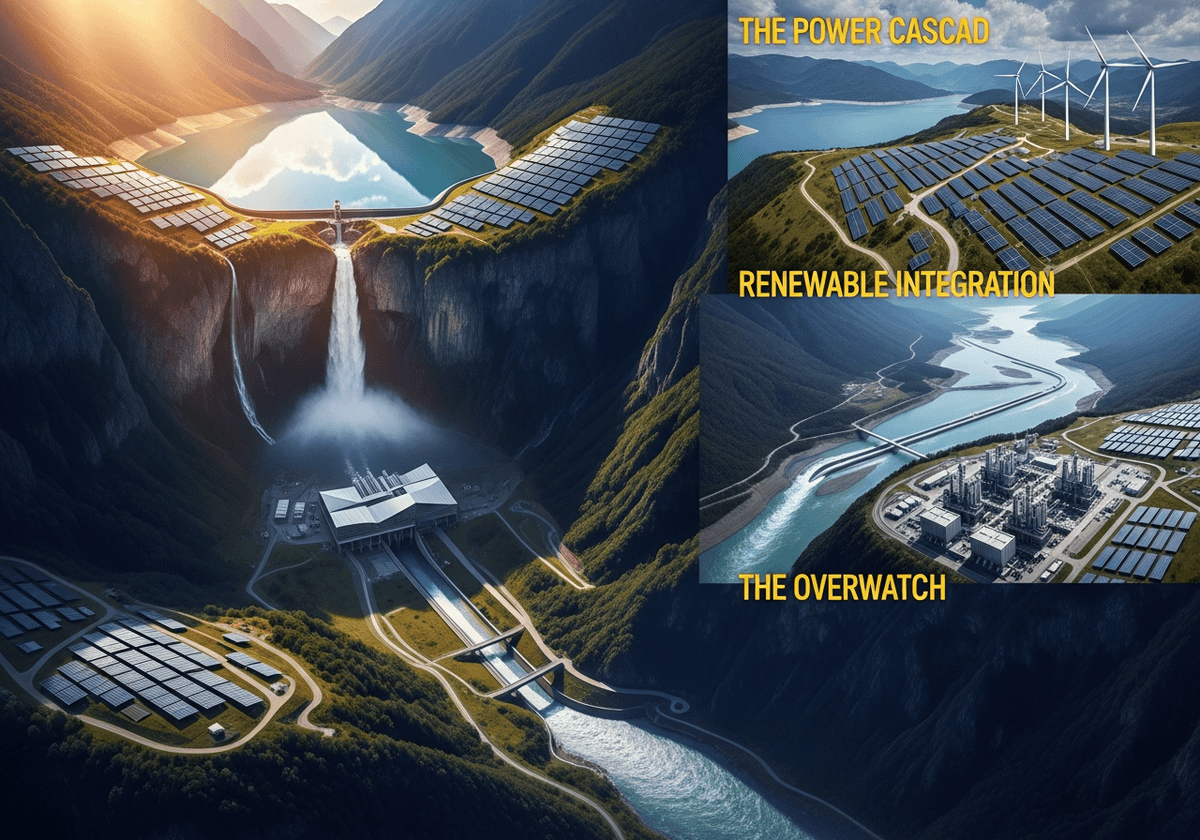
A energia hidrelétrica de bombeamento armazena energia elétrica bombeando água para montante e recuperando-a posteriormente por meio de turbinas no caminho de volta para jusante. É a tecnologia de armazenamento em escala de rede mais antiga em uso comercial, com raízes na Europa alpina da década de 1890, e permanece a maior em capacidade instalada, mesmo com o rápido crescimento da implantação de baterias em todo o mundo. A tecnologia foi ampliada globalmente em meados do século XX para equilibrar a geração de base nuclear inflexível e, nas últimas duas décadas, sua função passou a ser a de absorver a variabilidade da produção eólica e solar, um papel que depende do mesmo princípio físico fundamental: a energia potencial gravitacional convertida em eletricidade e vice-versa por meio de uma turbina-bomba reversível.
Nosso artigo a seguir aborda todo o escopo técnico e econômico do PSH: a física subjacente e os limites de eficiência, a arquitetura eletromecânica que possibilita a operação reversível, os serviços de estabilidade da rede que a tecnologia oferece além do simples armazenamento de energia, suas estratégias operacionais e mecanismos de receita, as restrições ambientais que definem onde os projetos serão construídos, configurações emergentes como PSH subterrâneo e em água do mar, os marcos regulatórios que regem sua implantação e uma comparação direta com baterias, ar comprimido, baterias de fluxo, hidrogênio e volantes de inércia, considerando os critérios que importam para decisões reais de investimento e planejamento.
Principais conclusões
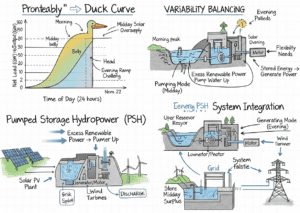
- PSH é a tecnologia de armazenamento em escala de rede mais antiga e ainda a maior: Originária da Europa Alpina da década de 1890, essa tecnologia continua sendo a dominante em termos de capacidade instalada em todo o mundo, mesmo com a aceleração da implantação de baterias.
Seus princípios físicos são simples, mas sua dimensão é enorme. O armazenamento de energia é proporcional à massa, à gravidade e à altura (E = η, m, g, h), mas como a água tem uma densidade energética muito baixa em comparação com as baterias químicas, o PSH precisa de reservatórios com milhões de metros cúbicos para armazenar o equivalente à capacidade de uma bateria em um armazém. - A relação entre altura e vazão determina todo o projeto de engenharia: Em locais de montanha com alta queda d'água, utilizam-se máquinas compactas do tipo Francis; em locais de rios com baixa queda d'água, são necessárias turbinas maciças do tipo Kaplan para movimentar grandes volumes de água — a geografia do local dita a tecnologia, e não o contrário.
- A eficiência de ida e volta normalmente fica entre 70% e 85%, um pouco abaixo da eficiência moderna. íon de lítio baterias (85–95%), mas o PSH mantém esse desempenho por 50 a 100 anos, em vez dos 10 a 20 anos antes que uma bateria precise ser substituída.
- O PSH faz mais do que armazenar energia — ele estabiliza a rede elétrica. Sua massa giratória proporciona inércia física, oferece regulação de frequência rápida, pode atuar como um capacitor síncrono para suporte de tensão sem movimentar água e é uma das poucas tecnologias capazes de religar uma rede elétrica em colapso.
- Seu papel mudou de "redução de picos" para "equilíbrio da variabilidade". Construída originalmente para operar em conjunto com a inflexível geração de base nuclear, a PSH hoje absorve principalmente as rampas íngremes de energia solar e eólica — mais visivelmente a "curva do pato" — tornando-se um ativo crítico para a integração de energias renováveis.
- A gestão ambiental é uma questão de projeto primordial, não uma reflexão tardia. Circuito fechado Configurações fora do leito do rio, controle de sedimentos, mitigação da evaporação e gestão da qualidade da água/térmica são fatores que influenciam onde e como os novos projetos de PSH (Potencial Hidroviário) são construídos e licenciados.
- Novas fronteiras estão se expandindo para a construção de sistemas solares fotovoltaicos. Sistemas subterrâneos (minas, cavernas), sistemas de água do mar, parques de energia híbridos que combinam energia solar flutuante com reservatórios e projetos modulares de pequeno porte estão trabalhando para superar a dependência tradicional dos sistemas solares fotovoltaicos em locais raros com grandes diferenças de altitude.
- O PSH complementa, em vez de competir com, outras tecnologias de armazenamento. Ele detém o nicho de longa duração, alta confiabilidade e inércia da rede; as baterias dominam a resposta rápida e a curta duração; o hidrogênio lidera o armazenamento sazonal. A rede elétrica do futuro precisa de um portfólio diversificado, não de uma única tecnologia vencedora.
Fundamentos e Evolução Histórica

A energia hidrelétrica de bombeamento (EHB), também conhecida como armazenamento hidroelétrico por bombeamento ou armazenamento de energia hidrelétrica por bombeamento (AEH), é a forma mais antiga e, de longe, a maior forma de armazenamento de energia em escala de rede no mundo atualmente. Em sua essência, a tecnologia é enganosamente simples: a água é bombeada para um reservatório morro acima quando a eletricidade é barata ou abundante, e liberada morro abaixo através de turbinas para gerar eletricidade quando ela é escassa ou cara. Essa simplicidade princípio mecânico A tecnologia PSH tornou-se a espinha dorsal do armazenamento em escala de rede por mais de um século, e continua sendo a tecnologia de armazenamento dominante em termos de capacidade instalada, mesmo em uma era de rápida queda nos custos das baterias.
O PSH é frequentemente descrito informalmente como uma "bateria de água".
Ao contrário de uma bateria química, que armazena energia nas ligações eletroquímicas de seus materiais ativos, uma usina hidrelétrica de bombeamento armazena energia no potencial gravitacional de uma massa de água elevada. A analogia é útil, mas imperfeita: uma bateria de água não se degrada quimicamente ao longo de milhares de ciclos como uma célula de íon-lítio, mas está sujeita às limitações geográficas, à disponibilidade de terreno adequado e direitos de água, além de exigir uma área física e um cronograma de construção muito maiores. Enquanto uma fábrica de baterias pode ser construída em dois anos, um sistema de armazenamento por bombeamento pode levar uma década ou mais, desde os estudos iniciais do local até o comissionamento. Essa relação de compromisso entre a velocidade de implantação e a longevidade do ativo é fundamental para a compreensão do papel das usinas hidrelétricas de bombeamento nas redes elétricas modernas.
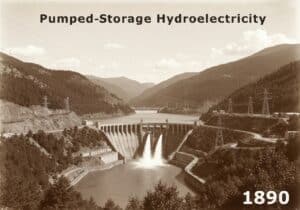
Origens iniciais (décadas de 1890 a 1920)As primeiras instalações de armazenamento por bombeamento surgiram nas regiões alpinas da Europa na última década do século XIX. A Suíça, a Itália e partes do sul da Alemanha possuíam dois ingredientes que tornaram o armazenamento por bombeamento viável em seus primórdios: uma topografia montanhosa abundante, oferecendo grandes diferenças de altitude em curtas distâncias, e uma nascente indústria elétrica que lutava com a discrepância entre a geração hidrelétrica contínua e a demanda industrial flutuante. As primeiras cargas industriais, dominadas por bondes, fábricas têxteis e redes de iluminação pública emergentes, eram altamente variáveis ao longo do dia, enquanto muitas das usinas hidrelétricas a fio d'água e alimentadas por lagos da época produziam uma geração relativamente estável. O armazenamento por bombeamento oferecia uma maneira de armazenar o excedente de geração durante os horários de baixa demanda e redistribuí-lo durante os horários de pico, suavizando a discrepância sem a necessidade de capacidade adicional baseada em combustíveis fósseis. Esses projetos de primeira geração eram modestos para os padrões modernos, geralmente construídos em torno de um único arranjo reversível ou de bomba e turbina em pares, com capacidades de armazenamento medidas em dezenas, em vez de milhares, de megawatts-hora. Mesmo assim, eles estabeleceram a lógica fundamental que ainda define a tecnologia hoje: usar energia barata ou excedente para bombear água, recuperar uma parte dessa energia posteriormente como eletricidade e lucrar ou explorar de alguma forma a diferença de valor entre os dois períodos. |
A simbiose da era nuclear (décadas de 1960 a 1980)A primeira grande expansão da tecnologia ocorreu nas décadas que se seguiram à Segunda Guerra Mundial, à medida que as nações reconstruíam e eletrificavam suas economias e a energia nuclear emergia como uma importante fonte de geração de base. As usinas nucleares são técnica e economicamente adequadas para operar em um nível de produção constante; aumentar e diminuir a potência de um reator rapidamente é mecanicamente desgastante e economicamente dispendioso, visto que o custo do combustível representa uma pequena fração da estrutura de custos total de uma usina nuclear, em comparação com o enorme custo de capital fixo. Isso criou um problema estrutural: a produção nuclear é mais eficiente quando estável, mas a demanda por eletricidade nunca é constante. Ela aumenta acentuadamente pela manhã e à noite e cai para um nível mínimo durante a madrugada. Durante esse período, o armazenamento por bombeamento tornou-se a tecnologia complementar natural para a geração de energia nuclear de base. Empresas de energia na França, Japão, Estados Unidos e Reino Unido construíram grandes usinas de armazenamento por bombeamento especificamente para absorver o excedente noturno de usinas nucleares (e, em menor escala, de usinas a carvão) que não podiam ser economicamente reduzidas. Esse excedente de energia, que de outra forma teria sido descartado ou vendido com prejuízo, foi utilizado para... bombear A água armazenada era bombeada para cima durante a noite. No dia seguinte, durante os picos de demanda da manhã e da noite, essa água armazenada era liberada para gerar eletricidade, permitindo que as usinas nucleares operassem com sua capacidade constante e eficiente, enquanto a rede elétrica ainda recebia um perfil de energia variável que correspondia à demanda. Essa relação é às vezes chamada de "simbiose nuclear-armazenamento por bombeamento" e explica por que países com grandes parques nucleares, como França, Japão e Estados Unidos, também tendem a ter grandes parques de usinas de armazenamento por bombeamento construídos durante esse mesmo período de várias décadas. |
A transição para as energias renováveis (século XXI)

O papel do armazenamento por bombeamento mudou substancialmente desde o início dos anos 2000 com a implantação em larga escala da geração eólica e solar. Enquanto o caso de uso no século XX era o "corte de pico" — suavizar uma curva de demanda diária conhecida e bastante previsível em relação a uma curva de oferta de carga base conhecida e bastante previsível — o caso de uso no século XXI tornou-se o "equilíbrio da variabilidade": absorver as flutuações muito menos previsíveis e impulsionadas pelo clima da produção renovável.
A geração solar, por exemplo, produz um pico acentuado ao meio-dia, seguido por um declínio acentuado ao entardecer, muitas vezes coincidindo precisamente com o pico de demanda noturno. Isso deu origem ao agora famoso fenômeno da "curva do pato" em redes com alta penetração solar, onde a demanda líquida (demanda total menos a oferta renovável) cai drasticamente no meio do dia e, em seguida, aumenta de forma extremamente acentuada no início da noite. A geração eólica, por sua vez, pode oscilar significativamente ao longo de horas ou dias, dependendo das condições climáticas, com pouca correlação com os padrões de demanda. O armazenamento por bombeamento, com sua capacidade de absorver grandes quantidades de energia para carregamento e atingir a produção máxima em questão de segundos a poucos minutos, provou ser adequado para gerenciar esses dois padrões de variabilidade impulsionados por energias renováveis, embora a tecnologia em si não tenha sido originalmente projetada para esse fim.
Distribuição global
O mapa global da capacidade de armazenamento por bombeamento reflete de perto a história que acabamos de descrever. O Japão construiu uma enorme frota de usinas de armazenamento por bombeamento a partir da década de 1960, impulsionado por sua forte dependência da energia nuclear e por sua geografia montanhosa, e permanece um dos maiores mercados de usinas de armazenamento por bombeamento do mundo. A capacidade de armazenamento por bombeamento da Europa está concentrada nos países alpinos (Suíça, Áustria, Itália) e em países que desenvolveram grandes programas nucleares (França), além de uma capacidade significativa na Espanha, Alemanha e países nórdicos. Os Estados Unidos construíram uma frota substancial durante as décadas de 1970 e 1980, grande parte dela ligada à expansão nuclear daquela época, com grandes instalações na região dos Apalaches, no Noroeste do Pacífico e na Califórnia. Mais recentemente, a China se tornou o maior mercado nacional individual para a construção de novas usinas de armazenamento por bombeamento, impulsionada por sua enorme e crescente capacidade de energia renovável e por um esforço estratégico nacional para infraestrutura de balanceamento da rede elétrica.
A Física do Armazenamento de Energia Gravitacional
Modelagem da Densidade de Energia
Os princípios físicos fundamentais do armazenamento por bombeamento baseiam-se na conversão entre energia potencial gravitacional e energia elétrica. A energia potencial armazenada em uma massa de água mantida a uma certa altura acima de um reservatório inferior é dada pela equação clássica da energia potencial gravitacional, ajustada pela eficiência de ciclo completo do sistema:
| (E = eta , m , g , h) |
onde
|
Como a água tem uma densidade fixa de aproximadamente 1.000 quilogramas por metro cúbico, esta equação pode ser reescrita em termos de volume do reservatório em vez de massa, o que é mais útil para fins de engenharia e planejamento do local: (E = eta , rho , V , g , h)
onde (rho) é a densidade da água e (V) é o volume de água que circula entre os reservatórios. Essa formulação revela imediatamente a principal relação de compromisso no projeto de armazenamento por bombeamento:
A capacidade total de armazenamento de energia aumenta linearmente tanto com o volume de água disponível quanto com a altura da queda d'água, o que significa que um local com o dobro da altura da queda d'água pode armazenar a mesma energia com metade do volume do reservatório, e vice-versa.
É por isso que locais alpinos e montanhosos de grande altitude, que podem oferecer de 500 a mais de 1.000 metros de diferença de altitude, conseguem atingir enormes capacidades de armazenamento de energia com reservatórios relativamente pequenos, enquanto locais de baixa altitude necessitam de volumes de reservatório muito maiores para armazenar uma quantidade comparável de energia.
Em comparação com o armazenamento de energia em baterias químicas, em termos volumétricos, a energia hidrelétrica bombeada é surpreendentemente pouco eficiente em termos energéticos. Um sistema típico de baterias de íon-lítio pode armazenar cerca de algumas centenas de watts-hora por litro de volume da célula, enquanto um metro cúbico (1.000 litros) de água bombeada a 500 metros de altura, mesmo com uma eficiência de ida e volta de 85%, armazena apenas cerca de 1,16 quilowatts-hora, ou aproximadamente 1,16 watts-hora por litro.
- Essa enorme diferença na densidade de energia volumétrica é precisamente o motivo pelo qual o armazenamento por bombeamento requer reservatórios medidos em milhões de metros cúbicos e áreas medidas em quilômetros quadrados, enquanto uma instalação de baterias que armazena a mesma energia total pode caber dentro de um único armazém.
- A desvantagem é que o "material ativo" subjacente para PSH, água e gravidade, custa essencialmente nada e não se degrada, enquanto os materiais ativos das baterias são fabricados, têm vida útil finita e representam um custo de capital contínuo, pois se degradam e exigem substituições eventuais.t.
Dica prática: Ao dimensionar um projeto do zero, é muito mais útil inverter a equação de energia e calcular o volume de reservatório necessário, dada uma capacidade energética alvo e a queda d'água disponível no local escolhido, em vez de partir de um tamanho fixo de reservatório e verificar qual será a capacidade energética resultante. Na prática, a seleção do local quase sempre começa com a pergunta "qual a queda d'água disponível?", visto que a queda d'água é determinada pela geografia, enquanto o volume do reservatório é a única variável que os engenheiros civis ainda podem ajustar por meio da altura da barragem, da escavação da bacia ou da área de implantação.
A Estação de Armazenamento por Bombeamento do Condado de Bath, na Virgínia, uma das maiores instalações desse tipo no mundo, combina uma queda d'água de aproximadamente 380 metros com um volume de reservatório grande o suficiente para suportar cerca de 3.000 megawatts de capacidade e aproximadamente 24.000 megawatts-hora de armazenamento. Isso ilustra como uma queda d'água comparativamente modesta e não extrema, quando combinada com reservatórios muito grandes, ainda pode fornecer armazenamento em escala de utilidade pública, comparável às maiores instalações de baterias já construídas, mas com uma duração medida em muitas horas, em vez da duração de uma a quatro horas típica de projetos de baterias em escala de rede.
A relação "Cabeça vs. Fluxo"
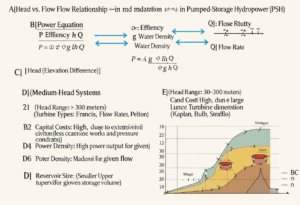
Além do armazenamento total de energia, a potência de saída de uma usina hidrelétrica reversível, ou seja, a taxa na qual ela pode fornecer energia, depende de uma relação diferente: o produto da altura da queda d'água e da vazão volumétrica de água através das turbinas. Isso é expresso como: (P = eta , rho , g , h , Q)
onde (P) é a potência instantânea (em watts) e (Q) é a vazão volumétrica (em metros cúbicos por segundo). Essa equação orienta uma das decisões de engenharia mais importantes no projeto de PSH: optar por uma configuração de alta ou baixa queda e qual tecnologia de turbina decorre dessa escolha.
Sistemas de alta queda, geralmente definidos como locais com uma diferença de elevação superior a aproximadamente 150 a 200 metros, podem gerar energia substancial com vazões relativamente modestas, pois o termo de queda na equação de potência realiza a maior parte do trabalho. Isso permite o uso de turbinas menores e de rotação mais rápida, além de condutos forçados de menor diâmetro (os tubos pressurizados que transportam água para as turbinas), o que, por sua vez, reduz os custos de capital por unidade de capacidade instalada para a infraestrutura hídrica, mesmo que os locais de alta queda estejam tipicamente situados em terrenos montanhosos, o que aumenta os custos de construção de túneis e obras civis. As turbinas-bomba reversíveis do tipo Francis dominam essa categoria, pois seu projeto de fluxo radial lida com altas pressões de forma eficiente.
Sistemas de baixa queda, tipicamente encontrados em rios ou em terrenos planos com diferenças de elevação inferiores a 30 a 50 metros, precisam movimentar volumes enormes de água para atingir uma produção de energia significativa, visto que a queda contribui comparativamente pouco. Isso impulsiona o uso de turbinas axiais de grande diâmetro e rotação mais lenta, mais comumente unidades do tipo Kaplan adaptadas para operação reversível de bomba-turbina, ou, em algumas aplicações de queda muito baixa, turbinas do tipo bulbo. Usinas de baixa queda tendem a ter áreas físicas maiores para seus canais e casas de máquinas em relação à sua produção de energia, mas podem ser instaladas em regiões sem topografia montanhosa acentuada, ampliando o alcance geográfico do desenvolvimento viável de usinas hidrelétricas de baixa queda. Entre esses dois extremos, locais de queda média, geralmente na faixa de 50 a 150 metros, frequentemente utilizam máquinas do tipo Francis também, embora a geometria específica do rotor seja ajustada de forma diferente daquela utilizada para aplicações de alta queda, a fim de equilibrar a eficiência em toda a faixa de vazão na qual a usina deverá operar.
Regra básica: Ao comparar, de forma geral, locais concorrentes na fase de estudo de viabilidade, os desenvolvedores experientes preferem um cálculo rápido da relação entre a altura da queda d'água e a distância antes de se comprometerem com estudos de engenharia detalhados; uma relação acima de aproximadamente 1:10 (um metro de queda vertical para cada dez metros de separação horizontal entre os reservatórios) é geralmente considerada atraente, uma vez que mantém o comprimento dos túneis ou condutos forçados, e, portanto, os custos de obras civis, sob controle em relação à queda d'água captada.
Termodinâmica do Ciclo
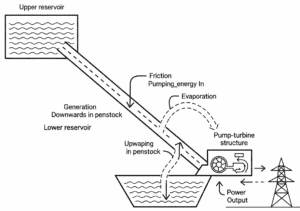
Nenhum ciclo de armazenamento por bombeamento real atinge a conversão de energia idealizada sugerida pela equação básica da energia potencial. Há perdas de energia em múltiplos estágios do ciclo de bombeamento-geração, e compreender onde essas perdas ocorrem é essencial para entender tanto o projeto da usina quanto os limites de desempenho realistas da tecnologia.
- A maior categoria de perda é o atrito do fluido, que ocorre quando a água se move através de condutos forçados, túneis e passagens internas da própria bomba-turbina. As perdas por atrito são proporcionais ao quadrado da velocidade do fluxo, o que significa que dobrar a vazão em um determinado tubo quadruplica aproximadamente a perda por atrito. pressão As perdas por atrito são um fator importante, e é por isso que os projetistas de sistemas hidráulicos preferem túneis e condutos forçados de maior diâmetro, mesmo que o custo de escavação ou fabricação seja maior, já que as perdas de energia evitadas ao longo de décadas de operação geralmente justificam o maior investimento inicial. As perdas por atrito estão presentes tanto na direção do bombeamento quanto na direção da geração, o que significa que reduzem a eficiência do percurso de ida e volta duas vezes: primeiro, porque a usina trabalha mais do que o teoricamente necessário para impulsionar a água morro acima, e novamente, porque parte da energia potencial da água é dissipada como calor em vez de ser convertida em eletricidade no caminho de volta.
- Uma segunda categoria de perdas ocorre na própria cadeia de conversão eletromecânica: perdas hidráulicas no rotor da bomba-turbina (onde a geometria das pás não consegue se adequar perfeitamente às condições de fluxo em todos os pontos de operação), perdas mecânicas em mancais e vedações, e perdas elétricas nos enrolamentos do gerador-motor, transformadores e equipamentos de manobra associados. Essas perdas são tipicamente menores em proporção do que as perdas por atrito na via navegável em usinas modernas bem projetadas, mas ainda assim são significativas, principalmente porque a mesma máquina precisa operar com eficiência em dois modos de operação muito diferentes (bombeamento e geração) com ângulos de pás e características de fluxo ideais distintos.
- Uma terceira categoria de perda, de menor escala, é a evaporação das superfícies abertas do reservatório. Essa perda representa uma perda do próprio fluido de trabalho, e não uma ineficiência na conversão de energia no sentido tradicional, mas ainda assim reduz a energia líquida disponível para ciclos futuros e exige a adição de água de reposição ao longo do tempo. Essa perda é altamente específica do local e dependente do clima, variando de insignificante em climas frios e úmidos a uma séria preocupação operacional e ambiental em regiões áridas, um tópico que será explorado em um capítulo posterior.
Eficiência de ida e volta (RTE)
O efeito cumulativo de todas essas perdas é capturado na métrica de eficiência de ciclo completo, frequentemente descrita pela abreviação "eficiência fio-água-fio", que significa a fração da energia elétrica retirada da rede durante o bombeamento que é devolvida à rede durante a geração. Usinas hidrelétricas de bombeamento modernas e bem projetadas normalmente atingem eficiências de ciclo completo na faixa de 70 a 85%, com as instalações de velocidade variável mais modernas, que utilizam turbinas-bomba reversíveis avançadas, na extremidade superior dessa faixa, e usinas mais antigas de velocidade fixa ou com localização menos otimizada, mais próximas da extremidade inferior.
Essa faixa de valores posiciona o armazenamento por bombeamento como amplamente competitivo com, embora geralmente um pouco inferior a, a eficiência de ciclo completo dos modernos sistemas de baterias de íon-lítio, que frequentemente atingem eficiências de ciclo completo na faixa de 85 a 95% no nível da célula (a eficiência no nível do sistema, incluindo perdas no inversor e no gerenciamento térmico, é um pouco menor). No entanto, a comparação não se resume apenas à eficiência:
- As centrais de armazenamento por bombeamento podem manter essa eficiência ao longo de toda a sua operação. vida útil A vida útil da infraestrutura civil é medida em décadas, geralmente de 50 a 100 anos, com reformas periódicas dos componentes eletromecânicos, enquanto os sistemas de baterias sofrem degradação gradual da capacidade e da eficiência ao longo de um ciclo de vida muito mais curto, normalmente medido em milhares de ciclos ou de 10 a 20 anos, antes que uma perda significativa de capacidade exija a substituição.
- E as centrais de armazenamento por bombeamento podem reter a energia (ou seja, a água) quase indefinidamente.
Dica: Ao avaliar o valor de eficiência de ida e volta (RTE) publicado para uma usina, sempre verifique se ele é citado no ponto de vazão de projeto ou se é a média em toda a faixa de operação, visto que as turbinas-bomba perdem eficiência consideravelmente em carga parcial; uma unidade com classificação de 80% de RTE em vazão máxima pode apresentar um valor próximo a 70% quando operando com 40% da vazão nominal, o que é significativamente importante para usinas que, cada vez mais, precisam acompanhar a produção variável de energia renovável em vez de operar em um ponto de projeto fixo.
The rest of this article is reserved for members
To limit scraping bots (currently 40,000 hits per day!),
we had to restrict access to full articles and tools to registered members only.
to access all the rest.
Perguntas frequentes
Como funciona, na prática, a energia hidrelétrica de bombeamento?
Durante períodos de baixa demanda de eletricidade ou geração excedente, a água é bombeada de um reservatório inferior para um reservatório superior elevado, armazenando a energia como potencial gravitacional. Quando a energia é necessária, essa mesma água é liberada de volta para baixo através de turbinas, convertendo sua energia potencial em eletricidade; na maioria das usinas modernas, uma única bomba-turbina reversível opera em ambas as direções, em vez de usar duas máquinas separadas.
Qual a eficiência do armazenamento por bombeamento em comparação com as baterias?
Uma usina hidrelétrica reversível normalmente devolve de 70 a 85% da eletricidade consumida durante o bombeamento, um valor ligeiramente inferior à eficiência de ida e volta de 85 a 95% das baterias de íon-lítio em nível de célula. Essa diferença, no entanto, torna-se menos relevante com o tempo, pois as usinas hidrelétricas reversíveis mantêm essa eficiência por 50 a 100 anos de operação, enquanto as baterias se degradam gradualmente e geralmente precisam ser totalmente substituídas após apenas 10 a 20 anos.
Por que não se pode construir usinas de armazenamento por bombeamento em qualquer lugar?
Ao contrário das baterias, que podem ser instaladas em praticamente qualquer lugar com ligação à rede elétrica, um projeto de armazenamento por bombeamento requer dois reservatórios separados por uma diferença de altitude significativa, geologia estável capaz de suportar barragens e túneis, e uma fonte de água confiável para o enchimento inicial e o abastecimento contínuo. Esses requisitos geográficos combinados significam que apenas um número limitado de locais em todo o mundo são realmente adequados para novos empreendimentos.
Quanto tempo leva para construir um projeto de armazenamento de água por bombeamento?
Desde os estudos iniciais de viabilidade, passando pelo licenciamento ambiental, engenharia detalhada e construção civil de barragens, túneis e usinas hidrelétricas, um projeto típico leva de cinco a dez anos, ou até mais, para entrar em operação comercial. Esse cronograma extenso contrasta fortemente com os projetos de baterias, que muitas vezes podem passar do planejamento à implantação em menos de dois anos.
O armazenamento por bombeamento é melhor do que o armazenamento em baterias?
Em vez de uma tecnologia ser categoricamente superior, cada uma é adequada a diferentes necessidades da rede elétrica. O armazenamento por bombeamento se destaca no fornecimento contínuo de grandes quantidades de energia por muitas horas, com excepcional confiabilidade a longo prazo e propriedades de estabilização da rede, enquanto as baterias respondem em milissegundos e são muito mais fáceis de instalar, tornando-as mais adequadas para aplicações de curta duração e resposta rápida.
Por quanto tempo uma usina hidrelétrica reversível consegue armazenar energia?
A duração da descarga depende da quantidade de água que os reservatórios de uma usina podem armazenar em relação à sua capacidade de geração, mas a maioria das instalações é projetada para manter a produção máxima por um período entre quatro e doze horas. Alguns reservatórios excepcionalmente grandes podem estender esse período, suportando vários dias de geração antes de precisarem ser reabastecidos.
O armazenamento por bombeamento tem impactos ambientais?
Sim, particularmente em locais conectados a rios naturais, onde os efeitos podem incluir a interrupção da migração de peixes, a alteração do transporte de sedimentos e mudanças nos padrões de fluxo natural dos quais os ecossistemas a jusante dependem. Reservatórios em climas quentes ou secos também perdem água por evaporação, o que é um dos vários motivos pelos quais os empreendedores estão cada vez mais optando por projetos de circuito fechado isolados de cursos d'água naturais.
De que forma o armazenamento por bombeamento ajuda a rede elétrica além do armazenamento de energia?
Além de simplesmente armazenar e liberar eletricidade, o grande gerador giratório no coração de uma usina PSH resiste naturalmente a oscilações repentinas na frequência da rede, pode operar para suportar os níveis de tensão locais sem movimentar água e pode até mesmo reiniciar uma rede completamente desenergizada após um grande apagão. A maioria dos sistemas de baterias só consegue replicar parcialmente essas funções de estabilização, já que não possuem a mesma massa rotativa física.
Por que o armazenamento por bombeamento está historicamente ligado à energia nuclear?
Os reatores nucleares operam com maior eficiência e segurança quando funcionam continuamente em um nível de produção constante, visto que aumentar e diminuir a potência gradualmente é mecanicamente desgastante e economicamente ineficiente. Usinas de bombeamento foram construídas ao lado das usinas nucleares especificamente para absorver o excedente de eletricidade gerado pelas usinas nucleares durante a noite e, em seguida, liberar essa energia armazenada durante os picos de demanda da manhã e da noite, que a produção nuclear sozinha não conseguiria suprir.
O que é armazenamento de água do mar ou armazenamento subterrâneo por bombeamento?
Essas são configurações de usinas mais recentes, projetadas para superar as limitações geográficas tradicionais do armazenamento por bombeamento. O armazenamento por bombeamento de água do mar utiliza o próprio oceano como reservatório inferior, possibilitando o uso de locais costeiros e insulares que não possuem topografia adequada no interior, enquanto o armazenamento por bombeamento subterrâneo utiliza minas abandonadas ou cavernas escavadas como reservatório inferior, permitindo que os projetos sejam construídos em regiões mais planas sem a necessidade de grandes extensões de terra.
Glossário de termos utilizados
Advanced Encryption Standard (AES): Um algoritmo de criptografia de chave simétrica estabelecido pelo Instituto Nacional de Padrões e Tecnologia dos EUA, que utiliza cifras de bloco com tamanhos de chave de 128, 192 ou 256 bits, projetado para proteger dados eletrônicos por meio de processos de substituição e permutação.
Compressed-Air-Energy Storage (CAES): Um sistema que armazena energia comprimindo o ar em cavernas ou contêineres subterrâneos, liberando-a para acionar turbinas e gerar eletricidade quando necessário, equilibrando efetivamente a oferta e a demanda nas redes elétricas.
Computer-Aided Engineering (CAE): Um conjunto de ferramentas de software que auxiliam nos processos de análise e projeto de engenharia, permitindo simulações, otimizações e validações do desempenho do produto por meio de métodos numéricos e técnicas de modelagem.
Pumped Hydroelectric Energy Storage (PHES): Um método de armazenamento de energia que utiliza o excesso de eletricidade para bombear água para uma altitude mais elevada, sendo esta posteriormente liberada para gerar eletricidade através de turbinas quando a demanda aumenta.
Pumped-Storage Hydroelectricity (PSH): Um método de armazenamento de energia que utiliza o excesso de eletricidade para bombear água para uma altitude mais elevada, a qual pode posteriormente ser liberada para gerar eletricidade durante os períodos de pico de demanda, permitindo que a água flua de volta através de turbinas.
Uninterruptible Power Supply (UPS): Um dispositivo que fornece energia de emergência a equipamentos conectados durante uma queda de energia, garantindo operação contínua e proteção contra flutuações de tensão. Normalmente inclui uma bateria, um inversor e um sistema de carregamento para manter o fornecimento e a estabilidade da energia.