Product Design, Manufacturing & Innovation Resources
بيت » Fundamental Definition of Pressure

Fundamental Definition of Pressure

1650
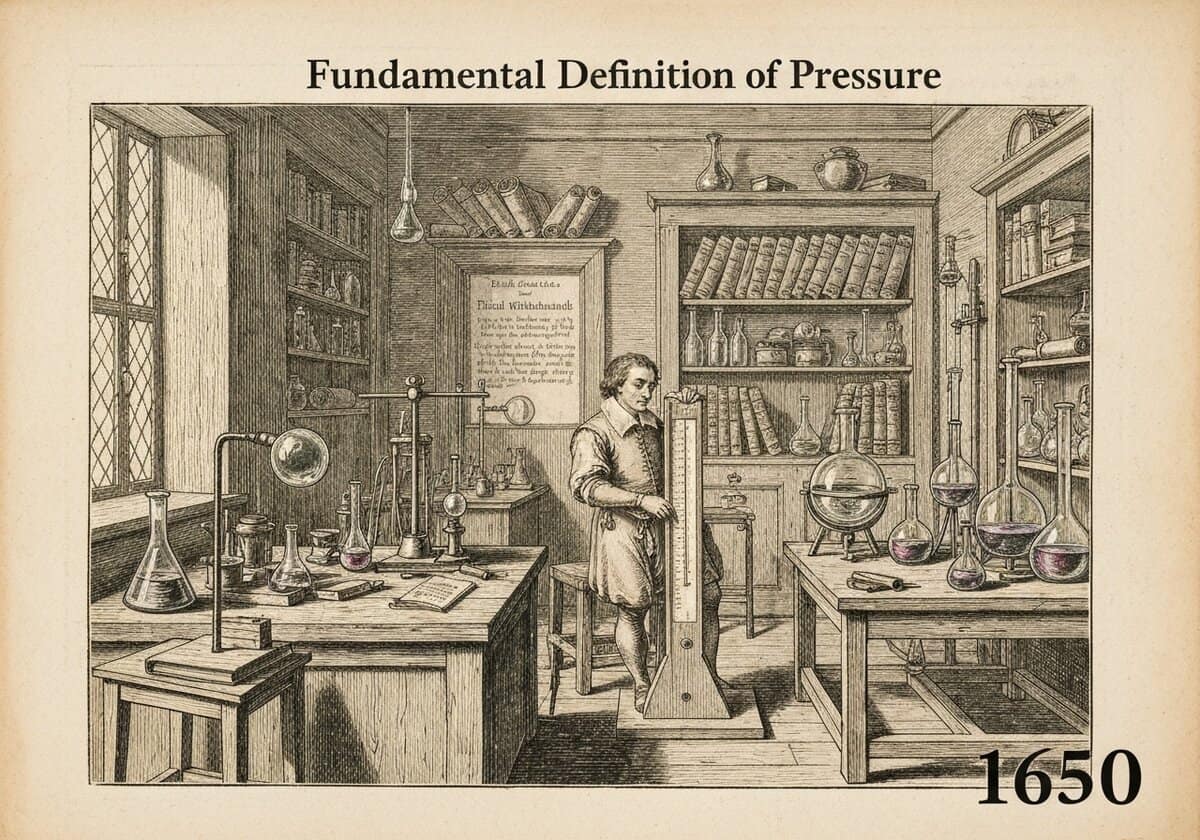
مختبر في القرن السابع عشر لقياس الضغط باستخدام مقياس الضغط في ميكانيكا الموائع.

(صورة تم إنشاؤها للتوضيح فقط)

يُعرَّف الضغط بأنه القوة العمودية (F) المؤثرة على سطح جسم ما لكل وحدة مساحة (A) تتوزع عليها هذه القوة. صيغته هي: p = F/A. وهو كمية قياسية، أي له مقدار فقط دون اتجاه. وحدة قياس الضغط في النظام الدولي للوحدات هي الباسكال (Pa)، وهي تعادل واحدًا نيوتن لكل متر مربع.


The concept of pressure evolved from early studies of mechanics and fluids. While earlier thinkers like Archimedes understood buoyancy, the formal quantification of pressure as force per unit area was crystallized during the 17th century through the work of scientists like Evangelista Torricelli and Blaise Pascal. Pressure is a fundamental concept in thermodynamics and fluid mechanics. It is an intensive property, meaning it does not depend on the size of the system. In a static fluid, pressure increases with depth due to the weight of the fluid above. This is the principle behind manometers and barometers. For gases, pressure is understood at a microscopic level as the average force from molecular collisions on the container walls. This kinetic theory of gases connects the macroscopic property of pressure to the microscopic behavior of atoms and molecules. The formula [latex]p = frac{F}{A}[/latex] is a macroscopic definition. For a force applied at an angle [latex]theta[/latex] to the surface normal, the formula becomes [latex]p = frac{F costheta}{A}[/latex]. In continuum mechanics, pressure is often represented as the isotropic part of the stress tensor, which describes the forces internal to a continuous material. This more advanced view allows for the analysis of pressure in solids and complex fluid flows where forces are not uniform or perpendicular. Understanding pressure is critical for designing everything from aircraft wings, which rely on pressure differentials for lift, to deep-sea submersibles built to withstand immense external pressure.

UNESCO Nomenclature: 2209
- الميكانيكا

يكتب

النظام التجريدي

الاضطراب

التأسيسية

الاستخدام

الاستخدام الواسع النطاق

السلائف

  • مبدأ أرخميدس للطفو
  • عمل غاليليو غاليلي في مجال الميكانيكا والجاذبية
  • اختراع إيفانجيليستا توريتشيلي للبارومتر
  • قوانين إسحاق نيوتن للحركة

التطبيقات

  • hydraulic systems
  • التنبؤ بالطقس
  • material science testing
  • medical blood pressure measurement
  • pneumatic tools

براءات الاختراع:

NA

أفكار ابتكارات محتملة

بسبب عمليات جمع البيانات من خلال برامج الروبوت، والتي تتجاوز حاليًا 40 ألفًا يوميًا، فإن هذا المحتوى مخصص لأعضاء المجتمع فقط.
> تسجيل الدخول < أو > سجل < (مجاني 100٪) للوصول إلى هذا، وكذلك جميع المحتويات والأدوات الأخرى المقيدة.

ذات صلة بـ: الضغط، القوة، المساحة، الباسكال، الكمية القياسية، ميكانيكا الموائع، الديناميكا الحرارية، وحدة النظام الدولي للوحدات، نيوتن، الميكانيكا.

السياق التاريخي

Fundamental Definition of Pressure

1600
1650
1650
1678
1687
1687
1738
1750
1650
1650
1672
1687
1687
1738
1750

(إذا كان التاريخ غير معروف أو غير ذي صلة، على سبيل المثال "ميكانيكا الموائع"، يتم توفير تقدير تقريبي لظهوره الملحوظ)

الصور بالحجم الكامل والتنزيلات متاحة فقط 100% مجاناً للأعضاء المسجلين.