Product Design, Manufacturing & Innovation Resources
Lar » Momento eletromagnético

Momento eletromagnético

1884
  • James Clerk Maxwell
  • John Henry Poynting
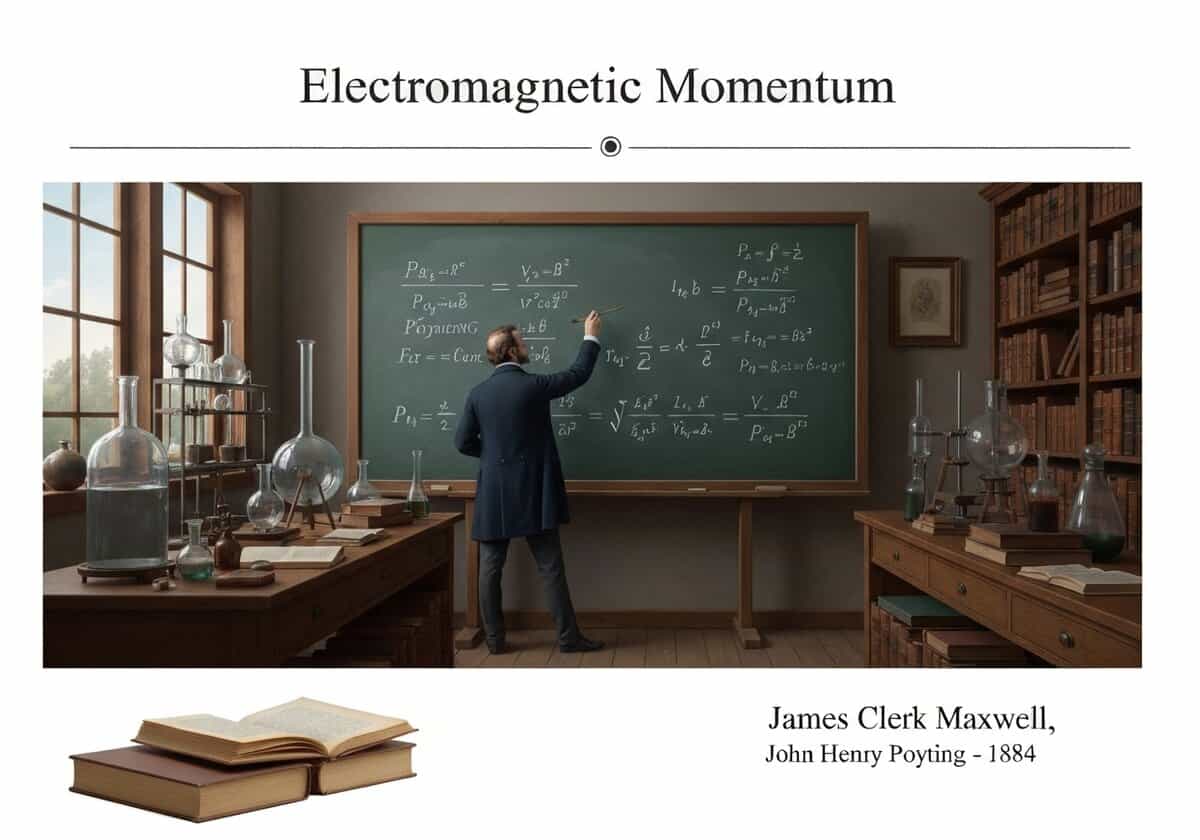
Laboratório do século XIX com um físico estudando o momento eletromagnético e o vetor de Poynting.

(Imagem gerada apenas para fins ilustrativos)

Electromagnetic fields can carry momentum. The momentum density of the electromagnetic field is given by the Poynting vector [latex]\vec{S}[/latex] divided by the speed of light squared, [latex]\vec{g} = \vec{S}/c^2 = (\vec{E} \times \vec{B})/(\mu_0 c^2)[/latex]. For momentum to be conserved in a system of charged particles and fields, the momentum of the fields deve be included alongside the mechanical momentum of the particles.

In classical mechanics, momentum is associated with massive particles. However, Maxwell’s equations of electromagnetism predict that electromagnetic waves, such as light, carry momentum despite being massless. This was a revolutionary concept. The conservation of total momentum in a system containing charged particles and electromagnetic fields requires accounting for the momentum stored in the fields themselves.

The flow of electromagnetic energy is described by the Poynting vector, [latex]\vec{S} = \frac{1}{\mu_0} (\vec{E} \times \vec{B})[/latex]. It was discovered that this energy flow is associated with a momentum density [latex]\vec{g} = \vec{S}/c^2[/latex]. The total momentum of a system is the sum of the mechanical momentum of all particles and the integral of the electromagnetic momentum density over all space: [latex]\vec{p}_{\text{total}} = \sum_i \vec{p}_{\text{mech}, i} + \int_V \frac{\vec{E} \times \vec{B}}{\mu_0 c^2} dV[/latex].

The rate of change of this total momentum is governed by the flow of momentum across the boundary of the volume, which is described by the Maxwell stress tensor. This tensor describes the forces that electromagnetic fields exert on their surroundings, including radiation pressure. The concept is crucial for understanding phenomena like solar sails, where the pressure from sunlight propels a spacecraft.

UNESCO Nomenclature: 2204
Eletromagnetismo

Tipo

Sistema abstrato

Interrupção

Fundamentais

Uso

Uso generalizado

Precursores

  • James Clerk Maxwell’s equations of electromagnetism
  • Michael Faraday’s concept of fields
  • Discovery of the finite speed of light
  • Classical law of conservação do momento

Aplicações

  • solar sails for spacecraft propulsion
  • optical tweezers for manipulating microscopic objects
  • resfriamento de átomos por laser
  • radiation pressure calculations in astrofísica
  • design of high-power laser systems

Patentes:

NA

Ideias de Inovação Potencial

  • tractor beams based on structured light fields
  • photonic propulsion for interstellar micro-probes
  • non-invasive cell classificação using optical forces
  • laser-based debris removal systems for Earth orbit
  • development of ultra-stable optical clocks
  • creation of novel metamaterials that manipulate light’s momentum
  • laser-induced fusion ignition systems
  • atmospheric cleaning using laser-induced plasma channels
  • advanced lithography techniques using radiation pressure
  • contactless manipulation of materials in vacuum or sterile environments
Related to: electromagnetic momentum, Poynting vector, Maxwell’s equations, radiation pressure, Maxwell stress tensor, momentum density, electromagnetic field, light, solar sail, optical tweezers.

Contexto histórico

Momento eletromagnético

1880
1882-01-01
1883
1884
1887
1888
1889
1877
1880
1882-01-01
1884
1885
1887
1889
1890

(Caso a data seja desconhecida ou irrelevante, por exemplo, "mecânica dos fluidos", é fornecida uma estimativa aproximada de seu surgimento notável)

10º ano aniversário

Imagens em tamanho real e downloads estão disponíveis apenas, 100% gratuitos, para membros registrados.