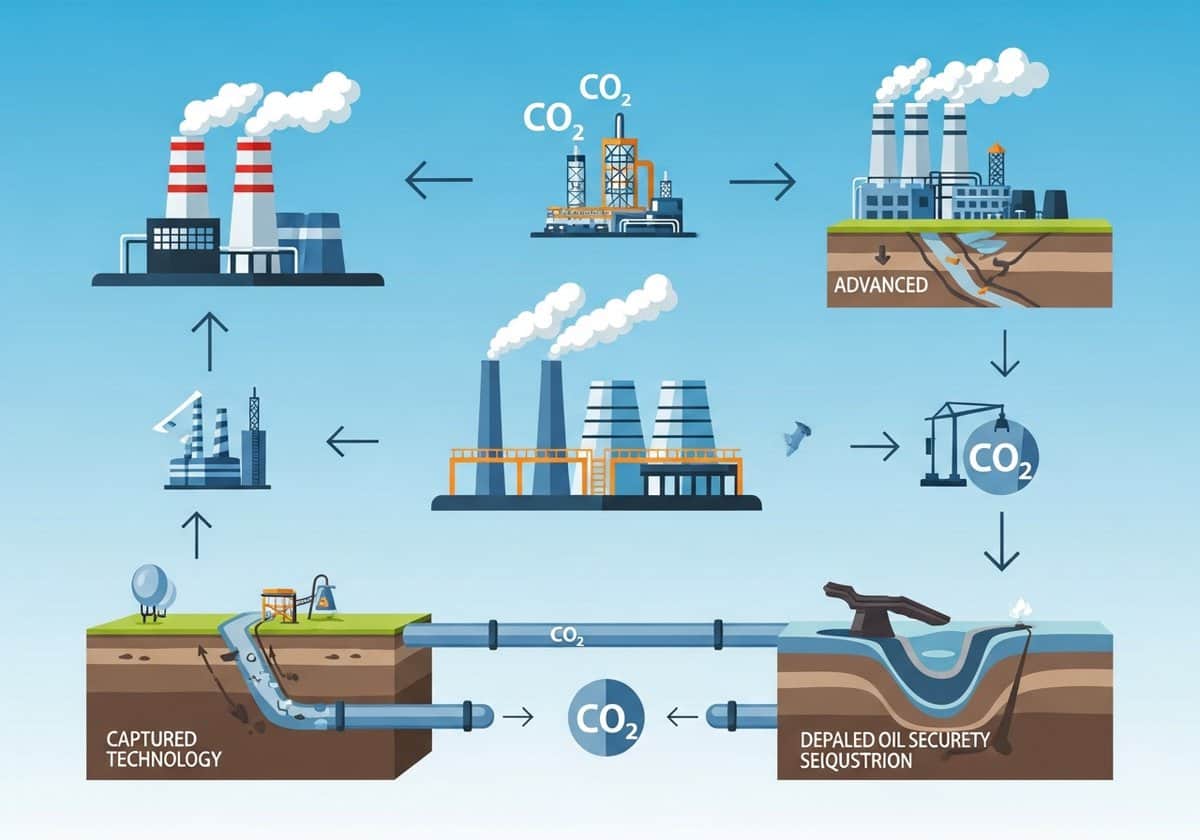
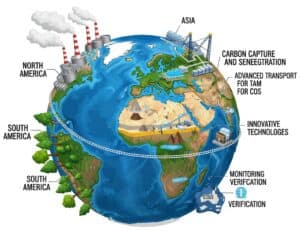
Captura de carbono and Sequestration (CCS) focuses on the separation of carbon dioxide from industrial and energy-related sources, its transport, and long-term storage in geological formations to mitigate atmospheric emissions. This field integrates advances in capture technologies including post-combustion, pre-combustion, and oxy-fuel processes, alongside innovations in CO2 transport infrastructure and secure subsurface storage methods such as saline aquifers, depleted oil and gas reservoirs, and mineral carbonation. Monitoring, verification, and risk assessment protocols ensure storage integrity and environmental safety. Our following collection compiles the most recent scientific publications and patented technologies addressing capture materials, process optimization, scale-up strategies, and regulatory frameworks critical for advancing CCS deployment and climate mitigation efforts:
This is our latest selection of worldwide publications and patents in english on Carbon Capture & Sequestration (CCS), between many scientific online journals, classified and focused on carbon capture, carbon sequestrat, CO2 storage, geological sequestration, carbon dioxide injection, enhanced oil recovery, carbon capture techno, post-combustion capture, pre-combustion capture, oxy-fuel combustion, carbon mineralization, carbon capture solvent, CO2 pipeline transport, CO2 storage, carbon capture membrane, carbon capture sorbent, carbon capture adsorption, carbon capture catalyst, carbon capture process, carbon capture retrofit, carbon capture regulatory framework and carbon capture environmental impact.
Systems and methods for carbon capture and solvent regeneration using radio frequency
Patent published on the 2026-10-15 in WO under Ref WO2026213698 by ACCELEWARE LTD [CA] (Okoniewski Michal M [ca], Pasalic Damir [ca], Tessier Lynn P [ca], Nielsen Jorgen S [ca])
Abstract: Systems and methods for capturing carbon and regenerating solvent are disclosed. The method involves collecting providing an amine solvent; introducing a gaseous feed stream to the amine solvent to capture carbon dioxide from a gaseous feed stream, producing a pregnant solvent; applying radiofrequency energy at a low frequency to the pregnant solvent to heat the pregnant solvent to a desorption temperature. The pregnant solvent can separate at the desorption temperature to yield carbon dioxide a[...]
Our summary: The method captures carbon dioxide using an amine solvent and radiofrequency energy. It produces a pregnant solvent that separates into carbon dioxide and regenerated solvent. The regenerated solvent is cooled and reused for further carbon capture.
carbon capture, solvent regeneration, radio frequency, desorption
Patent
Electrochemical carbon capture apparatus based on solid electrolyte reactor, preparation method thereof, and carbon capture method
Patent published on the 2026-10-15 in US under Ref US20260317913 by THE HONG KONG POLYTECHNIC UNIV [CN] (Zhang Xiao [cn], Zhai Yanjie [cn])
Abstract: [0000] The present application relates to the technical field of carbon capture and environmental protection, and in particular to an electrochemical carbon capture apparatus based on a solid electrolyte reactor, a preparation method, and a carbon capture method. The electrochemical carbon capture apparatus based on the solid electrolyte reactor includes: a porous solid electrolyte layer; a cathode electrode and an anode electrode, respectively arranged on two sides of the porous solid electroly[...]
Our summary: The application describes an electrochemical carbon capture apparatus utilizing a solid electrolyte reactor. It includes a porous solid electrolyte layer, cathode and anode electrodes, and various membranes. The method focuses on improving carbon capture efficiency and environmental protection.
Electrochemical, Carbon Capture, Solid Electrolyte, Environmental Protection
Patent
A system for the improved management of water tables in soils
Patent published on the 2026-10-07 in GB under Ref GB2705268 by WILLIAM MARTIN BARNARD [GB] (William Martin Barnard [gb])
Abstract: The invention pertains to the use of biochar 6 to aid conveyance of subsurface water. The biochar is inserted into channels in land (Fig 6). The biochar inserted into channels controls the water table depth in peatland or mineral based soils. The insertion of the biochar is also for carbon sequestration. The biochar may be inserted into the channels by injection. A device 1 is used to insert the biochar into the land, and may be able to be supported or towed by vehicles, can make channels in sub[...]
Our summary: The system utilizes biochar to enhance subsurface water conveyance in soils. Biochar is inserted into channels to control water table depth and aid carbon sequestration. A specialized device facilitates the insertion of biochar into the land, replacing traditional drainage methods.
biochar, water management, carbon sequestration, subsurface drainage
Patent
Energy optimization apparatus
Patent published on the 2026-10-01 in US under Ref US20260302791 by PENN STATE RES FOUND [US] (Seiler Jacob [us], Pavlak Gregory S [us], Freihaut James [us])
Abstract: An integrated energy management and optimization system for a controlled environment agriculture (CEA) facility includes at least one combined heat and power (CHP) unit and auxiliary technologies such as a thermal energy storage system, a battery energy storage system, a chiller, a cooling energy storage system, an exhaust treatment unit, and a carbon capture and utilization system. The system utilizes a multi-objective optimization algorithm, such as a mixed-integer linear programming (MILP) mo[...]
Our summary: The energy optimization apparatus integrates various technologies for controlled environment agriculture. It employs a multi-objective optimization algorithm to enhance efficiency while minimizing costs and emissions. The system can supply energy and participate in market activities, utilizing waste heat recovery from secondary facilities.
energy management, optimization system, combined heat and power, multi-objective optimization
Patent
Method for co2 storage comprising flowing liquid co2 through a subsea heating unit
Patent published on the 2026-09-30 in EP under Ref EP4814362 by TOTALENERGIES ONETECH [FR] (Davidsen SØren Mylius [fr])
Abstract: [0001] The present invention relates to a method for CO storage, comprising: - flowing CO in a liquid phase from a storage tank into a subsea heating unit, wherein the temperature of the CO upon entering the subsea heating unit is equal to the temperature of the CO in the storage tank ± 10°C; - flowing the CO through the subsea heating unit, wherein the CO in the subsea heating unit stays entirely in the liquid phase, wherein the CO is heated by the surrounding seawater while it flows through [...]
Our summary: The invention involves a method for CO2 storage using a subsea heating unit. Liquid CO2 flows from a storage tank into the heating unit while maintaining a specific temperature range. The heated liquid CO2 is then injected into a subsea subterranean formation.
CO2 storage, subsea heating unit, liquid phase, injection method
Patent
A systematic review of supervised machine learning for CO2 storage performance prediction in deep saline sandstone formations
Published on 2026-09-26 by @OXFORD
Abstract: AbstractCarbon capture and storage (CCS) is a key mitigation strategy for industrial CO2 emissions, with deep saline sandstone formations widely investigated because of their large storage capacity and multiple trapping mechanisms. Captured CO2 streams often contain impurities such as N2, CH4, H2S, SO2, NOx, Ar, and CO, which can affect density, viscosity, interfacial tension, geochemical reactions, injectivity, plume migration, and trapping behavior. This systematic literature review followed a[...]
Our summary: This systematic review analyzes the use of supervised machine learning for predicting CO2 storage performance in deep saline sandstone formations. It highlights the impact of impurities on various physical properties and identifies common machine learning models used in the field. The review emphasizes the need for improved datasets and methodologies to enhance the applicability of these models in real-world scenarios.
machine learning, CO2 storage, sandstone formations, systematic review
Publication
Concrete element made of reinforced concrete
Patent published on the 2026-09-24 in WO under Ref WO2026195600 by HOLCIM TECH LTD [CH] (Andermatt Roman [ch])
Abstract: A concrete element made of reinforced concrete comprising a plurality of carbon sequestration bodies embedded within the concrete element; and a holding structure comprising discrete structural elements arranged to maintain relative positions of the carbon sequestration bodies.[...]
Our summary: This concrete element includes embedded carbon sequestration bodies. It features a holding structure with discrete structural elements. The arrangement maintains the relative positions of the carbon sequestration bodies.
reinforced concrete, carbon sequestration, structural elements, holding structure
Patent
technological pathways, global implementations, and future prospects
Published on 2026-08-19 by @OXFORD
Abstract: AbstractBioenergy with carbon capture and storage (BECCS) is a key pathway for coupling renewable energy generation with atmospheric carbon removal, but its climate benefit depends on system boundaries, biomass sustainability, capture-route selection, storage permanence, and policy support. This review critically examines the full BECCS chain, including biomass cultivation, conversion technologies, carbon dioxide (CO₂) capture routes, transport and storage infrastructure, life-cycle performanc[...]
Our summary: BECCS integrates renewable energy with carbon removal but relies on various factors for effectiveness. The review assesses the entire BECCS chain, highlighting the importance of accurately measuring carbon metrics. Challenges to large-scale deployment include sustainability issues, infrastructure needs, and market incentives.
BECCS, carbon capture, biomass sustainability, techno-economic feasibility
Publication