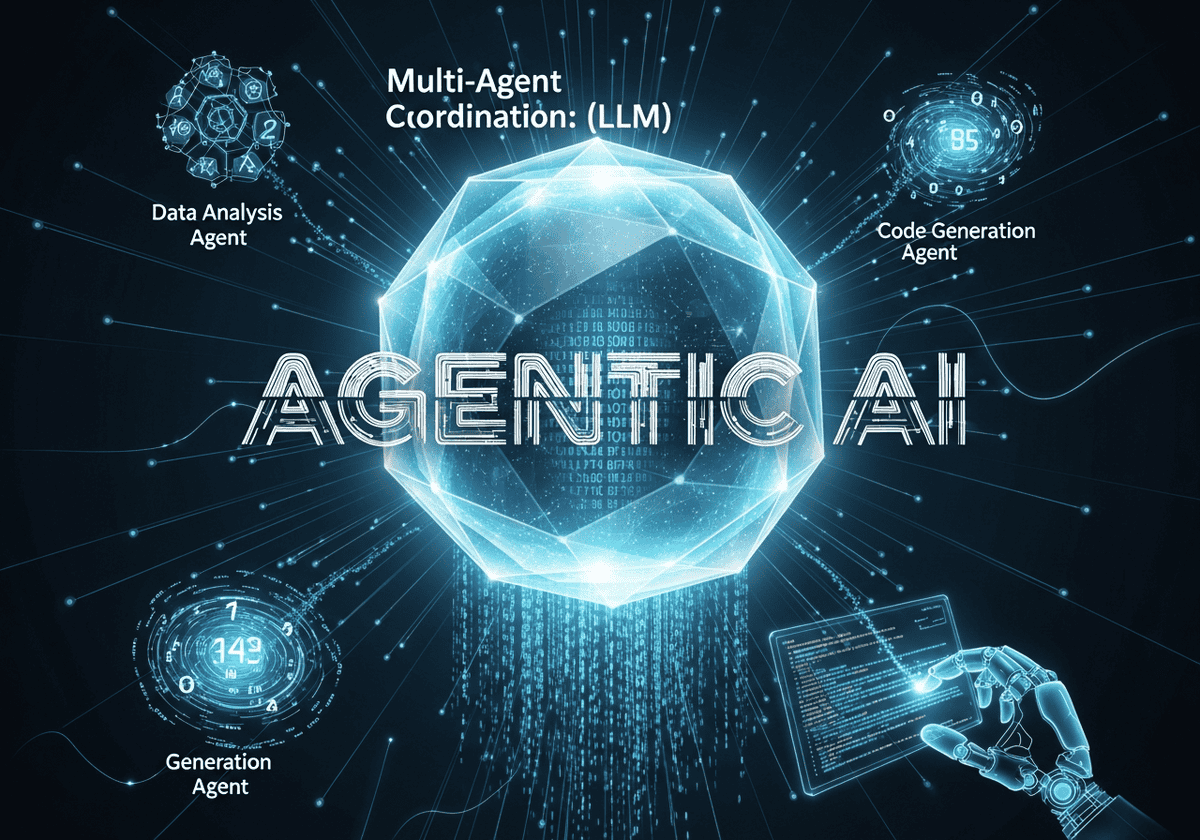

A Inteligência Artificial Agêntica designa sistemas de IA que buscam objetivos de múltiplas etapas de forma autônoma, iterando por meio de ciclos de percepção, planejamento, uso de ferramentas e autocorreção, sem exigir intervenção humana em cada ponto de decisão — uma mudança estrutural em relação aos modelos de resposta rápida em direção a arquiteturas que decompõem objetivos complexos em subtarefas, executam ações em ambientes externos, avaliam os resultados e revisam os planos de acordo.
A arquitetura agentiva canônica acopla um núcleo de raciocínio baseado em um modelo de linguagem robusto com um registro de ferramentas — navegadores web, interpretadores de código, clientes de API, sistemas de arquivos, interfaces de banco de dados — e uma arquitetura de memória que abrange o contexto de trabalho de curto prazo, registros episódicos de ações passadas e conhecimento de longo prazo recuperado, permitindo que o agente mantenha a busca coerente por seus objetivos em horizontes de interação estendidos que ultrapassam qualquer janela de contexto individual. Configurações multiagentes ampliam ainda mais esse conceito, distribuindo subtarefas entre agentes especializados coordenados por um orquestrador, introduzindo protocolos de comunicação entre agentes, agregação de resultados e resolução de conflitos como preocupações arquitetônicas adicionais.
As publicações e patentes indexadas abaixo abordam algoritmos de planejamento, arquiteturas de uso de ferramentas, sistemas de memória, protocolos de coordenação multiagente, benchmarks de avaliação de agentes e metodologias de restrição de segurança.
Um agente é um modelo com uma lista de tarefas e uma caixa de ferramentas. O próprio modelo é explicado em grandes modelos de linguageme as instruções que o guiam. engenharia de resposta rápidaImplantações leves estão em andamento. pequenos modelos de linguagemOs agentes físicos continuam em robóticae a superfície de ataque em cibersegurança.
Esta é a nossa mais recente seleção de publicações e patentes mundiais em inglês sobre IA Agética, provenientes de diversos periódicos científicos online, classificadas e focadas em IA Agética, agente de IA, agente de IA autônomo, sistema multiagente, orquestração de agentes de IA, ciclo de planejamento de agentes, agente ReAct, planejamento baseado em cadeia de pensamento, agente de IA que utiliza ferramentas, IA com chamada de funções, memória de agentes de IA, memória de longo prazo de agentes, memória episódica de agentes, memória de trabalho de agentes, decomposição de tarefas de agentes de IA, planejamento hierárquico de agentes, autocorreção de agentes de IA, reflexão de agentes de IA, avaliação de agentes de IA, modelagem de recompensas de agentes, sandboxing de agentes de IA, salvaguardas de segurança para agentes, coordenação multiagente, protocolo de comunicação de agentes, registro de ferramentas para agentes de IA, agente executor de código, agente de navegação na web, agente com recuperação aprimorada, avaliação de benchmarks de agentes e agente com interação humana.
Multi-System Orchestration by Artificial Intelligence Agents
Patent published on the 2026-11-19 in US under Ref US20260368564 by SERVICENOW INC [US] (Lehmann Yaron [us], Shei Danica [us], Menahem Gabby [us], Mann Dror [us], Heidemann Matthew [us])
Abstract: A method includes receiving, using a multi-agent controller, a user query. The method also includes identifying, using the multi-agent controller, a plurality of artificial intelligence (AI) agents for responding to the user query. The plurality of AI agents may include (i) a first AI agent associated with a first platform and (ii) a second AI agent associated with a second platform that is different from the first platform. The method additionally includes generating, using the multi-agent cont[...]
Our summary: The method utilizes a multi-agent controller to receive user queries. It identifies multiple AI agents from different platforms to respond to these queries. Output data is generated based on the operations of these AI agents.
Multi-Agent Systems, Artificial Intelligence, Orchestration, User Query
Patent
Anticipatory Authentication for Account-specific Artificial Intelligence Agents
Patent published on the 2026-11-19 in US under Ref US20260368285 by AIRIA LLC [US] (Chawla Ravish [us], Reagan Spencer [us])
Abstract: A system allows users to utilize AI agents that access user-specific accounts (e.g., for tools) rather than just global tools that use a system login. The AI agent can execute multiple agent objects, such as an AI model. A tool can be assigned to an AI object, such that the tool is used when the AI object executes. An agent executor can check with an authentication service to determine whether the user is authenticated with a provider of the tool. If not, the agent executor can pause AI agent ex[...]
Our summary: The system enables AI agents to access user-specific accounts instead of global tools. It pauses execution if authentication fails and prompts the user for credentials. Upon successful authentication, it resumes the agent s operation and stores an authorization token.
Anticipatory Authentication, AI Agents, User-specific Accounts, Agent Executor
Patent
Systems and Methods for Deep Profile-Driven Agent-to-Agent Affective Matchmaking
Patent published on the 2026-11-19 in US under Ref US20260368703 by RAHAMIM ROEE [IL] (Rahamim Roee [il])
Abstract: A system and method enabling personalized matchmaking through autonomous AI Matchmakers that aggregate extensive user data into a deep personal profile, compute emotional resonance tokens, and securely negotiate compatibility between AI agents. The invention operates as a plugin within messaging or matchmaking platforms, combining multimodal inputs (behavioral history, sentiment analysis, biometric signals) with cross-user clustering insights to derive robust match scores. It incorporates advanc[...]
Our summary: The system enables personalized matchmaking through AI Matchmakers that create deep personal profiles. It combines multimodal inputs and cross-user clustering to compute match scores. Advanced security features and privacy preservation are integral to the approach, enhancing compatibility recommendations.
Affective matchmaking, AI agents, emotional resonance, user privacy
Patent
Methods and systems for an electronic platform implementing the simultaneous generation of hardware-buffered evaluation of independent human and hidde
Patent published on the 2026-11-19 in US under Ref US20260368538 by SHAH SOHAM PRANAV [US] (Shah Soham Pranav [us])
Abstract: Methods and systems for multi-agent query processing to facilitate the parallel generation of independent human and AI agent workflows within a synchronized processing window are described. An independent, unbiased AI agent may evaluate these distinct response threads during a hardware-managed buffering period to select a final response, which may comprise a segmented combination of both inputs. The system may integrate hardware-rooted interruption detection, such as by utilizing peripheral sens[...]
Our summary: The system enables simultaneous generation of independent human and AI workflows through multi-agent query processing. It utilizes hardware-buffered evaluation to select final responses from distinct input threads. Additionally, it incorporates interruption detection and a sandbox for simulating AI workflows to enhance decision-making.
AI Workflow, Multi-Agent Processing, Hardware Buffering, Human-AI Interaction
Patent
Debugging agents using trajectories
Patent published on the 2026-11-19 in WO under Ref WO2026241223 by NEC LAB AMERICA INC [US] (Cheng Wei [us], Chen Haifeng [us])
Abstract: Systems and methods for debugging artificial intelligence (AI) agents. The method including receiving a first agent trajectory from an AI agent, the first agent trajectory containing at least one failed task, identifying an error type of the first agent trajectory by referencing historical trajectories stored in a database, retrieving an error type of the first agent trajectory from a database, wherein the database stores agent types and trajectories with corresponding error type labels and a na[...]
Our summary: The method involves receiving an AI agent s trajectory with failed tasks. It identifies error types by referencing historical data and retrieves similar trajectories. An LLM generates explanations to help the agent execute tasks more accurately.
Debugging, AI agents, trajectories, error analysis
Patent
Virtual multi-purpose ai agent
Patent published on the 2026-11-19 in WO under Ref WO2026238907 by MERCEDES BENZ GROUP AG [DE] (Berenz Frederik [de])
Abstract: The invention relates to a method for executing an AI agent for automatically operating a graphical user interface displayed on a user computer, comprising the following steps: generating (S1) an action database by analyzing an initial state of the graphical user interface prior to an automatic action, and an end state after an action; performing (S2) a training process on a machine learning model using data from the action database; detecting (S4) a user request; automatically determining (S5) [...]
Our summary: The invention describes a method for an AI agent that automates interactions with a graphical user interface. It involves generating an action database, training a machine learning model, and detecting user requests to achieve desired outcomes. The agent performs a graduated search for optimal actions based on the initial and end states of the interface.
AI agent, graphical user interface, machine learning, automation
Patent
A Scoping Review
Published on 2026-02-01 by Jonathan Gibson, Praveen Chinniah, Shashank Chapala, Ojasvi Vemuri, Rajesh Botchu @MDPI
Abstract: Objectives: Artificial intelligence (AI) is a transformative development in the field of medicine. In the field of musculoskeletal radiology, agentic AI is a technology that could flourish, but currently, the limited evidence base is fragmented and sparse, and we present a scoping review of it. Methods: Parallel searches were conducted in four databases: PubMed, Embase, Scopus, and Web of Science. Search terms included all agentic AI and autonomous AI agents, as well as radiology. All papers und[...]
Our summary: This scoping review evaluates the potential of agentic AI in musculoskeletal radiology. It identifies eleven relevant studies highlighting improved decision support, workflow optimization, and image analysis. Despite promising findings, the evidence base remains limited and theoretical.
AI in Radiology, Musculoskeletal Imaging, Workflow Optimization, Decision Support
Publication
A Novel Security Index for Assessing Information Systems in Industrial Organizations Using Web Technologies and Fuzzy Logic
Published on 2026-01-29 by Sulieman Khaddour, Fares Abu-Abed, Valery Bogatikov @MDPI
Abstract: Industrial information systems based on web technologies (ISOWT) face escalating security challenges, particularly in critical sectors such as energy. Traditional qualitative security assessments often lack the ability to deliver actionable, real-time insights for managing complex, dynamic threats. This paper proposes a novel security index for evaluating ISOWT in industrial organizations by integrating fuzzy logic, metric-based evaluation, fuzzy Markov chains, and multi-agent systems. The propo[...]
Our summary: This paper introduces a novel security index for evaluating industrial information systems using web technologies and fuzzy logic. It quantifies deviations from an ideal safety center, enabling early risk detection and proactive mitigation. The methodology shows significant improvements in security metrics and outperforms existing assessment techniques.
Security Index, Fuzzy Logic, Information Systems, Web Technologies
Publication