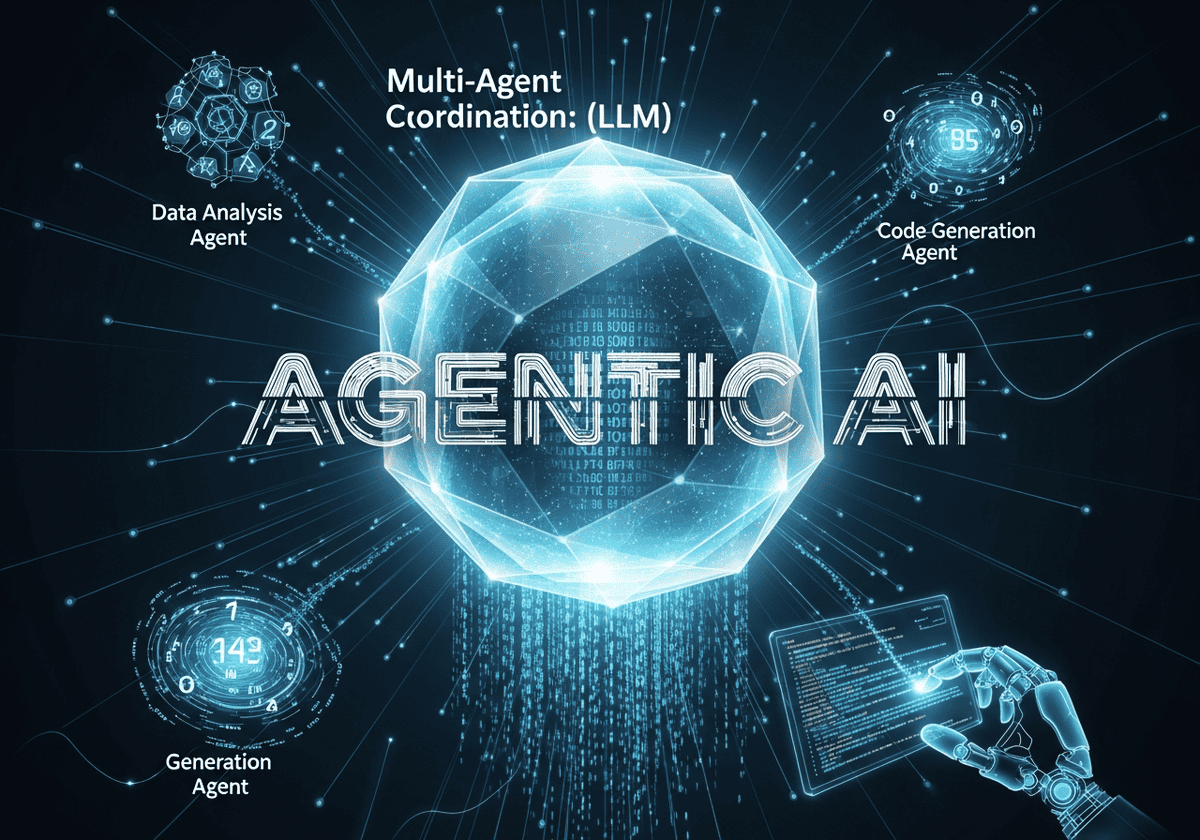

La IA agente designa a los sistemas de IA que persiguen objetivos de varios pasos de forma autónoma, iterando a través de bucles de percepción, planificación, uso de herramientas y autocorrección sin requerir intervención humana en cada punto de decisión; se trata de una ruptura estructural con los modelos de respuesta inmediata de un solo turno hacia arquitecturas que descomponen objetivos complejos en subtareas, ejecutan acciones contra entornos externos, evalúan los resultados y revisan los planes en consecuencia.
La arquitectura agéntica canónica combina un gran núcleo de razonamiento basado en modelos lingüísticos con un registro de herramientas -navegadores web, intérpretes de código, clientes API, sistemas de archivos, interfaces de bases de datos- y una arquitectura de memoria que abarca el contexto de trabajo a corto plazo, los registros episódicos de acciones pasadas y el conocimiento recuperado a largo plazo, lo que permite al agente mantener una persecución coherente de objetivos en horizontes de interacción amplios que superan cualquier ventana de contexto individual. Las configuraciones multiagente van más allá y distribuyen las subtareas entre agentes especializados coordinados por un orquestador, lo que introduce la interacción entre agentes. comunicación la agregación de resultados y la resolución de conflictos.
Las publicaciones y patentes que se indexan a continuación abordan algoritmos de planificación, arquitecturas de uso de herramientas, sistemas de memoria, protocolos de coordinación multiagente, puntos de referencia para la evaluación de agentes y metodologías de restricciones de seguridad.
Esta es nuestra última selección de publicaciones y patentes mundiales en inglés sobre IA agéntica, entre muchas revistas científicas en línea, clasificadas y centradas en IA agéntica, agente de IA, agente autónomo de IA, sistema multiagente, orquestación del agente de IA, bucle de planificación del agente, agente ReAct, planificación de la cadena de pensamiento, agente de IA que utiliza herramientas, llamada a funciones, memoria del agente de IA, memoria a largo plazo del agente, memoria episódica del agente, memoria de trabajo del agente, descomposición de tareas del agente de IA, planificación jerárquica del agente, autocorrección del agente de IA, reflexión del agente de IA, evaluación del agente de IA, configuración de la recompensa del agente, aislamiento del agente de IA, barandillas de seguridad del agente, coordinación multiagente, protocolo de comunicación del agente, registro de herramientas del agente de IA, agente ejecutor de código, agente de navegación web, agente de recuperación aumentada, evaluación comparativa del agente y agente humano en bucle.
Secure check processing system and related method
Patent published on the 2026-06-11 in US under Ref US20260162094 by IWALLET INC [US] (Kolchin Dmitriy [us])
Abstract: [0000] An AI-based method for integrating payment processing across disparate systems enables seamless transaction reconciliation and payment status updates without relying on APIs. The AI agent autonomously retrieves transaction data from third-party processors, scheduling systems, or CRMs using techniques such as web scraping, optical character recognition (OCR), and pattern recognition. The agent dynamically adapts to system workflows through reinforcement learning, performs risk assessments [...]
Our summary: The method enables seamless payment processing across different systems without APIs. It uses AI to autonomously retrieve transaction data and adapt to workflows. The system enhances operational efficiency and compliance through real-time updates and audit logs.
payment processing, AI integration, transaction reconciliation, risk assessment
Patent
Agentic ai system for dynamically determining optimal toolchain, and driving method therefor
Patent published on the 2026-05-28 in WO under Ref WO2026111487 by LG MANAGEMENT DEVELOPMENT INST CO LTD [KR] (Lee Hong Lak [kr], Sohn Sung Ryull [kr], Choi Ye Muk [kr])
Abstract: The present disclosure provides an agentic AI driving method for dynamically determining an optimal toolchain on the basis of an execution mode according to a user input and an expected latency of a toolchain DB. Accordingly, an external tool and an internal module are controlled to execute a main task and output a final response including the execution result.[...]
Our summary: The system dynamically determines the optimal toolchain based on user input and expected latency. An external tool and internal module are controlled to execute a main task. The final response includes the execution result.
Agentic AI, toolchain optimization, execution mode, latency management
Patent
Method and system for artificial intelligence (ai) agent training
Patent published on the 2026-05-28 in US under Ref US20260148085 by TATA CONSULTANCY SERVICES LTD [IN] (Sivakumar Narendran [gb], Ramasamy Venkada Subramanian [in], Viswanathan Sankaranarayanan [in], Kannan Radhika [in])
Abstract: [0000] AI systems, while have excelled in environments defined by clear rules and singular tasks, have been found to be struggling to handle Knowledge works which encompass tasks requiring judgment, interpretation, and creative problem-solving. Method and system disclosed herein provide an Artificial Intelligence (AI) agent training approach. In this approach, the system 100 achieves collaboration between different AI agents that are part of a network, for handling each task. During the training[...]
Our summary: This method enhances AI agent training by fostering collaboration among multiple agents. It addresses challenges in knowledge work that require judgment and creativity. The training utilizes dynamically decided actions based on activation levels of active agents.
AI training, collaborative agents, knowledge work, dynamic decision-making
Patent
Method for performing a task according to a flare model including a multi-modal planning module and an environment-adaptive replanning module and ai a
Patent published on the 2026-05-21 in US under Ref US20260141703 by UIF UNIV INDUSTRY FOUNDATION YONSEI UNIV [KR] (Kim Tae Woong [kr], Kim Byeonghwi [kr], Choi Jonghyun [kr])
Abstract: [0000] A method for performing a task according a FLARE model including a multi-modal planning module and an environment-adaptive replanning module is provided. The method of an AI agent includes steps of: (a) instructing the multi-modal planning module to calculate degrees of similarity between training data and a current pair comprised of natural language data and image data and acquire k natural language data by using the degrees of similarity; (b) instructing the multi-modal planning module [...]
Our summary: The method involves an AI agent utilizing a multi-modal planning module to analyze natural language and image data. It generates an initial action plan based on similarity degrees and adapts the plan using an environment-adaptive replanning module when necessary. The process ensures effective task performance even when target information is incomplete.
AI, multi-modal planning, environment-adaptive replanning, FLARE model
Patent
Computer-implemented method, computer system, data models, and computer program for simulating degradation, ageing, performance, and/or thermal behavi
Patent published on the 2026-05-20 in EP under Ref EP4745825 by BATTERY SPHERE GMBH [DE] (Lutz Lukas [de], Scherrer Luca [de], Alves Dalla Corte Daniel [de], Principe Victor [de])
Abstract: [0001] The invention relates to a computer-implemented method for simulating and predicting a degradation, ageing, performance, and/or thermal behavior of an electric battery, a method for generating corresponding training datasets, and a computer system for supporting users in different aspects of battery development, testing and validation. This battery domain specific artificial intelligence system (Battery AI System) applies raw data preparation steps like segmenting, timestamp data extracti[...]
Our summary: The invention describes a method and system for simulating battery degradation and performance. It utilizes transformer-based machine learning models for accurate predictions. A large language model facilitates user interaction with the Battery AI System.
simulation, battery, machine learning, degradation
Patent
Dynamic navigation generation using ai
Patent published on the 2026-05-07 in US under Ref US20260126295 by IBM [US] (Brew Kevin Wayne [us], Shah Priti Ashvin [us], Morillo Jaime D [us])
Abstract: [0000] A monitoring system includes a computer hardware system with a hardware processor configured to initiate the following executable operations. Communications from one or more communication devices associated with first responders are real-time monitored. Using an artificial intelligence (AI) agent analyzing the communications, an event is detected. Using the AI agent, an event location associated with the event is identified. Using the AI agent and the event location, an occlusion zone ass[...]
Our summary: The system monitors real-time communications from first responders. An AI agent detects events and identifies their locations. It generates occlusion zones and updates map data for route adjustments.
AI, dynamic navigation, event detection, occlusion zone
Patent
agentic AI and the future of electron microscopy
Published on 2026-04-10 by Vida Jamali, Amirali Aghazadeh, Josh Kacher @NATURE npj
Abstract: npj Computational Materials, Published online: 10 April 2026; doi:10.1038/s41524-026-02077-yAdvances in microscopy have long focused on improving resolution, throughput, and automation. The next transformation may lie in enabling microscopes to contribute to the reasoning that guides experiments. Recent advances in agentic artificial intelligence (AI) suggest a future in which microscopes do more than simply acquire images. Agentic systems could draw on prior knowledge, interpret experimental ou[...]
Our summary: Advances in agentic AI could enable electron microscopes to interpret data and design experiments. This transformation may shift microscopes from passive tools to active collaborators in research. The transition requires community support through open access and data sharing initiatives.
agentic AI, electron microscopy, experimental design, materials characterization
Publication
A Scoping Review
Published on 2026-02-01 by Jonathan Gibson, Praveen Chinniah, Shashank Chapala, Ojasvi Vemuri, Rajesh Botchu @MDPI
Abstract: Objectives: Artificial intelligence (AI) is a transformative development in the field of medicine. In the field of musculoskeletal radiology, agentic AI is a technology that could flourish, but currently, the limited evidence base is fragmented and sparse, and we present a scoping review of it. Methods: Parallel searches were conducted in four databases: PubMed, Embase, Scopus, and Web of Science. Search terms included all agentic AI and autonomous AI agents, as well as radiology. All papers und[...]
Our summary: This scoping review evaluates the potential of agentic AI in musculoskeletal radiology. It identifies eleven relevant studies highlighting improved decision support, workflow optimization, and image analysis. Despite promising findings, the evidence base remains limited and theoretical.
AI in Radiology, Musculoskeletal Imaging, Workflow Optimization, Decision Support
Publication