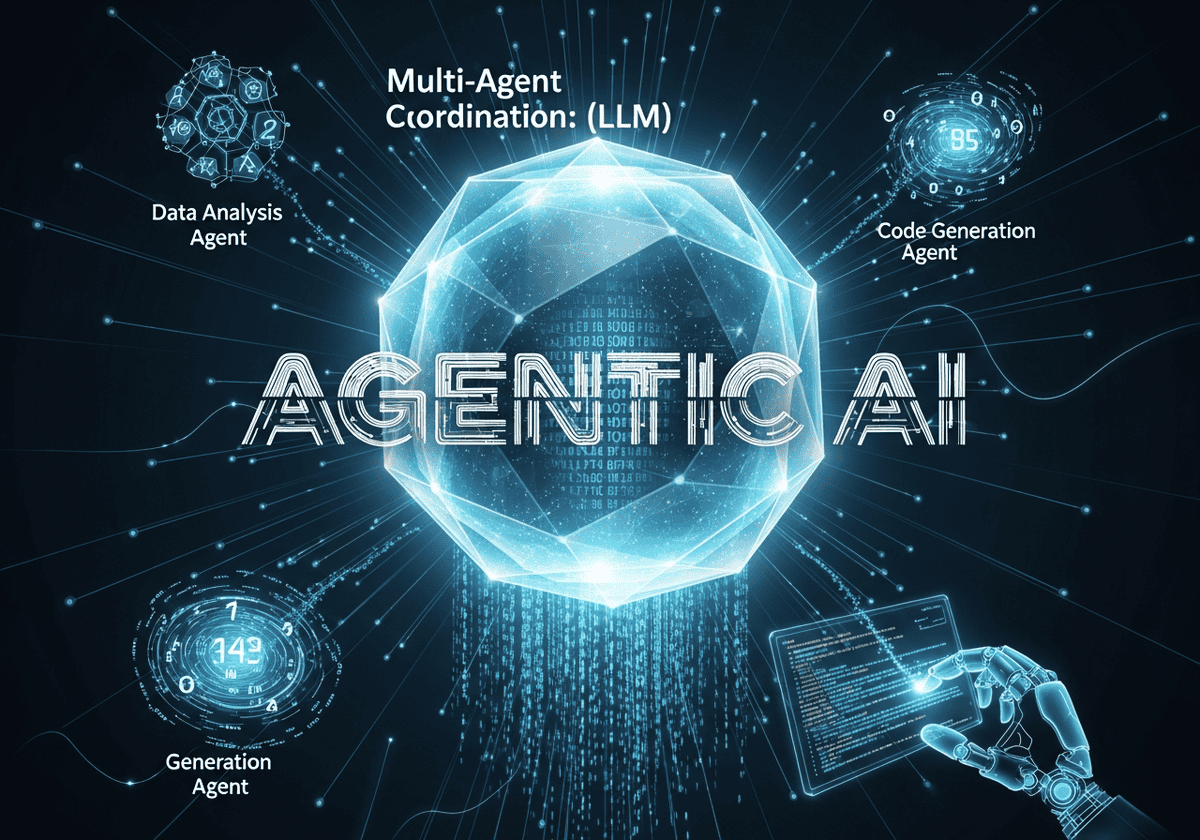
يشير مصطلح الذكاء الاصطناعي الفاعل إلى أنظمة الذكاء الاصطناعي التي تسعى لتحقيق أهداف متعددة الخطوات بشكل مستقل من خلال التكرار عبر الإدراك والتخطيط واستخدام الأدوات وحلقات التصحيح الذاتي دون الحاجة إلى تدخل بشري في كل نقطة قرار - وهو تحول هيكلي من نماذج الاستجابة الفورية ذات الدور الواحد نحو بنى تقوم بتقسيم الأهداف المعقدة إلى مهام فرعية، وتنفيذ الإجراءات ضد البيئات الخارجية، وتقييم النتائج، ومراجعة الخطط وفقًا لذلك.
تزاوج البنية العميلة المتعارف عليها بين نواة منطقية لنموذج لغوي كبير مع سجل أدوات - متصفحات الويب ومترجمات الأكواد وعملاء واجهة برمجة التطبيقات وأنظمة الملفات وواجهات قواعد البيانات - وبنية ذاكرة تشمل سياق عمل قصير الأجل وسجلات عرضية للإجراءات السابقة والمعرفة المسترجعة على المدى الطويل، مما يسمح للوكيل بالحفاظ على السعي لتحقيق هدف متماسك عبر آفاق تفاعل ممتدة تتجاوز أي نافذة سياق واحد. تعمل التكوينات متعددة الوكلاء على توسيع هذا الأمر إلى أبعد من ذلك، حيث توزع المهام الفرعية عبر وكلاء متخصصين يتم تنسيقها من قبل منظم، مما يؤدي إلى تقديم تواصل البروتوكولات، وتجميع النتائج، وحل النزاعات باعتبارها اهتمامات معمارية إضافية.
تتناول المنشورات وبراءات الاختراع المفهرسة أدناه خوارزميات التخطيط، وهياكل استخدام الأدوات، وأنظمة الذاكرة، وبروتوكولات تنسيق الوكلاء المتعددين، ومعايير تقييم الوكلاء، ومنهجيات قيود السلامة.
هذه هي أحدث مجموعة مختارة من المنشورات وبراءات الاختراع العالمية باللغة الإنجليزية حول الذكاء الاصطناعي الوكيل، بين العديد من المجلات العلمية على الإنترنت، مصنفة ومركزة على الذكاء الاصطناعي الوكيل، وكيل الذكاء الاصطناعي، وكيل الذكاء الاصطناعي المستقل، نظام الذكاء الاصطناعي متعدد الوكلاء، تنسيق وكيل الذكاء الاصطناعي، حلقة تخطيط الوكيل، وكيل ReAct، وكيل ReAct، تخطيط سلسلة الأفكار، وكيل الذكاء الاصطناعي باستخدام الأدوات، وكيل الذكاء الاصطناعي باستخدام الأدوات، وظيفة استدعاء الذكاء الاصطناعي، ذاكرة وكيل الذكاء الاصطناعي، ذاكرة الوكيل طويلة الأجل، ذاكرة الوكيل العرضية, وذاكرة الوكيل العاملة، وتحلل مهام وكيل الذكاء الاصطناعي، والتخطيط الهرمي للوكيل، والتصحيح الذاتي لوكيل الذكاء الاصطناعي، وانعكاس وكيل الذكاء الاصطناعي، وتقييم وكيل الذكاء الاصطناعي، وتشكيل مكافأة الوكيل، ووضع وكيل الذكاء الاصطناعي في وضع الحماية للوكيل، وحواجز حماية سلامة الوكيل، والتنسيق بين الوكلاء المتعددين، وبروتوكول اتصال الوكيل، وسجل أدوات وكيل الذكاء الاصطناعي، والوكيل المنفذ للرموز، والوكيل المتصفح للويب، والوكيل المعزز بالاسترجاع، وتقييم معايير الوكيل، والوكيل البشري في الحلقة.
Self-pruning fractal computational architecture for high-performance computing on resource-constrained and noisy quantum hardware
Patent published on the 2026-07-02 in WO under Ref WO2026139942 by MARECHAL THIERRY [CA] (Marechal Thierry [ca])
Abstract: A computational architecture employing self-pruning fractal branch management for achieving supercomputer-class performance on standard hardware and noisy intermediate-scale quantum (NISQ) devices. Unlike conventional parallel computing systems requiring massive hardware resources or genetic algorithms requiring extensive population evolution, this invention utilizes hierarchical fractal doubles—modular computational units organized in self-similar tree structures—with real-time adaptive pru[...]
Our summary: The architecture employs self-pruning fractal branch management for high-performance computing on noisy quantum hardware. It achieves supercomputer-class performance with modular units organized in fractal structures, utilizing real-time adaptive pruning to eliminate non-promising branches. Applications span neural architecture search, protein folding, and quantum system modeling, achieving significant speedups while being energy-efficient and noise-tolerant.
fractal architecture, quantum computing, self-pruning, computational efficiency
Patent
Hardware-enforced agentic genai workflow orchestrator with cryptographic ethical guardrails and human-in-the-loop escalation for autonomous clinical o
Patent published on the 2026-07-02 in US under Ref US20260188502 by BICKERSTAFF III GEORGE WILLIAM [US] (Bickerstaff Iii George William [us])
Abstract: A hardware-anchored orchestration system for autonomous GenAI agents in clinical settings, implementable in ASIC or FPGA fabric to ensure deterministic enforcement independent of software execution layers. The system utilizes a hardware-isolated ethical supervisor—comprising a HSM or TPM—to monitor agentic workflows against human-configured safety thresholds stored in an ethical guardrail manifest in a silicon vault. Hardware-based logic gates detect statistically anomalous token-level entro[...]
Our summary: The system orchestrates autonomous GenAI agents in clinical environments using hardware for deterministic enforcement. It employs a hardware-isolated ethical supervisor to monitor workflows against safety thresholds. In case of a safety breach, it activates a hardwired interlock to prevent non-compliant outputs.
Hardware Orchestration, GenAI Agents, Ethical Supervision, Cryptographic Compliance
Patent
Deterministic ai agent liability firewall and insurance engine with hardware-enforced envelope binding and privacy-preserving risk pooling
Patent published on the 2026-07-02 in US under Ref US20260187731 by BICKERSTAFF III GEORGE WILLIAM [US] (Bickerstaff Iii George William [us])
Abstract: A hardware-enforced AI liability containment system binds autonomous AI agent decisions to predefined liability envelopes retrieved from TEE-sealed policy stores within trusted execution environments (TEEs) comprising Intel SGX enclaves, AMD SEV-SNP protected VMs, or ARM TrustZone secure worlds, materially altering processor states to isolate all liability computations. Real-time risk exposure is computed using trust-state signals derived from TEE-resident hardware mechanisms comprising enclave-[...]
Our summary: This system binds AI agent decisions to liability envelopes using hardware-enforced mechanisms. It computes real-time risk exposure through TEE-derived trust-state signals. Insurance pools manage excess exposure with zk-SNARK proofs, ensuring verifiable operations in secure environments.
deterministic AI, liability containment, trusted execution environments, zero-knowledge proofs
Patent
Cross-agent context management for multi-agent system
Patent published on the 2026-07-02 in US under Ref US20260186828 by MICROSOFT TECH LICENSING LLC [US] (Wang Jeffrey [us], Katarya Vivek [us], Chandla Amol [us], Ng Christopher [us], Racca David Nicolas [it], Baruch Keren [us], Bottaro Juan Pablo [es], Sachindran Santhosh [us], Mohanasundaram Gokulraj [us], Arcara Kevin [us])
Abstract: An example maps input to a first task executable by a first task agent of a multi-agent application system. A search is formulated using the input and the first task. The search is executed on a second layer of a multi-layer memory accessible to the orchestrator agent. First cross-agent context data related to the input and the first task is extracted from results of the search. The first task and the first cross-agent context data are routed to the first task agent. Output is received from the [...]
Our summary: This content describes a method for managing context in a multi-agent system. It involves mapping input to tasks executed by agents and utilizing a multi-layer memory for searches. The process includes routing data between agents to generate responses based on task execution.
context management, multi-agent system, task execution, orchestrator agent
Patent
Information gathering using an intake artificial intelligence agent
Patent published on the 2026-07-02 in US under Ref US20260187111 by MAPLEBEAR INC [US] (Vrabec Helena Ursic [us], Bernard Benjamin [us], Lei Kevin [us], Cohen Spencer Lee [us], Lee Junghoon [ca], Bowering Robert [ca], Hohenberger Taylor [us])
Abstract: [0000] A question is posed by a user of a user device as part of an online chat session with an online system. An intake artificial intelligence (AI) agent interacts with the user via the online chat session in one or more rounds of messaging to gather information that may be used by a human agent to respond to the question. At some point, the online system may identify in an output of the intake AI agent an indication that there is sufficient context regarding the question to transfer the quest[...]
Our summary: An intake AI agent interacts with users in an online chat to gather relevant information. The system assesses when enough context is available to transfer the interaction to a human agent. The human agent utilizes the gathered session information to formulate a response to the user s question.
AI agent, information gathering, online chat, human agent
Patent
Knowledge extraction system and knowledge extraction method
Patent published on the 2026-07-02 in US under Ref US20260187494 by HITACHI LTD [JP] (Suzuki Shintaro [jp], Hyodo Akihiko [jp], Sakaniwa Hidenori [jp])
Abstract: [0000] An AI agent system includes an episode memory database configured to accumulate dialogue histories with users as episode memories including a plurality of messages—, a semantic memory construction unit configured to cluster the messages included in the episode memories into a plurality of clusters and extract scenario branches based on transitions of the messages between the clusters, and a semantic memory database configured to store the scenario branches as semantic memories.[...]
Our summary: The AI agent system accumulates dialogue histories in an episode memory database. It clusters messages into groups and extracts scenario branches based on message transitions. The scenario branches are stored as semantic memories in a dedicated database.
knowledge extraction, AI agent, semantic memory, dialogue history
Patent
agentic AI and the future of electron microscopy
Published on 2026-04-10 by Vida Jamali, Amirali Aghazadeh, Josh Kacher @NATURE npj
Abstract: npj Computational Materials, Published online: 10 April 2026; doi:10.1038/s41524-026-02077-yAdvances in microscopy have long focused on improving resolution, throughput, and automation. The next transformation may lie in enabling microscopes to contribute to the reasoning that guides experiments. Recent advances in agentic artificial intelligence (AI) suggest a future in which microscopes do more than simply acquire images. Agentic systems could draw on prior knowledge, interpret experimental ou[...]
Our summary: Advances in agentic AI could enable electron microscopes to interpret data and design experiments. This transformation may shift microscopes from passive tools to active collaborators in research. The transition requires community support through open access and data sharing initiatives.
agentic AI, electron microscopy, experimental design, materials characterization
Publication
A Scoping Review
Published on 2026-02-01 by Jonathan Gibson, Praveen Chinniah, Shashank Chapala, Ojasvi Vemuri, Rajesh Botchu @MDPI
Abstract: Objectives: Artificial intelligence (AI) is a transformative development in the field of medicine. In the field of musculoskeletal radiology, agentic AI is a technology that could flourish, but currently, the limited evidence base is fragmented and sparse, and we present a scoping review of it. Methods: Parallel searches were conducted in four databases: PubMed, Embase, Scopus, and Web of Science. Search terms included all agentic AI and autonomous AI agents, as well as radiology. All papers und[...]
Our summary: This scoping review evaluates the potential of agentic AI in musculoskeletal radiology. It identifies eleven relevant studies highlighting improved decision support, workflow optimization, and image analysis. Despite promising findings, the evidence base remains limited and theoretical.
AI in Radiology, Musculoskeletal Imaging, Workflow Optimization, Decision Support
Publication