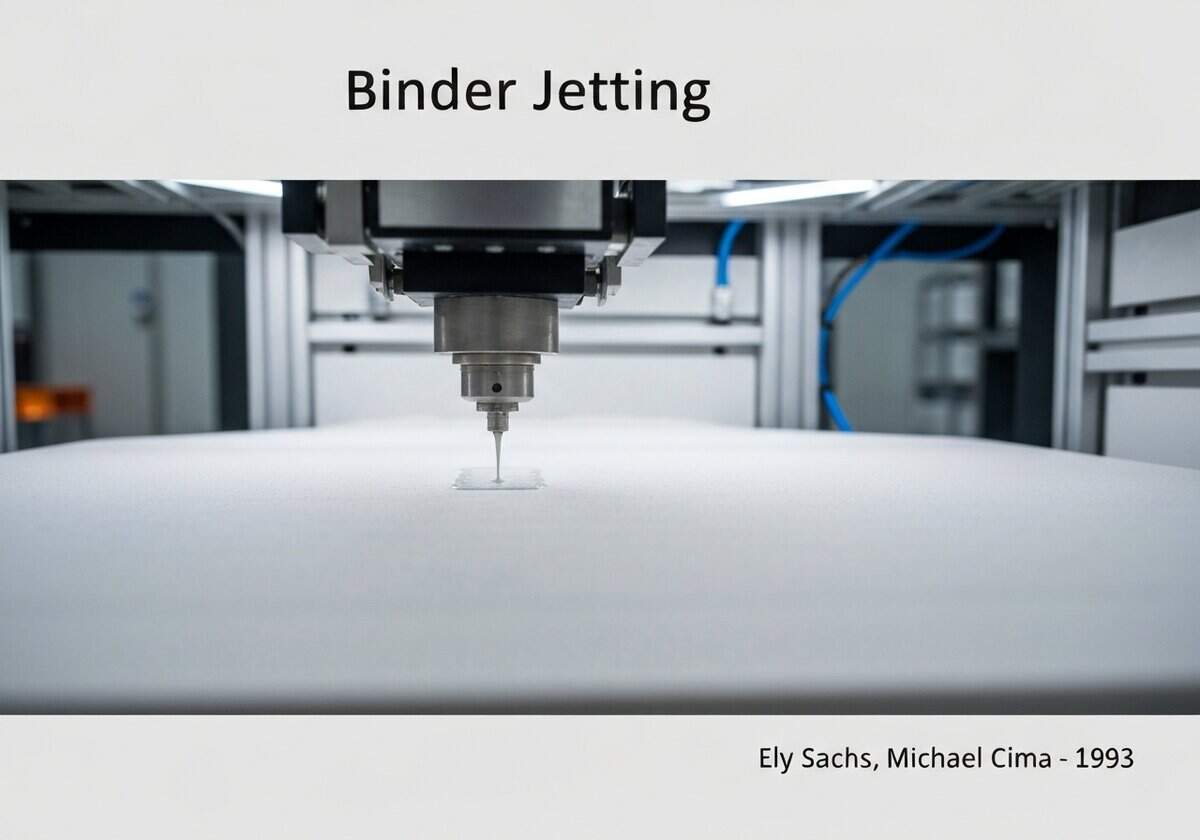
바인더 제팅은 잉크젯 방식의 프린트 헤드를 사용하여 액체 결합제를 분말층 위에 선택적으로 분사하는 적층 제조 공정입니다. 프린트 헤드가 분말층 위를 이동하면서 결합제 방울을 분사하여 입자들을 결합시킵니다. 그런 다음 제작 플랫폼이 내려가고 새로운 분말층이 도포되며, 이 과정이 층별로 반복됩니다.
(설명을 위한 생성된 이미지입니다)
바인더 제팅은 잉크젯 방식의 프린트 헤드를 사용하여 액체 결합제를 분말층 위에 선택적으로 분사하는 적층 제조 공정입니다. 프린트 헤드가 분말층 위를 이동하면서 결합제 방울을 분사하여 입자들을 결합시킵니다. 그런 다음 제작 플랫폼이 내려가고 새로운 분말층이 도포되며, 이 과정이 층별로 반복됩니다.

The primary advantage of binder jetting is its speed and scalability, as the inkjet deposition process is typically faster than laser-based methods. It also operates at room temperature, which avoids the thermal stresses and warping common in high-temperature processes. This makes it suitable for a wide range of materials, including sand, metals, ceramics, and 고분자. After printing, the part exists in a fragile ‘green state,’ held together only by the binder. It must be carefully excavated from the surrounding loose powder. For metal and ceramic parts, a crucial post-processing step is required to achieve final density and strength. This typically involves sintering in a furnace to burn out the binder and fuse the material particles, a process that causes significant and predictable shrinkage. Alternatively, the green part can be infiltrated with a lower-melting-point metal, such as bronze, to fill the pores and create a dense composite. A unique feature is the ability to incorporate color into the binder, allowing for the creation of full-color 3D models directly from the printer.
바인더 제팅
(날짜를 알 수 없거나 관련이 없는 경우, 예를 들어 "유체역학"의 경우, 주목할 만한 등장 시기를 대략적으로 추정하여 제공합니다.)

고화질 이미지 및 다운로드는 등록된 회원에게만 100% 무료로 제공됩니다.
> 로그인 <