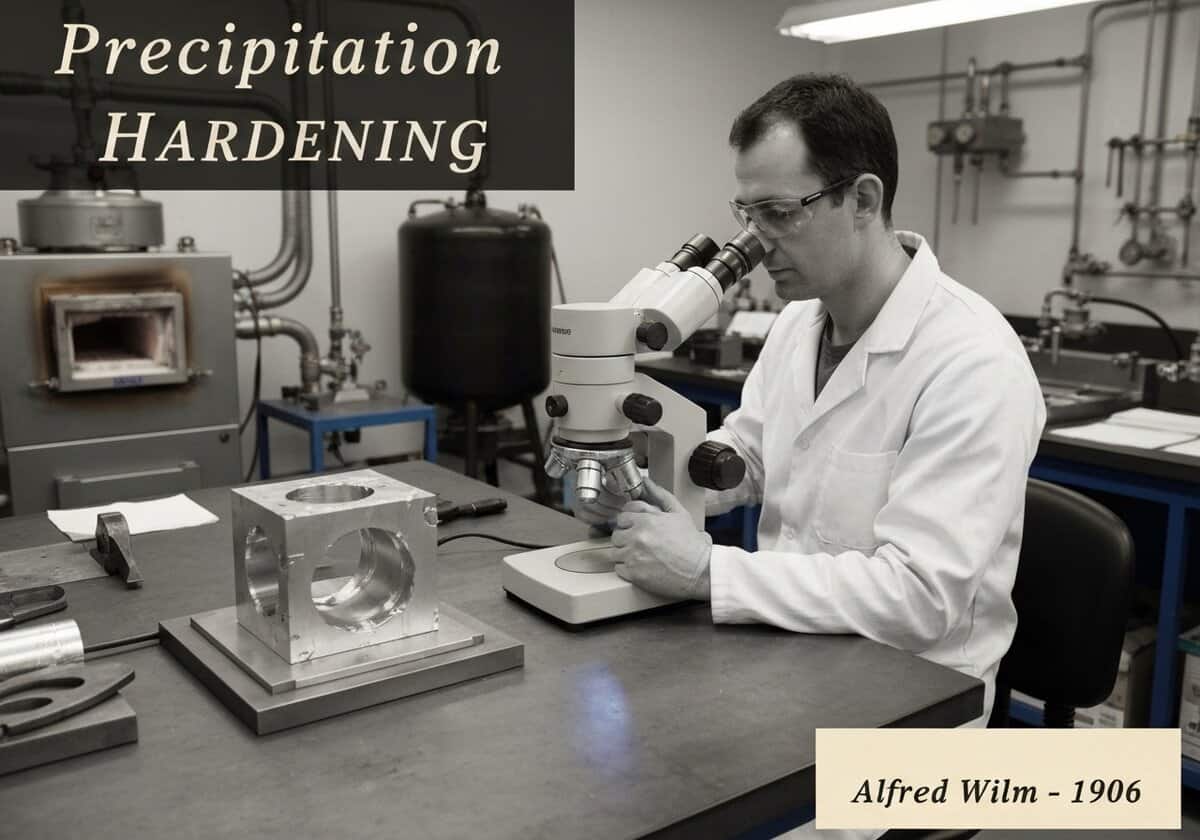
석출 경화 또는 시효 경화는 가단성 재료의 항복 강도를 증가시키는 열처리 공정입니다. 이 공정은 합금을 가열하여 용질 원소를 용해(용화)하고, 급속 냉각(담금질)하여 용질 원소를 과포화 고용체에 가두어 둔 다음, 더 낮은 온도에서 시효 처리하여 미세한 제2상 입자(석출물)를 형성함으로써 전위 이동을 방해하는 과정을 포함합니다.


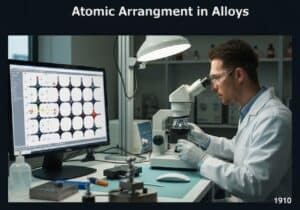
(설명을 위한 생성된 이미지입니다)
석출 경화 또는 시효 경화는 가단성 재료의 항복 강도를 증가시키는 열처리 공정입니다. 이 공정은 합금을 가열하여 용질 원소를 용해(용화)하고, 급속 냉각(담금질)하여 용질 원소를 과포화 고용체에 가두어 둔 다음, 더 낮은 온도에서 시효 처리하여 미세한 제2상 입자(석출물)를 형성함으로써 전위 이동을 방해하는 과정을 포함합니다.
The discovery of precipitation hardening by Alfred Wilm was accidental. While studying an aluminum 합금 containing copper, magnesium, and manganese (later named Duralumin), he noticed its hardness increased over several days after quenching, even at room temperature. This phenomenon is now understood as a three-step process. First, in solution treatment, the alloy is heated to a temperature high enough to dissolve all the solute atoms into a single-phase solid solution. Second, the alloy is rapidly quenched in a medium like water, which freezes the atoms in place, creating a supersaturated solid solution. This state is thermodynamically unstable. Third, during aging (either at room temperature or an elevated temperature), the supersaturated solute atoms diffuse and cluster together to form extremely small, coherent particles of a new phase called precipitates.
These precipitates act as powerful obstacles to the movement of dislocations, which are the primary carriers of plastic deformation in crystalline materials. The effectiveness of the strengthening depends on the size, shape, and distribution of these precipitates. Initially, as precipitates form and grow, the strength increases. However, if the aging process continues for too long (over-aging), the precipitates become too large and lose coherency with the matrix, allowing dislocations to bypass them more easily, which leads to a decrease in strength. This process allows for the precise tailoring of an alloy’s 기계적 특성.
석출 경화
(날짜를 알 수 없거나 관련이 없는 경우, 예를 들어 "유체역학"의 경우, 주목할 만한 등장 시기를 대략적으로 추정하여 제공합니다.)

고화질 이미지 및 다운로드는 등록된 회원에게만 100% 무료로 제공됩니다.
> 로그인 <