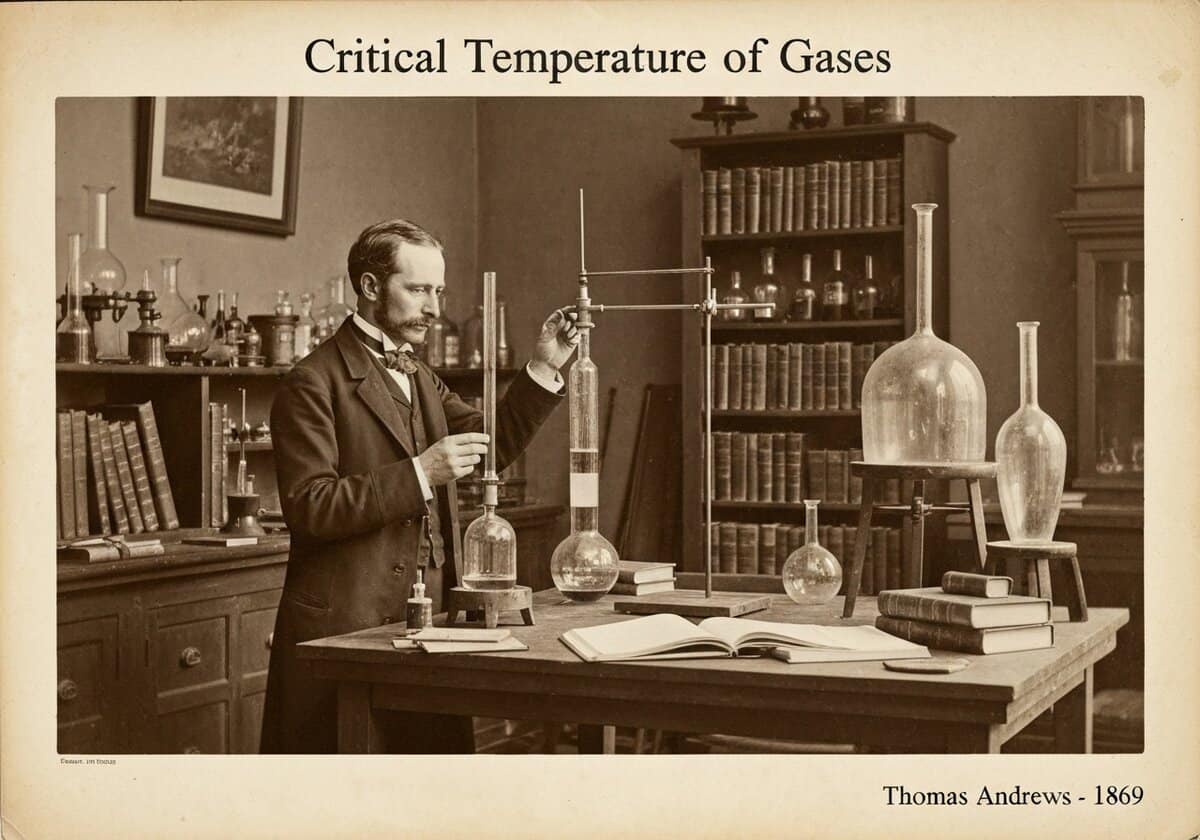
Thomas Andrews’ experiments in the 1860s on carbon dioxide were pivotal. He meticulously measured its pressure-volume-temperature (P-V-T) relationships and discovered that above approximately 30.98 °C (304.1 K), CO2 could not be liquefied no matter how much pressure was applied. He termed this the ‘critical temperature.’ Below this temperature, increasing the pressure on the gas would eventually cause it to condense into a liquid. At the critical temperature itself, the gas transitions into a liquid at a specific ‘critical pressure’ and ‘critical volume,’ a state known as the critical point. At this point, the densities of the liquid and gas phases become equal, and the meniscus separating them disappears. The substance becomes a supercritical fluid, possessing properties of both a gas and a liquid. This discovery was crucial because it explained why earlier attempts by scientists like Faraday to liquefy gases such as oxygen, nitrogen, and 水素 had failed; they were not cooling the gases below their respective, much lower, critical temperatures, a prerequisite for liquefaction by compression.