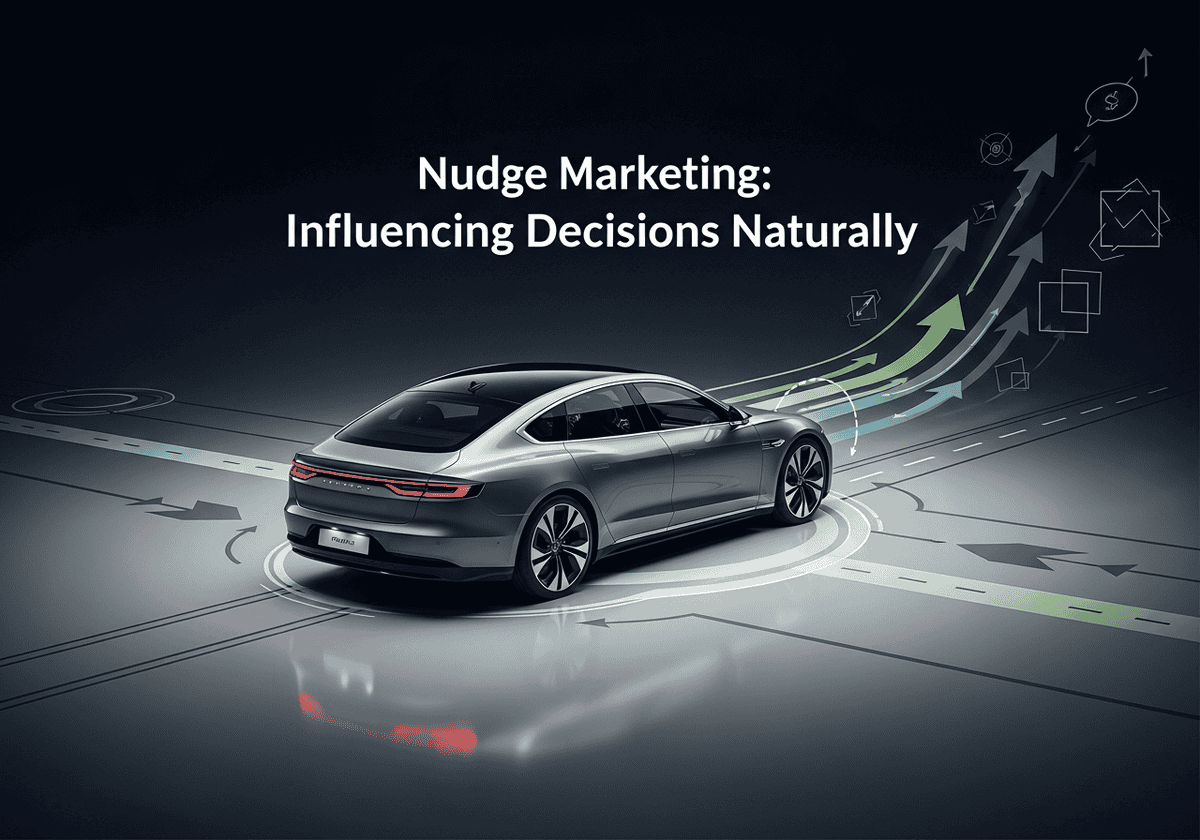

Nudge marketing beginnings: in 1956, a Chrysler engineer named Virgil Exner introduced the concept of “Forward Look” styling — cars that appeared to be moving even while parked. Buyers responded. Sales climbed. Nobody told customers they had to buy. Nobody ran fear campaigns about missing out on this design. The product simply looked right, and that was enough.
That is, in its crudest form, the intuition behind nudge marketing: structure the environment so the desired behavior feels natural, obvious, and low-effort. No coercion. No manipulation. Just architecture.
The term “nudge” effectively entered formal marketing and policy discourse in 2008, courtesy of behavioral economist Richard Thaler and legal scholar Cass Sunstein. Their book “Nudge: Improving Decisions About Health, Wealth, and Happiness” laid out a struttura per quello che chiamavano “paternalismo libertario” – l’idea che si possano guidare le persone verso decisioni migliori (o commercialmente preferite) lasciando la loro libertà di scelta del tutto intatta. Premio Nobel Thaler avrebbe poi vinto il
For marketers, the book was a quiet revolution. It reframed the entire question of persuasion:
instead of asking “how do we convince people?” the more productive question became “how do we design the context so people convince themselves?”.
Very complementary to this article, in our serie about marketing technics, you may also be interested in these two:

What Is Nudge Marketing?
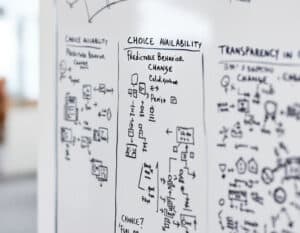
A nudge, in Thaler and Sunstein’s definition, is “any aspect of the choice architecture that alters people’s behavior in a predictable way without forbidding any options or significantly changing their economic incentives.” The key phrase is “choice architecture” — the design of the environment in which decisions get made.
Nudge marketing applies this framework commercially. It is the deliberate design of customer touchpoints — digital interfaces, physical retail environments, pricing structures, communication sequences, product packaging, and more — to guide purchasing behavior, retention, and engagement by working with how humans actually think, rather than how economic theory imagines they think.
The distinction from standard marketing tactics is important and often misunderstood: nudge marketing does not use persuasive arguments. It does not explain why a product is good. It does not offer incentives. It changes the context around the decision itself. Where advertising says “here is why you should buy this,” a nudge says “here is where the buy button is, and it is larger than the cancel button, and it is green, and you only have to click once.”
Three conditions define a true marketing nudge:
- The alternative options remain available. A nudge does not remove choices. It changes how they are presented. If a default setting auto-enrolls users in email newsletters, the option to opt out must genuinely exist and be accessible.
- The behavior change is predictable. Nudges work because they exploit known, documented patterns of human cognition. The nudge designer understands the psychology behind the intervention.
- The change is made transparently or neutrally — not through deception or manufactured urgency that is demonstrably false.
This third condition is where most of the ethical debate concentrates, and we will return to it. But first, the psychology.
The Fake Fly @Schiphol Airport Toilets Example

Because no nudge marketing article would be complete without that famous example … The Schiphol Airport urinal fly is one of the most cited examples in applied behavioral design, and it earns that status because it works through a mechanism that bypasses every layer of conscious resistance:
In the early 1990s, the Amsterdam airport’s facilities manager Aad Kieboom etched a small image of a housefly into the porcelain of men’s urinals, positioned just above the drain. “Spillage” dropped by approximately 80%. No signage. No fines. No appeals to cleanliness or civic responsibility. The intervention succeeded because it exploited a hardwired targeting reflex — men aim at things. The fly provided a focal point that the blank porcelain did not, and the visual target was sufficient to redirect behavior at the moment of action, which is precisely when behavioral interventions are most effective. What makes this psychologically significant is not the cleverness of the idea but the mechanism behind it: the behavior change was achieved entirely within System 1 processing. No deliberate thought was required, solicited, or useful. The user never formed an intention to aim more accurately — he simply did, because the environment changed.
As seen in the behavioral chapter hereafter, the marketing and policy implications of the fly are more consequential than the anecdote suggests. It is a pure demonstration that behavior is substantially a product of environmental design, not character or intention. Traditional facilities management had approached the spillage problem as a compliance issue — posters, cleaning schedules, social pressione — which are all System 2 interventions applied to a System 1 behavior. They failed predictably.
The fly worked because Kieboom diagnosed the actual mechanism of the behavior rather than its surface appearance.
For marketers, the translation is direct: most conversion and engagement problems that get treated as messaging problems are actually architecture problems. The customer is not failing to be persuaded; the environment is failing to channel an existing impulse toward completion. The fly did not create a new preference. It gave an existing one somewhere to go.
The Behavioral Science Foundations
Nudge marketing draws heavily from decades of behavioral economics and cognitive psychology research. Understanding the underlying science is not optional for practitioners — it is what separates principled nudge design from guesswork.
System 1 vs. System 2 Thinking
Daniel Kahneman’s dual-process theory, popularized in “Thinking, Fast and Slow” (2011), è il quadro intellettuale centrale.
- System 1 thinking is fast, automatic, and effortless.
- System 2 is slow, deliberate, and effortful.
The vast majority of everyday decisions — including most purchasing decisions — are made via System 1.
Nudge is almost entirely an intervention at the System 1 level. When a streaming platform pre-selects an annual subscription as the default, it is betting that most users will not activate System 2 to evaluate whether monthly billing would be cheaper. And for a significant portion, that bet pays off.
Pro tip: distinguish between nudges that serve users and nudges that extract from them: not all nudges are equivalent. A default that helps users avoid a decision they would regret creates long-term value. A default that charges users for a service they did not consciously select creates short-term revenue and long-term churn, chargebacks, and brand damage. The financially rational approach is to concentrate nudge investment on choices where the nudged outcome genuinely serves the customer, and to remove defaults and friction-based mechanics where they do not. Users who feel manipulated tell others.
Status Quo Bias
People disproportionately favor the current state of affairs. Changing anything feels like a loss, and loss aversion — the tendency to feel losses approximately twice as acutely as equivalent gains — reinforces inertia.
Defaults exploit this directly. Whatever option is presented as the “default” inherits the psychological weight of the status quo, even when it was only set yesterday by a product manager.
The research on this is extensive. William Samuelson and Richard Zeckhauser first documented status quo bias formally in 1988, and subsequent studies have replicated it across contexts ranging from retirement savings enrollment to organ donation registries to software preferences.
Salience and Attention
Humans allocate attention unevenly. We notice what is large, brightly colored, moving, or positioned at eye level. We systematically ignore what is small, gray, peripheral, or requires scrolling.
Choice architecture that leverages salience — by making a preferred option more visually prominent without hiding alternatives — is among the most widely deployed nudge strategies in digital marketing.
Social Proof
Robert Cialdini identified social proof as one of the fundamental principles of influence. When people are uncertain about the correct behavior, they look to what others are doing. This is not shallow conformism — it is a rational heuristic for navigating uncertainty. If a thousand people chose the same hotel room configuration, it probably is not terrible.
In nudge terms, social proof functions as an informational shortcut that reduces decision friction. Displaying review counts, “bestseller” labels, or “X people are looking at this right now” notifications all activate this mechanism — though the last example edges toward manufactured urgency and raises distinct ethical issues.
Framing Effects
The same factual information presented in different frames produces different decisions. Amos Tversky and Daniel Kahneman demonstrated this with their famous Asian disease problem (1981): when a public health intervention was described as saving 200 lives (gain frame), people preferred it over a certain-loss version, even when the statistical outcomes were mathematically identical.
In marketing, this translates directly:
“95% fat-free” and “5% fat” are the same product.
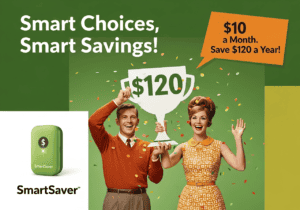
“Save $120 a year” and “just $10 a month” describe the same price.
The frame shapes the emotional response, which shapes the decision.
Cognitive Load and Decision Fatigue
Making decisions consumes mental resources. As a decision sequence becomes longer or more complex, decision quality degrades — a phenomenon documented by Shai Danziger et al. in their work on Israeli parole board decisions (2011), where favorable rulings dropped sharply as judges progressed through their daily case load. Nudge design frequently works by reducing the number of decisions required, or by simplifying the information environment so that the preferred option requires the least cognitive effort to choose.
The rest of this article is reserved for members
To limit scraping bots (currently 40,000 hits per day!),
we had to restrict access to full articles and tools to registered members only.
to access all the rest.
Domande frequenti
How does nudge marketing differ from traditional incentive-based persuasion?
Unlike traditional marketing which relies on direct incentives like discounts or overt persuasion, nudging alters the “choice architecture” to influence behavior without restricting options. It leverages subconscious pregiudizi cognitivi to make the desired action the path of least resistance for the consumer.
What is the strategic role of choice architecture in digital product design?
Choice architecture refers to the intentional design of the environment in which consumers make decisions, such as the order of products on a page or the phrasing of a call-to-action. By organizing these elements strategically, marketers can guide users toward high-value outcomes while maintaining the user’s sense of autonomy.
How does Dual Process Theory (System 1 and System 2) underpin nudge effectiveness?
Nudges primarily target “System 1” thinking, which is fast, automatic, and prone to heuristics, rather than the logical and effortful “System 2.” By appealing to these mental shortcuts, marketers can bypass analytical friction and drive immediate, intuitive conversions.
Why is the “Default Bias” considered the most powerful tool in the nudge arsenal?
Humans have a strong tendency to stick with pre-selected options because they imply a recommendation and minimize the cognitive effort required to choose. Setting the most beneficial or profitable option as the default can significantly increase adoption rates without removing the customer’s ability to opt-out.
How can the “Decoy Effect” be used to optimize high-ticket pricing strategies?
By introducing a third, less attractive “decoy” option, marketers can make a specific target product appear much more valuable by comparison. This technique shifts the consumer’s focus from the absolute price to the relative value, nudging them toward the more expensive “middle” or “premium” tier.
What is the “IKEA Effect” and how does it function as a retention nudge?
The IKEA Effect suggests that consumers place a disproportionately high value on products they have partially created or customized themselves. In marketing, nudging users to invest small amounts of effort—like setting up a profile or customizing a dashboard—creates a psychological “sunk cost” that boosts long-term loyalty.
How do professionals distinguish between ethical nudging and “sludge” or dark patterns?
Ethical nudges are transparent, easy to opt out of, and designed to improve the user’s welfare, whereas “sludge” uses friction to make beneficial actions (like canceling a subscription) intentionally difficult. Professionals use the “transparency test” to ensure that if the nudge were made public, the consumer would still feel the brand is acting in their best interest.
How does “Anchoring” influence price perception during the customer journey?
Anchoring occurs when the first piece of information presented—such as an original “was” price—serves as a mental reference point for all subsequent judgments. By establishing a high anchor early, marketers make the final offer seem like a significant bargain, regardless of its actual market value.
What is the impact of “Social Proof” on conversion velocity in e-commerce?
Social proof nudges, such as “15 people bought this in the last hour,” leverage the human instinct to follow the herd to reduce perceived purchase risk. This technique creates a sense of safety and urgency, effectively shortening the consideration phase of the buyer’s journey.
How should marketers manage “Cognitive Load” to prevent decision paralysis?
When faced with too many choices, consumers often experience “choice overload” and fail to make any decision at all. Nudge marketing solves this by using filters, “expert picks,” or simplified categories to reduce mental effort and guide the user toward a manageable subset of options.
What metrics beyond Conversion Rate (CR) are essential for measuring nudge effectiveness?
Professionals track “Behavioral Lift,” which measures the incremental change in specific actions compared to a control group, and “Persistence,” which evaluates if the behavior continues after the nudge is removed. Additionally, monitoring “Customer Sentiment” ensures that subtle nudges aren’t being perceived as manipulative or annoying over time.
How is AI-driven personalization evolving the future of nudge marketing?
Modern AI combined with massive individual user’s data collection allows for “hyper-nudging,” where choice architecture is dynamically adjusted in real-time based on an individual’s specific behavioral history and psychological profile. This moves the strategy away from “one-size-fits-all” pregiudizi toward personalized interventions that trigger the right heuristic for the right person at the right moment.
Glossario dei termini utilizzati
Conversion Rate (CR): the percentage of visitors to a website or landing page who complete a desired action, such as making a purchase or signing up for a newsletter, calculated by dividing the number of conversions by the total number of visitors.
Software as a Service (SaaS): un modello di distribuzione del software in cui le applicazioni sono ospitate nel cloud e accessibili tramite Internet, in genere tramite abbonamento, consentendo agli utenti di utilizzare il software senza installazione o manutenzione sui dispositivi locali.
User experience (UX): la soddisfazione complessiva e la percezione di un utente quando interagisce con un prodotto, un sistema o un servizio, comprendendo usabilità, accessibilità, design e risposta emotiva durante l'intero processo di interazione.
User Interface (UI): un sistema che consente l'interazione tra utenti e applicazioni software, comprendendo elementi visivi, controlli e layout generale per facilitare le attività dell'utente e migliorare l'esperienza.