Product Design, Manufacturing & Innovation Resources
Casa » Teoria degli insiemi di Zermelo-Fraenkel (ZFC)

Teoria degli insiemi di Zermelo-Fraenkel (ZFC)

1922
  • Ernst Zermelo
  • Abraham Fraenkel
  • Thoralf Skolem
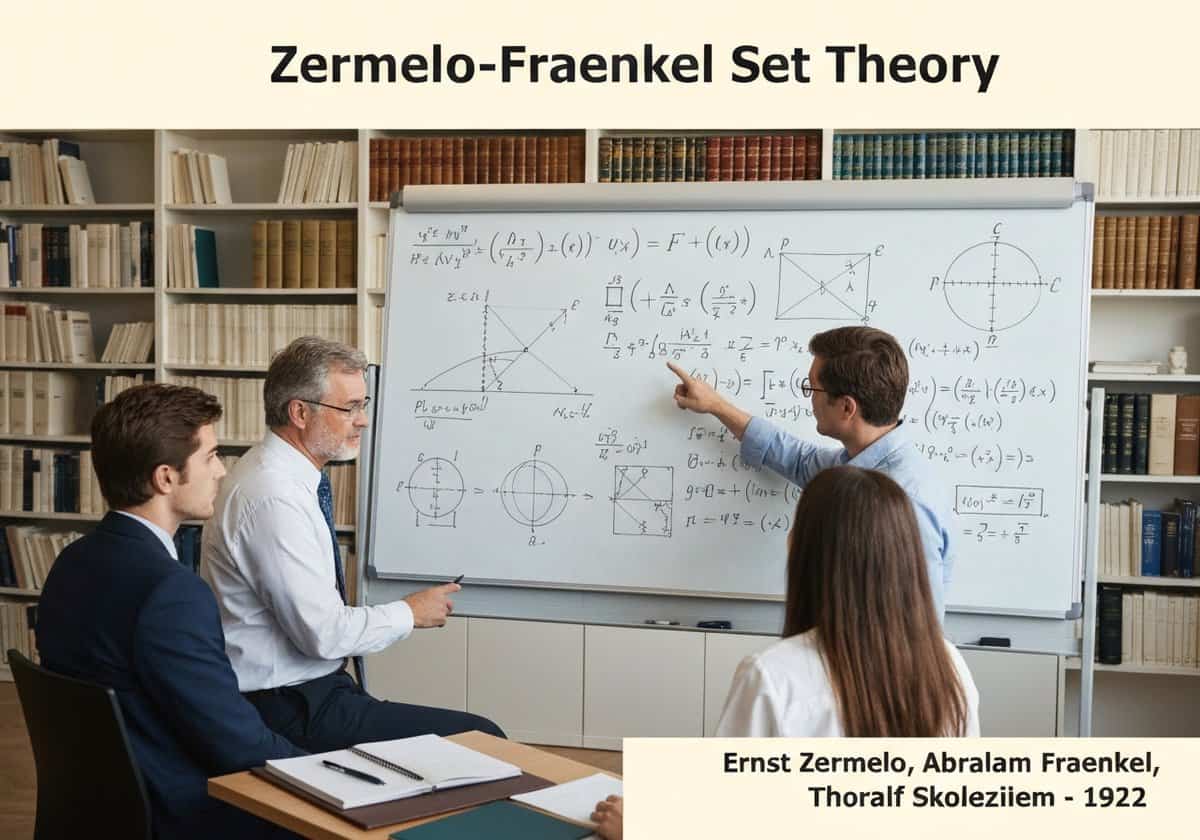
Mathematics office showcasing Zermelo–Fraenkel set theory discussions.

(Immagine generata a solo scopo illustrativo)

La teoria degli insiemi di Zermelo-Fraenkel, comunemente abbreviata in ZFC (con l'assioma di scelta), è il sistema assiomatico standard per la matematica contemporanea. Consiste in una raccolta di assiomi, espressi nella logica del primo ordine, che formalizzano le proprietà degli insiemi. Quasi tutti i teoremi matematici in uso oggi possono essere formulati e dimostrati all'interno di ZFC.

ZFC was developed in the early 20th century to put set theory on a rigorous axiomatic footing, thereby avoiding paradoxes like Russell’s paradox that arose from naive set theory. The axioms define the universe of sets. Key axioms include the Axiom of Extensionality (two sets are equal if they have the same elements), the Axiom of Union (the union of the elements of a set is a set), the Axiom of Power Set (the set of all subsets of a set is a set), and the Axiom Schema of Specification (which allows defining a subset by a property). Abraham Fraenkel and Thoralf Skolem independently proposed the Axiom Schema of Replacement, which is more powerful and necessary for constructing certain large infinite sets. The ‘C’ in ZFC stands for the Axiom of Choice, a powerful and once-controversial axiom stating that for any collection of non-empty sets, it is possible to choose one element from each set. While most mathematicians accept ZFC as the standard foundation, its consistency cannot be proven within ZFC itself, a consequence of Gödel‘s second incompleteness theorem.

UNESCO Nomenclature: 1201
Mondo.innovazione

Tipo

Abstract System

Interruzione

Foundational

Utilizzo

Uso diffuso

Precursori

  • Georg Cantor’s original (naive) set theory
  • Richard Dedekind’s work on the foundations of arithmetic
  • Discovery of paradoxes in naive set theory (e.g., Russell’s paradox)
  • Ernst Zermelo’s initial axiomatization of set theory (1908)

Applicazioni

Brevetti:

NA

Idee e potenziali innovazioni

  • sviluppo della teoria dei modelli nella logica matematica
  • formalizzazione dell'analisi reale e della topologia
  • creazione della teoria dei grandi cardinali
  • assistenti di prova come Coq e Isabelle/HOL che si basano sulla teoria degli insiemi o su teorie di tipo simili
  • fondamenti per la teoria dei database, in particolare modelli relazionali
  • formal semantics for programming languages
  • sviluppo della teoria delle categorie come fondamento alternativo
  • progressi nella teoria descrittiva degli insiemi
  • dimostrazione dell'indipendenza dell'ipotesi del continuo da ZFC
  • quadro per la definizione di strutture dati complesse nell'informatica teorica
Related to: ZFC, set theory, axiom of choice, foundations of mathematics, axiom, Zermelo, Fraenkel, first-order logic, Russell’s paradox, modern mathematics.

Contesto storico

Teoria degli insiemi di Zermelo-Fraenkel (ZFC)

1900
1903
1914
1922
1925
1928
1930
1899
1900
1911
1920
1924
1925
1930
1931

(se la data è sconosciuta o non rilevante, ad esempio "meccanica dei fluidi", viene fornita una stima approssimativa della sua notevole comparsa)

decimo anno anniversario

Le immagini a grandezza naturale e i download sono disponibili, gratuitamente al 100%, solo per gli utenti registrati.

> Login <