Product Design, Manufacturing & Innovation Resources
Casa » Assumptions of ANOVA

Assumptions of ANOVA

1930
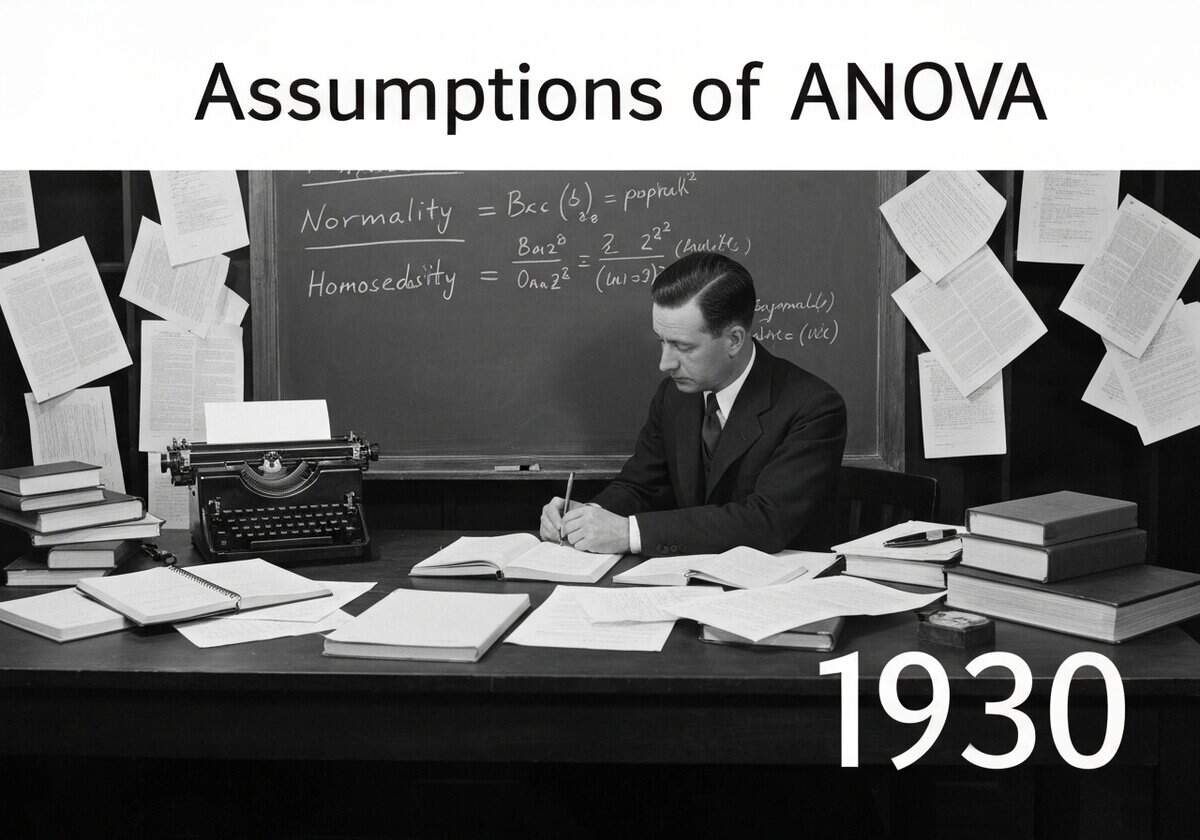
Statistico che convalida le ipotesi di ANOVA in un ufficio degli anni '30.

(Immagine generata a solo scopo illustrativo)

Per i risultati di un ANOVA to be considered valid, several key assumptions about the data dovere be met. These are: (1) Independence of observations, meaning the errors are uncorrelated. (2) Normality, where the residuals for each group are approximately normally distributed. (3) Homoscedasticity, or homogeneity of variances, meaning the variance of residuals is equal across all groups.

These assumptions relate to the residuals (the differences between observed values and the group means), not the raw data itself. Independence is the most critical assumption and is typically ensured by proper experimental design and random sampling; violations can lead to severely biased results. Normality means the distribution of residuals within each group should follow a bell curve. ANOVA is considered relatively robust to moderate violations of this assumption, especially with large and balanced sample sizes, due to the Central Limit Theorem. Homoscedasticity ([latex]\sigma_1^2 = \sigma_2^2 = \dots = \sigma_k^2[/latex]) means the spread or scatter of data points around their group mean should be similar for all groups. Significant violation of this assumption (heteroscedasticity) can increase the rate of Type I errors. Statisticians have developed diagnostic tools to check these assumptions. For example, Q-Q plots can assess normality, and Levene’s test or Bartlett’s test can check for homogeneity of variances. If assumptions are severely violated, researchers may need to transform the data or use alternative statistical methods that do not rely on these assumptions.

UNESCO Nomenclature: 1209
- Statistiche

Tipo

Sistema astratto

Interruzione

Incrementale

Utilizzo

Uso diffuso

Precursori

  • Teorema del limite centrale (Abraham de Moivre, Pierre-Simon Laplace)
  • Theory of the normal distribution (Carl Friedrich Gauss)
  • Concept of statistical residuals from regression models
  • Sviluppo di test di ipotesi formali (Jerzy Neyman, Egon Pearson)

Applicazioni

  • diagnostic checking in statistical modeling to ensure validity
  • guiding data transformation (e.g., log transform to correct for heteroscedasticity)
  • informing the choice of non-parametric alternatives like the Kruskal-Wallis test when assumptions are violated
  • ensuring the reliability of scientific research findings published in peer-reviewed journals
  • validating the results of A/B testing in business analytics

Brevetti:

NA

Idee e potenziali innovazioni

  • automated data science platforms that automatically check assumptions and suggest appropriate tests or transformations
  • sperimentazione clinica software that flags potential data quality issues based on assumption violations in real-time
  • financial risk models that incorporate tests for heteroscedasticity to improve volatility prediction
  • machine learning model validation modules that use these principles to check residual distributions
  • educational software that provides interactive visualizations to help students understand the impact of violating each assumption
  • a browser extension for researchers that scans online datasets and reports on their suitability for ANOVA
  • an integrated development environment (IDE) plugin for R or Python that provides inline warnings about potential assumption violations in statistical code
  • quality control systems that monitor not just the mean but also the variance of a process to detect instability
  • environmental science software that validates sensor network data by checking for spatial independence
  • UN bioinformatica tool that recommends specific statistical tests based on the characteristics of gene expression data
Argomenti correlati: presupposti dell'ANOVA, indipendenza, normalità, omoschedasticità, residui, test di Levene, test di Shapiro-Wilk, robustezza, validità statistica, diagnostica dei dati.

Contesto storico

Assumptions of ANOVA

1922
1925
1928
1930
1936
1940
1943
1920
1924
1925
1930
1931
1939
1940
1950

(se la data è sconosciuta o non rilevante, ad esempio "meccanica dei fluidi", viene fornita una stima approssimativa della sua notevole comparsa)

decimo anno anniversario

Le immagini a grandezza naturale e i download sono disponibili, gratuitamente al 100%, solo per gli utenti registrati.

> Login <