Rivestimento a rotazione per deposizione di film sottili
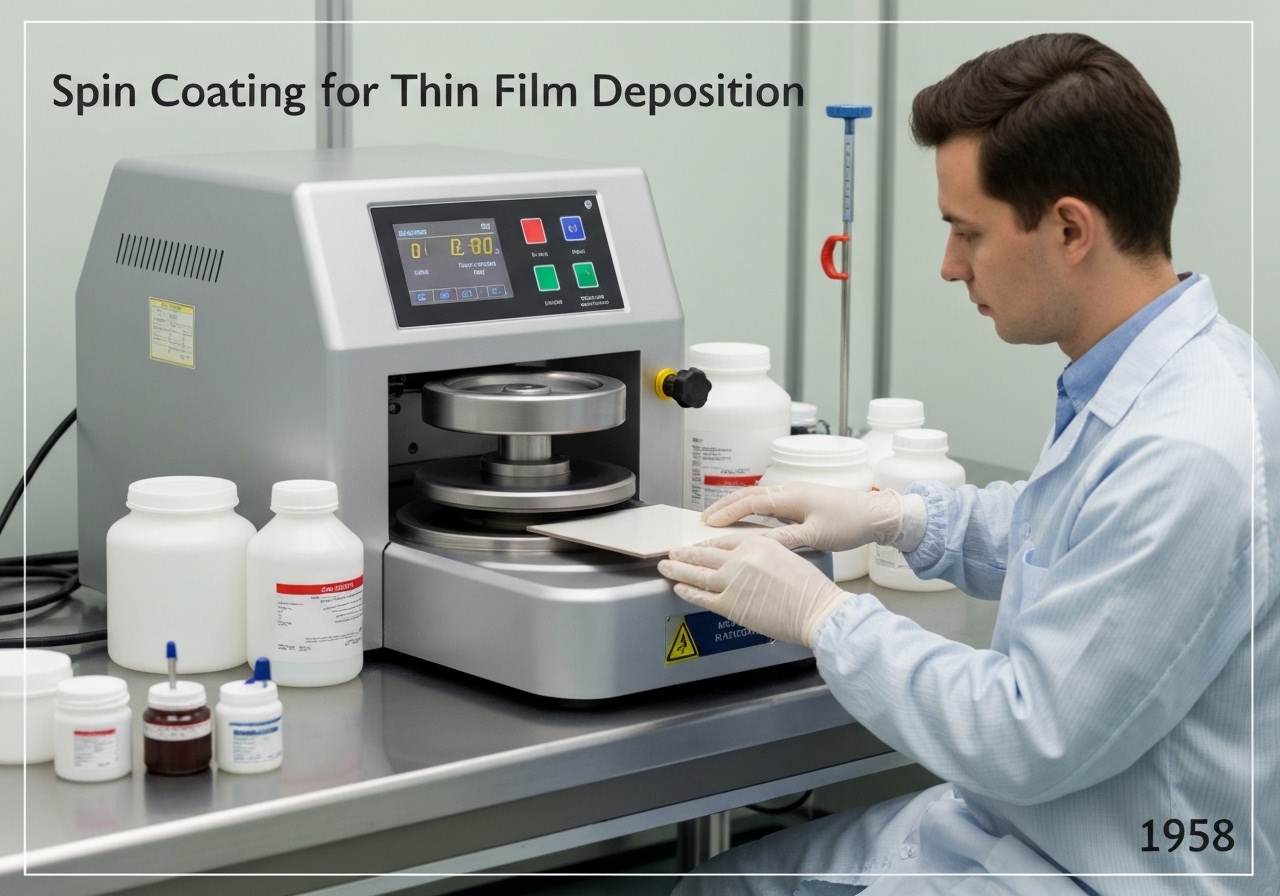
Rotazione rivestimento is a procedure for depositing uniform thin films onto flat substrates. An excess of a coating solution is placed on the substrate, which is then rotated at high speed. Centrifugal force spreads the solution, and solvent evaporation or curing solidifies the film, with the final thickness determined by viscosità, concentrazione e velocità di rotazione.
The spin coating process is divided into four main stages: deposition, spin-up, spin-off, and evaporation. In the deposition stage, an excess of the coating fluid is dispensed onto the substrate’s surface. During the spin-up stage, the substrate is rapidly accelerated to its final, desired rotation speed, causing the fluid to flow radially outward due to centrifugal force. The spin-off stage follows, where the excess fluid is ejected from the substrate’s edge, and the film thins. The final stage is evaporation, where the solvent evaporates from the film, leaving behind the solid coating. The thickness of the resulting film is highly dependent on several parameters. The key relationship was modeled by Emslie, Bonner, and Peck, showing that the final film thickness [latex]h_f[/latex] is proportional to the inverse square root of the angular velocity [latex]\omega[/latex], the initial solution concentration, and the solvent evaporation rate, and is also a function of the fluid viscosity [latex]\nu[/latex]. The formula is often simplified as [latex]h_f \propto \omega^{-1/2}[/latex]. This technique is favored for its simplicity, speed, and ability to produce highly uniform films with thicknesses ranging from a few nanometers to several micrometers on a laboratory scale. However, it is inherently a batch process and can be wasteful, as a significant portion of the initial solution is flung off the substrate.
UNESCO Nomenclature: 3322
- Tecnologia dei materiali
Interruzione
Incrementale
Precursori
- scoperta della forza centrifuga da parte di Christiaan Huygens
- sviluppo del motore elettrico
- sintesi di polimeri solubili e fotoresist
- comprensione della dinamica dei fluidi e dei principi di evaporazione del solvente
Applicazioni
- fabbricazione di dispositivi microelettronici e semiconduttori
- produzione di rivestimenti ottici come strati antiriflesso
- creazione di diodi organici a emissione di luce (OLED)
- produzione di compact disc (CD) e dischi versatili digitali (DVD)
- ricerca e sviluppo di nuovi materiali e sensori
Idee e potenziali innovazioni
A causa dell'eliminazione del traffico generato dai bot, che attualmente supera i 40.000 al giorno, questo contenuto è riservato ai membri della community.
> Accedi O > Registrati L'accesso a questo contenuto, così come a tutti gli altri contenuti e strumenti riservati, è (100% gratuito).
Argomenti correlati: spin coating, film sottile, deposizione, substrato, forza centrifuga, semiconduttore, fotolitografia, soluzione polimerica, rivestimento uniforme, scienza dei materiali.