Product Design, Manufacturing & Innovation Resources
Casa » Teorema di Bayes

Teorema di Bayes

1763-12-23
  • Thomas Bayes
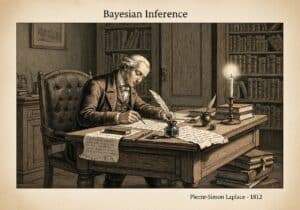
  • Pierre-Simon Laplace
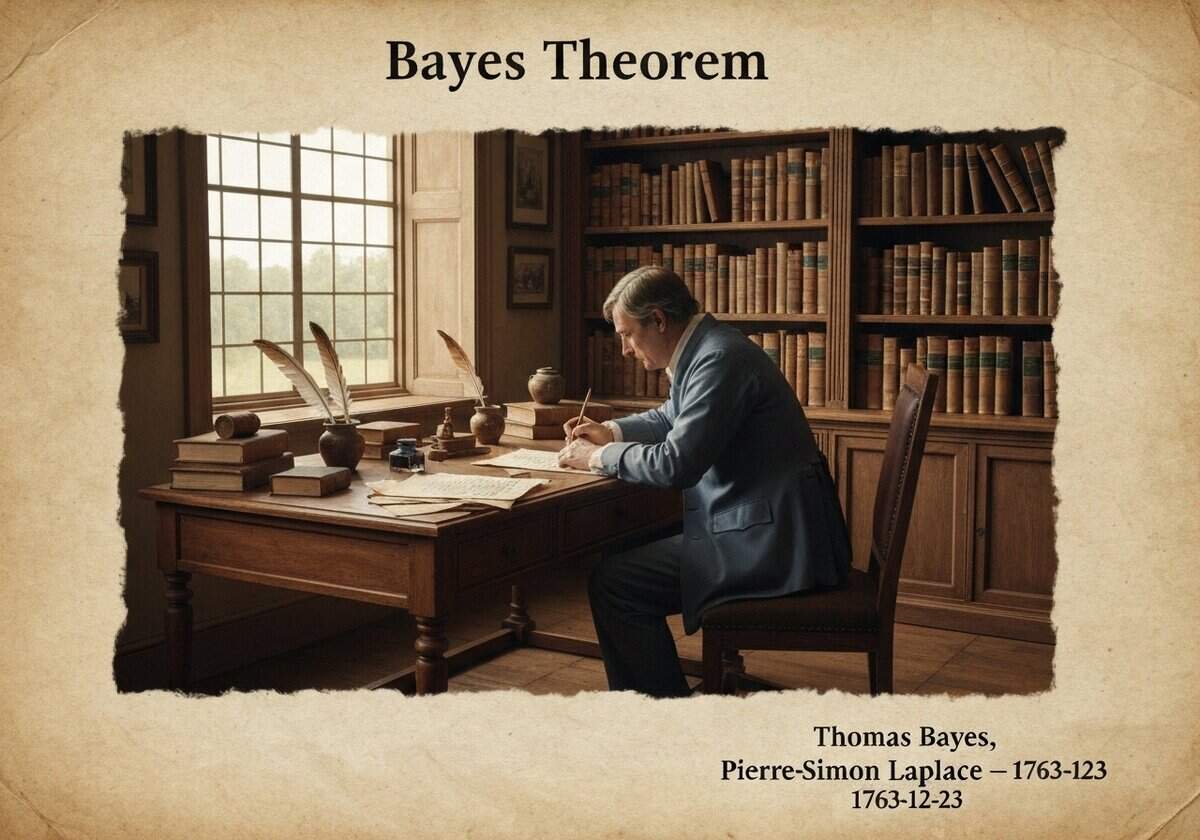
Historical study room with mathematician calculating Bayes' theorem.

(Immagine generata a solo scopo illustrativo)

Bayes’ theorem describes the probability of an event based on prior knowledge of conditions that might be related to the event. It is a fundamental concept in probability theory and statistics. Mathematically, it is stated as [latex]P(A|B) = \frac{P(B|A)P(A)}{P(B)}[/latex], where A and B are events and [latex]P(B) \neq 0[/latex]. It relates the conditional and marginal probabilities of two random events.

Bayes’ Theorem provides a mathematical way to update existing beliefs with new evidence. In the formula [latex]P(A|B) = \frac{P(B|A)P(A)}{P(B)}[/latex], [latex]P(A|B)[/latex] is the posterior probability: the probability of hypothesis A given the evidence B. [latex]P(B|A)[/latex] is the likelihood: the probability of observing evidence B if hypothesis A is true. [latex]P(A)[/latex] is the prior probability: the initial belief in hypothesis A before seeing evidence B. Finally, [latex]P(B)[/latex] is the marginal likelihood or evidence: the total probability of observing the evidence B under all possible hypotheses. This term serves as a normalization constant, ensuring the posterior probabilities sum to one.

The theorem was first presented in Thomas Bayes’s essay “An Essay towards solving a Problem in the Doctrine of Chances,” which was read to the Royal Society in 1763 after his death. However, it was Pierre-Simon Laplace who independently developed and popularized the theorem, applying it to problems in celestial mechanics, medical statistics, and jurisprudence. The novelty of the theorem was its formalization of inverse probability—reasoning from effects back to their causes. While classical (frequentist) statistics focuses on the probability of data given a hypothesis, Bayesian statistics focuses on the probability of the hypothesis given the data, which is often a more intuitive and direct answer to scientific questions.

UNESCO Nomenclature: 1208
- Statistiche

Tipo

Sistema astratto

Interruzione

Rivoluzionario

Utilizzo

Uso diffuso

Precursori

  • Teoria generale della probabilità (sviluppata da Pascal, Fermat, Bernoulli)
  • Concetto di probabilità condizionata
  • Lavori sui problemi di probabilità inversa di matematici precedenti

Applicazioni

  • Filtraggio antispam nei client di posta elettronica
  • Test diagnostici medici
  • Algoritmi di apprendimento automatico (ad esempio, classificatori Naive Bayes)
  • Operazioni di ricerca e soccorso
  • Modellazione ecologica
  • Previsione del mercato finanziario

Brevetti:

NA

Idee e potenziali innovazioni

A causa dell'eliminazione del traffico generato dai bot, che attualmente supera i 40.000 al giorno, questo contenuto è riservato ai membri della community.
> Accedi O > Registrati L'accesso a questo contenuto, così come a tutti gli altri contenuti e strumenti riservati, è (100% gratuito).

Correlato a: teorema di Bayes, probabilità condizionata, a posteriori, a priori, verosimiglianza, statistica bayesiana, probabilità inversa, Thomas Bayes, Laplace, evidenza.

Contesto storico

Teorema di Bayes

1650
1736
1750
1763-12-23
1780
1805
1822
1640
1650
1747
1758
1777
1799
1812
1822

(se la data è sconosciuta o non rilevante, ad esempio "meccanica dei fluidi", viene fornita una stima approssimativa della sua notevole comparsa)

Invenzioni, innovazioni e principi tecnici correlati

Le immagini a grandezza naturale e i download sono disponibili, 100% gratuitamente, solo per i membri registrati.

> Login <