Product Design, Manufacturing & Innovation Resources
Casa » Serie di Fourier

Serie di Fourier

1822
  • Jean-Baptiste Joseph Fourier
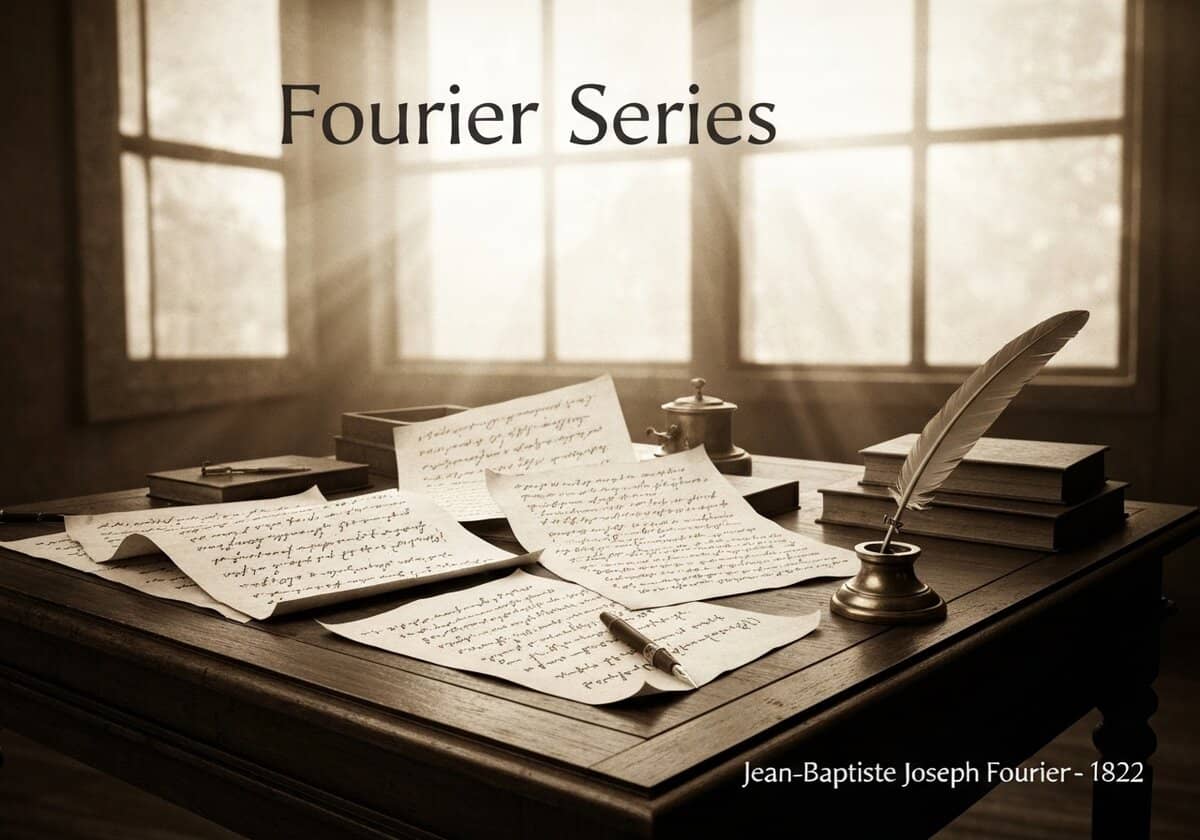
Studio antico con equazioni delle serie di Fourier, penna d'oca e compasso in un ambiente vintage.

(Immagine generata a solo scopo illustrativo)

UN Fourier series decomposes any periodic function or signal into a sum of simple oscillating functions, namely sines and cosines. For a function [latex]s(x)[/latex] with period [latex]P[/latex], the series is given by [latex]s(x) \approx \frac{a_0}{2} + \sum_{n=1}^{\infty} \left[ a_n \cos\left(\frac{2\pi n x}{P}\right) + b_n \sin\left(\frac{2\pi n x}{P}\right)\right][/latex]. The terms [latex]a_n[/latex] and [latex]b_n[/latex] are the Fourier coefficients.

The concept of a Fourier series is a cornerstone of harmonic analysis. It posits that a wide class of periodic functions can be represented or approximated by an infinite sum of sine and cosine functions. This idea was formally introduced by Joseph Fourier in his work on heat conduction. The function [latex]s(x)[/latex] must be periodic over an interval of length [latex]P[/latex]. The term [latex]frac{a_0}{2}[/latex] represents the DC component, or the average value of the function over one period. Each subsequent term in the summation, indexed by [latex]n[/latex], is a harmonic. The [latex]n=1[/latex] term is the fundamental frequency, and higher values of [latex]n[/latex] correspond to its integer multiples, or overtones.

The coefficients [latex]a_n[/latex] and [latex]b_n[/latex] determine the amplitude of each cosine and sine wave, respectively. They are calculated by integrating the product of the original function [latex]s(x)[/latex] with the corresponding basis function (cosine or sine) over one period. This process leverages the orthogonality of the sine and cosine functions over the interval [latex][0, P][/latex]. The convergence of the series to the original function is not guaranteed for all functions but holds under certain conditions, such as the Dirichlet conditions. This decomposition is powerful because it transforms a problem in the time or spatial domain into the frequency domain, where analysis can often be simplified.

UNESCO Nomenclature: 1201
- Algebra

Tipo

Sistema astratto

Interruzione

Rivoluzionario

Utilizzo

Uso diffuso

Precursori

  • serie trigonometriche opera di Leonhard Euler
  • solutions to the wave equation by Daniel Bernoulli
  • lavoro sulle corde vibranti di Jean Le Rond d'Alembert
  • foundations of calculus by Isaac Newton and Gottfried Leibniz

Applicazioni

Brevetti:

NA

Idee e potenziali innovazioni

  • real-time spectral analysis for diagnostica per immagini (mri)
  • cancellazione adattiva del rumore nei dispositivi audio di consumo
  • algoritmi di compressione per lo streaming di video ad alta definizione
  • modellazione predittiva delle fluttuazioni del mercato azionario utilizzando componenti di frequenza
  • monitoraggio non invasivo della salute strutturale dei ponti mediante analisi delle vibrazioni
  • composizione musicale basata sull'intelligenza artificiale basata sulla decomposizione armonica
  • algoritmi di calcolo quantistico per l'elaborazione del segnale
  • advanced data crittografia using frequency-domain transformations
  • esplorazione geofisica mediante decomposizione delle onde sismiche
  • profili di equalizzazione audio personalizzati per apparecchi acustici
Related to: Fourier series, periodic function, harmonic analysis, sine, cosine, Fourier coefficients, signal decomposition, frequency domain, equazione del calore, Joseph Fourier.

Contesto storico

Serie di Fourier

1777
1799
1812
1822
1827
1829
1850
1763-12-23
1780
1805
1822
1822
1828
1848
1850

(se la data è sconosciuta o non rilevante, ad esempio "meccanica dei fluidi", viene fornita una stima approssimativa della sua notevole comparsa)

decimo anno anniversario

Le immagini a grandezza naturale e i download sono disponibili, gratuitamente al 100%, solo per gli utenti registrati.

> Login <