Thermite Ignition and Propagation
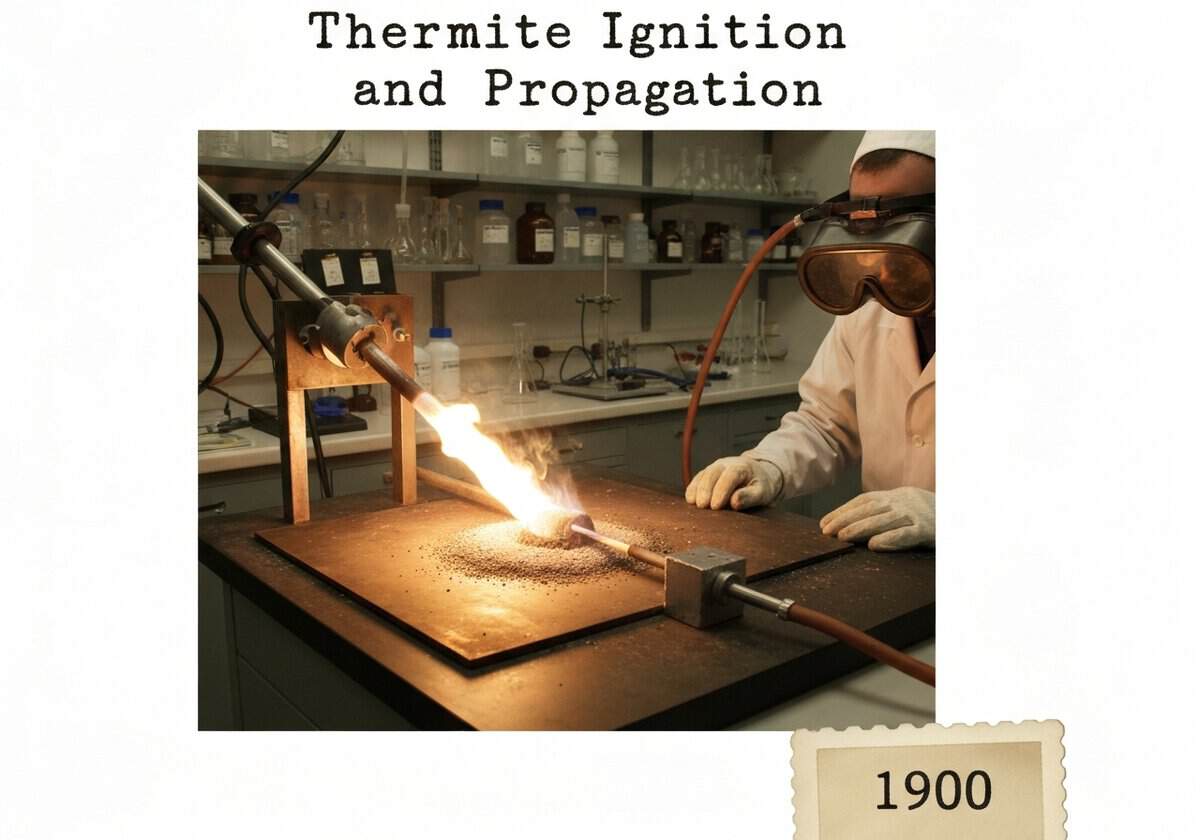
Thermite possesses a very high activation energy, making it stable at room temperature and difficult to ignite. Ignition requires reaching temperatures of approximately 1,300 °C (2,400 °F). This is typically achieved not with a direct flame but with an intermediate, high-temperature initiator like a burning magnesium ribbon or a specially designed pyrotechnic fuse, which provides the necessary localized energy to start the reaction.
The high ignition temperature of thermite is a direct consequence of its reaction mechanism, which is a solid-state reaction. Unlike gas or liquid-phase reactions where reactants are mobile and mix freely, in thermite, the aluminum and metal oxide particles are initially in solid form. For the reaction to begin, atoms must gain enough kinetic energy to overcome the energy barrier for diffusion and bond rearrangement at the particle interfaces. This requires a significant input of thermal energy, defining its high activation energy.
A simple match or propane torch does not provide a sufficiently high temperature or energy density to initiate the self-sustaining reaction. The standard method involves using a material that burns at a very high temperature. Magnesium ribbon is a classic initiator, as its combustion in air (\(2Mg + O_2 \rightarrow 2MgO\)) reaches temperatures of about 2,200 °C, well above thermite’s ignition point. Other initiators include sparklers (which contain metal powders and oxidizers) or mixtures like potassium permanganate and glycerin, which react hypergolically. Once a small portion of the thermite mixture is ignited, the immense heat it releases is transferred to the adjacent material, causing the reaction to propagate in a wave-like front through the entire mixture. The speed of this propagation depends on factors like stoichiometry, particle size, and packing density. Finer powders with greater surface area react faster, while denser packing improves thermal conductivity, aiding propagation. This high activation energy is a crucial safety feature, preventing accidental ignition while allowing for deliberate and controlled use.
UNESCO Nomenclature: 2207
– Physical chemistry
Precursors
- the arrhenius equation, relating reaction rate to temperature and activation energy
- discovery and characterization of magnesium’s high-temperature combustion properties
- the concept of activation energy in chemical reactions, proposed by svante arrhenius
- studies in heat transfer and thermal conductivity in solid materials
Applications
- design of safe handling and storage procedures for thermite mixtures
- development of reliable fuses for military incendiary devices
- controlled and predictable initiation of exothermic welding processes
- creation of high-delay, high-energy pyrotechnic effects
- use in laboratory settings for high-temperature material synthesis
Potential Innovations Ideas
Due to scrapping bot traffic, currently more than 40k per day, this content is reserved to community members.
> Login < or > Register < (100% free) to access this, so as all other restricted content and tools.
Related to: activation energy, ignition temperature, magnesium ribbon, fuse, chemical kinetics, self-sustaining reaction, exothermic, combustion, pyrotechnics, initiator.