Product Design, Manufacturing & Innovation Resources
Home » Thermate Composition

Thermate Composition

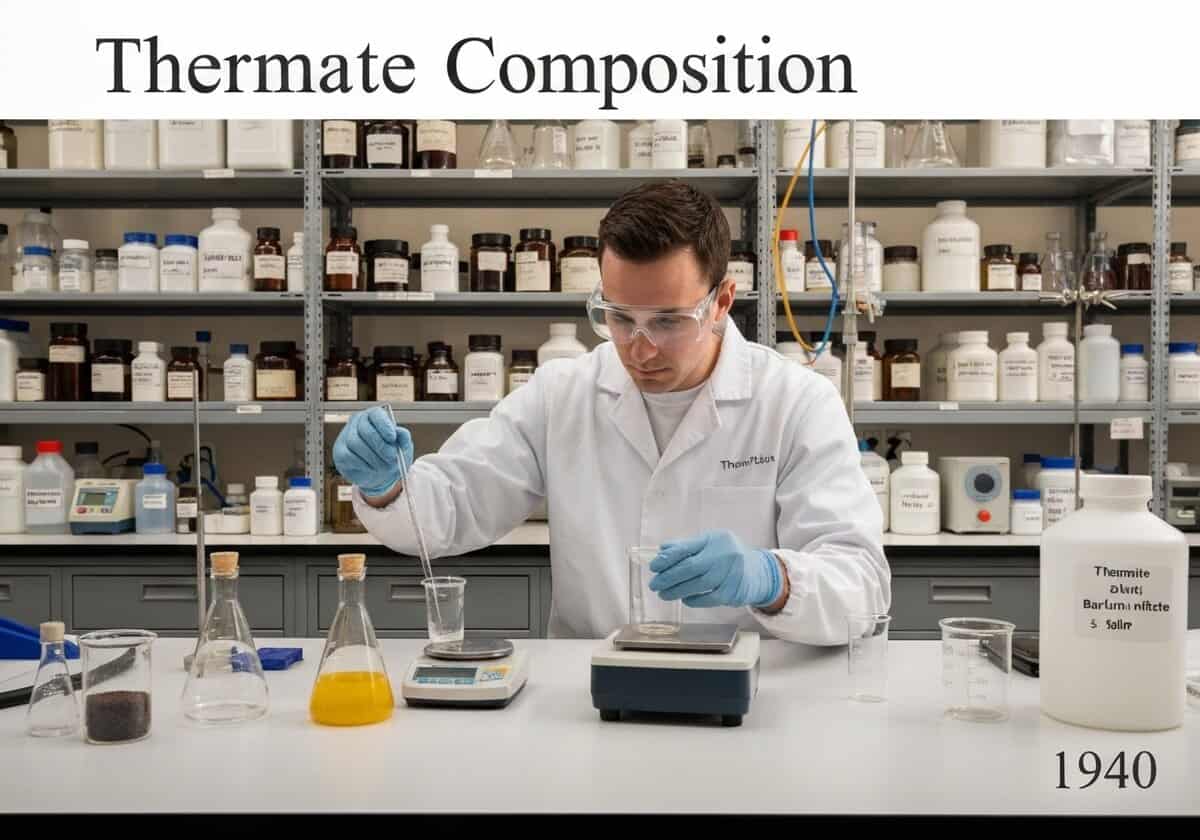
1940
Laboratory scene with chemist measuring thermate composition for incendiary applications.

(generated image for illustration only)

Thermate is an incendiary composition that enhances standard thermite. It is typically a mixture of thermite, barium nitrate (\(Ba(NO_3)_2\)), and sulfur. The barium nitrate acts as an oxidizer, increasing the thermal output and making the reaction less dependent on atmospheric oxygen. Sulfur is added primarily to lower the ignition temperature, making the mixture easier and more reliably ignited.

Thermate was developed to improve upon the properties of thermite for military incendiary applications. While standard thermite is effective at melting through steel, its utility can be limited by its very high ignition temperature and its reliance on a solid-state reaction. Thermate addresses these issues through chemical additives. The primary additive, barium nitrate, is a salt containing a high percentage of oxygen. When heated, it decomposes and releases this oxygen, which then participates in the combustion. This makes the reaction more vigorous and produces a more significant flame effect, which is useful for igniting surrounding materials. It also allows the mixture to burn more effectively in enclosed spaces or even underwater, where access to atmospheric oxygen is limited.

The second key additive is sulfur. Its role is to lower the activation energy of the overall reaction. Sulfur forms low-melting-point eutectics with the other components, which facilitates the initiation of the reaction at a lower temperature than pure thermite. This makes ignition more reliable, a critical factor for military ordnance. Sometimes, a binder (like polybutadiene acrylonitrile) is also added to the mixture to create a more solid, stable charge that can be cast into specific shapes. The combination of these components results in a material that is easier to ignite, burns more energetically, and is more effective as a general-purpose incendiary agent than thermite alone. The AN-M14 TH3 grenade, used by the U.S. military, is a classic example, capable of burning through a half-inch steel plate and destroying sensitive equipment.

UNESCO Nomenclature: 2206
– Inorganic chemistry

Type

Material

Disruption

Substantial

Usage

Niche/Specialized

Precursors

  • the invention of the goldschmidt process (thermite)
  • the historical use of nitrates (e.g., potassium nitrate in gunpowder) as oxidizers
  • understanding of eutectic mixtures and their effect on melting points
  • the need for improved incendiary weapons during world war ii

Applications

  • incendiary grenades, such as the us an-m14 th3 grenade
  • cutting tools for military sabotage or demolition of enemy equipment
  • underwater cutting and welding applications where atmospheric oxygen is absent
  • pyrotechnic flares and signals requiring a brilliant, high-temperature flame

Patents:

    Potential Innovations Ideas

    Due to scrapping bot traffic, currently more than 40k per day, this content is reserved to community members.
    > Login < or > Register < (100% free) to access this, so as all other restricted content and tools.

    Related to: thermate, thermite variant, barium nitrate, sulfur, incendiary, pyrotechnics, oxidizer, an-m14, military, composite material.

    Historical Context

    Thermate Composition

    1932
    1936-01-01
    1938
    1940
    1950
    1950
    1950
    1932
    1933
    1937
    1940
    1947
    1950
    1950
    1950

    (if date is unknown or not relevant, e.g. "fluid mechanics", a rounded estimation of its notable emergence is provided)

    Related Invention, Innovation & Technical Principles

    Full size images and downloads are only available, 100% free, for registered members.

    > Login <