Product Design, Manufacturing & Innovation Resources
Home » PFAS Bioaccumulation and Biomagnification

PFAS Bioaccumulation and Biomagnification

2000
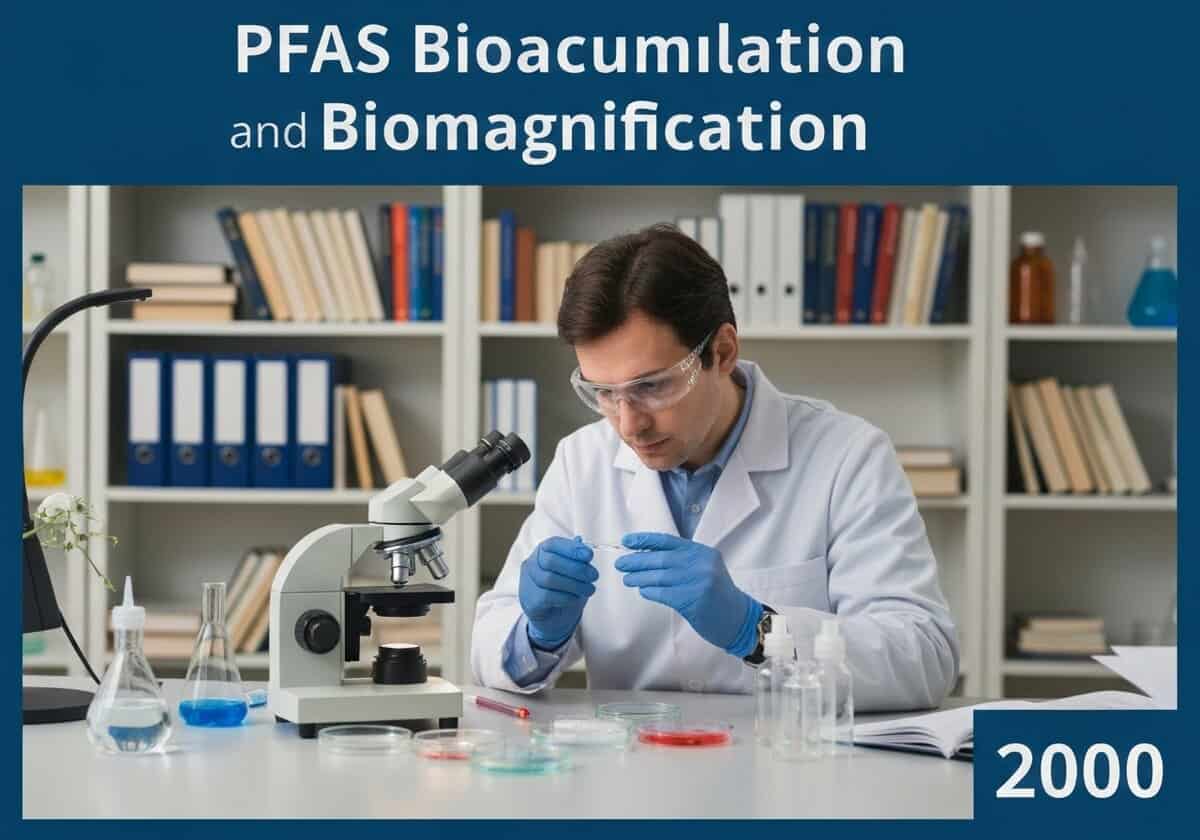
Toxicologist analyzing fish samples for PFAS in a laboratory setting.

(generated image for illustration only)

Unlike many persistent organic pollutants that accumulate in fatty tissues, long-chain PFAS like PFOA and PFOS primarily bind to proteins in the blood serum (e.g., albumin) and accumulate in well-perfused organs like the liver. This leads to bioaccumulation within an organism and biomagnification up the food chain, resulting in higher concentrations in apex predators, including humans.
The environmental behavior of long-chain PFAS is distinct from classical persistent organic pollutants (POPs) like PCBs or DDT. While traditional POPs are lipophilic (fat-loving) and accumulate in adipose tissue, the amphiphilic nature of PFAS (having both a hydrophobic/lipophobic tail and a hydrophilic head) dictates a different biological fate. The charged functional group (e.g., carboxylate in PFOA or sulfonate in PFOS) interacts with proteins. Specifically, these compounds bind to serum albumin in the blood and fatty acid-binding proteins within cells. This protein-binding mechanism facilitates their transport throughout the body and leads to accumulation in protein-rich tissues and organs with high blood flow, such as the liver, kidneys, and blood itself. Because they are not easily metabolized or excreted, their biological half-life in humans can be several years. This persistence within a single organism is the basis for bioaccumulation. As organisms are consumed by others higher up the food web, the concentration of PFAS increases at each trophic level, a process known as biomagnification. This is why top predators like polar bears, dolphins, and humans often exhibit the highest levels of PFAS contamination.

UNESCO Nomenclature: 2512
– Toxicology

Type

Biological Process

Disruption

Incremental

Usage

Widespread Use

Precursors

  • understanding of food webs and trophic levels
  • development of analytical chemistry techniques (e.g., LC-MS/MS) to detect low concentrations of chemicals in biological tissues
  • the concept of bioaccumulation established with earlier pollutants like ddt and mercury
  • studies on protein binding of pharmaceuticals

Applications

  • development of public health advisories for fish consumption
  • environmental regulations limiting pfas discharge (e.g., stockholm convention)
  • biomonitoring programs to track human exposure levels
  • toxicological models to predict health risks

Patents:

NA

Potential Innovations Ideas

Due to scrapping bot traffic, currently more than 40k per day, this content is reserved to community members.
> Login < or > Register < (100% free) to access this, so as all other restricted content and tools.

Related to: bioaccumulation, biomagnification, pfas, pfoa, pfos, toxicology, persistent organic pollutants, serum albumin, environmental fate, food chain.

Historical Context

PFAS Bioaccumulation and Biomagnification

1990
1990
1990
2000
2006
1990
1990
1990
1993
2001-09-01

(if date is unknown or not relevant, e.g. "fluid mechanics", a rounded estimation of its notable emergence is provided)

Related Invention, Innovation & Technical Principles

Full size images and downloads are only available, 100% free, for registered members.

> Login <