Product Design, Manufacturing & Innovation Resources
Home » Meissner Effect

Meissner Effect

1933
  • Walther Meissner
  • Robert Ochsenfeld
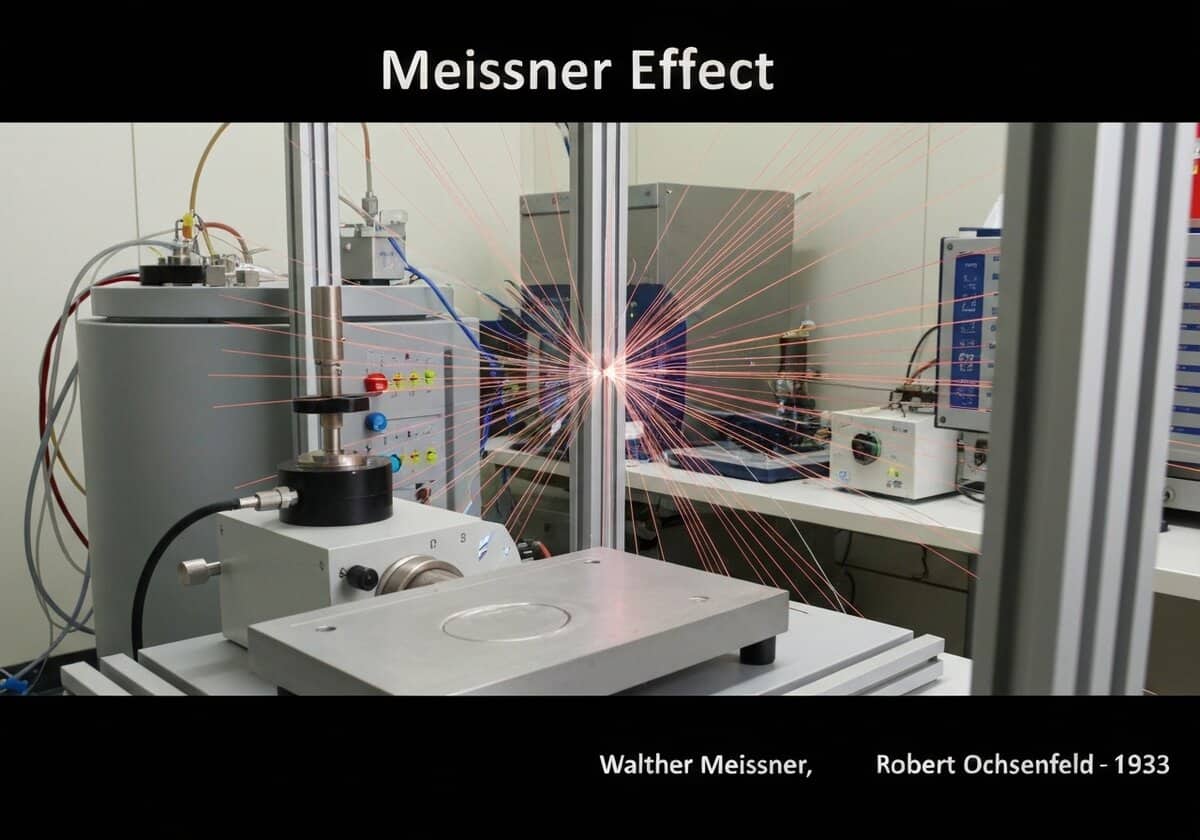
Superconductor in laboratory demonstrating Meissner effect in solid state physics.

(generated image for illustration only)

Discovered in 1933 by Walther Meissner and Robert Ochsenfeld, the Meissner effect is the expulsion of a magnetic field from a superconductor during its transition to the superconducting state. When a material is cooled below its critical temperature (\(T_c\)) in the presence of a weak external magnetic field, it actively cancels all magnetic flux inside it, becoming a perfect diamagnet.


The Meissner effect is a defining characteristic of superconductivity, distinguishing it from a hypothetical perfect conductor. A perfect conductor, according to Lenz’s law, would trap any existing magnetic field inside it as it cools, because changing the flux would induce currents to oppose the change. In contrast, a superconductor actively expels the field. This expulsion is achieved by the generation of screening currents on the surface of the material. These currents create a magnetic field that perfectly cancels the external field within the bulk of the superconductor. The magnetic field penetrates only a small distance into the surface, known as the London penetration depth (\(\lambda\)). This discovery was crucial because it showed that superconductivity is a true thermodynamic phase transition, not just a case of infinite conductivity. It provided a key piece of the puzzle that any microscopic theory of superconductivity would have to explain. The effect is the basis for the dramatic levitation demonstrations where a magnet floats above a high-temperature superconductor cooled with liquid nitrogen. The expulsion of the magnet’s field by the superconductor creates a repulsive force strong enough to counteract gravity.

The Meissner effect breaks down when the applied magnetic field is too strong. For Type I superconductors, superconductivity is abruptly destroyed above a critical field \(H_c\). For Type II superconductors, the field begins to penetrate the material in the form of quantized flux vortices above a lower critical field \(H_{c1}\), while the material remains superconducting until a much higher upper critical field \(H_{c2}\).

UNESCO Nomenclature: 2211
– Solid state physics

Type

Physical Property

Disruption

Foundational

Usage

Widespread Use

Precursors

  • discovery of superconductivity (1911)
  • Maxwell’s equations of electromagnetism
  • Lenz’s law
  • understanding of diamagnetism

Applications

  • maglev trains (magnetic levitation)
  • superconducting magnetic bearings
  • diagnostics of superconducting materials
  • demonstrations of quantum phenomena

Patents:

NA

Potential Innovations Ideas

Due to scrapping bot traffic, currently more than 40k per day, this content is reserved to community members.
> Login < or > Register < (100% free) to access this, so as all other restricted content and tools.

Related to: Meissner effect, superconductivity, diamagnetism, magnetic field expulsion, London penetration depth, critical temperature, Type I superconductor, screening currents, magnetic levitation, phase transition.

Historical Context

Meissner Effect

1930
1931
1932
1933
1937
1940
1947
1930
1930
1931
1932
1936-01-01
1938
1940
1950

(if date is unknown or not relevant, e.g. "fluid mechanics", a rounded estimation of its notable emergence is provided)

Related Invention, Innovation & Technical Principles

Full size images and downloads are only available, 100% free, for registered members.

> Login <