Product Design, Manufacturing & Innovation Resources
Home » ISO 5725 Definition of Accuracy

ISO 5725 Definition of Accuracy

1994
  • International Organization for Standardization (ISO)
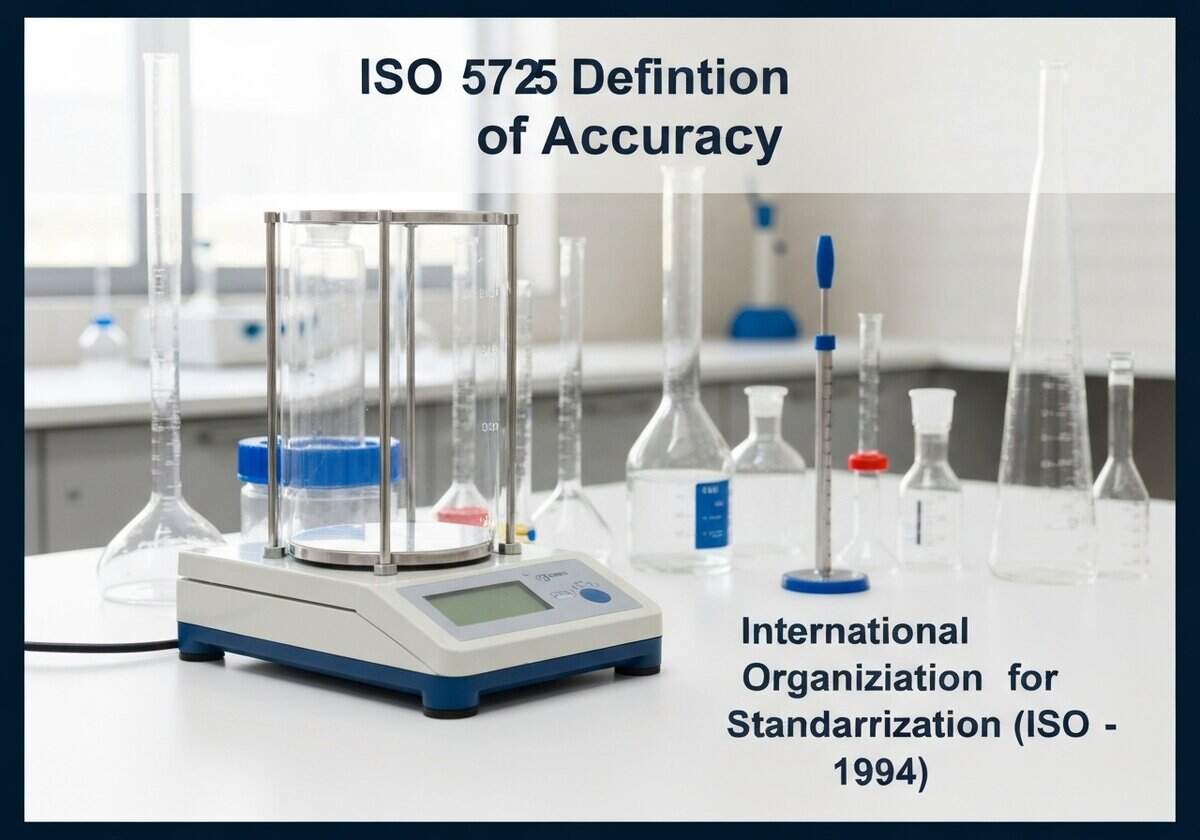
Precision balance scale and calibrated glassware in a laboratory for metrology applications.

(generated image for illustration only)

The ISO 5725 standard defines accuracy as the combination of trueness and precision. Trueness is the closeness of the mean of a large series of measurements to the accepted reference value, quantifying systematic error or bias. Precision is the closeness of agreement among a set of results, quantifying random error. Thus, accuracy requires both high trueness and high precision.


The International Organization for Standardization (ISO) standard 5725, “Accuracy (trueness and precision) of measurement methods and results,” provides a formal framework to avoid the ambiguity of the common term ‘accuracy’. By decomposing accuracy into two distinct components, it allows for a more rigorous analysis of measurement error. ‘Trueness’ is a qualitative concept that is expressed quantitatively as ‘bias’. It measures how far the mean of a large set of measurements deviates from the true or accepted reference value. A measurement method with high trueness has low systematic error.

‘Precision’ under ISO 5725 is further subdivided into ‘repeatability’ and ‘reproducibility’. Repeatability refers to the variation in measurements taken by a single person or instrument on the same item and under the same conditions (short-term variation). Reproducibility describes the variation arising when using the same measurement process among different instruments, operators, or laboratories (long-term variation). A measurement method is precise if it has small random errors, leading to low variability under both repeatability and reproducibility conditions. Therefore, according to ISO 5725, a measurement is ‘accurate’ only if it is both true (low bias) and precise (low random variation).

UNESCO Nomenclature: 2208
– Metrology

Type

Abstract System

Disruption

Substantial

Usage

Widespread Use

Precursors

  • Earlier statistical work on error analysis by figures like Ronald Fisher
  • The need for international harmonization in trade and science
  • Development of quality management systems like iso 9000
  • Previous national standards on measurement uncertainty

Applications

  • laboratory quality assurance (e.g., iso/iec 17025)
  • chemical analysis and analytical chemistry
  • manufacturing process control
  • clinical laboratory testing
  • environmental monitoring and compliance

Patents:

NA

Potential Innovations Ideas

Due to scrapping bot traffic, currently more than 40k per day, this content is reserved to community members.
> Login < or > Register < (100% free) to access this, so as all other restricted content and tools.

Related to: iso 5725, trueness, precision, accuracy, bias, repeatability, reproducibility, metrology.

Historical Context

ISO 5725 Definition of Accuracy

1985
1986
1990
1994
1997
2002
2015-09-14
1984
1986
1986
1991
1995
2000
2004

(if date is unknown or not relevant, e.g. "fluid mechanics", a rounded estimation of its notable emergence is provided)

Related Invention, Innovation & Technical Principles

Full size images and downloads are only available, 100% free, for registered members.

> Login <