Product Design, Manufacturing & Innovation Resources
Home » Greenhouse Gas Protocol Emission Scopes

Greenhouse Gas Protocol Emission Scopes

2001-09-01
  • World Resources Institute (WRI)
  • World Business Council for Sustainable Development (WBCSD)
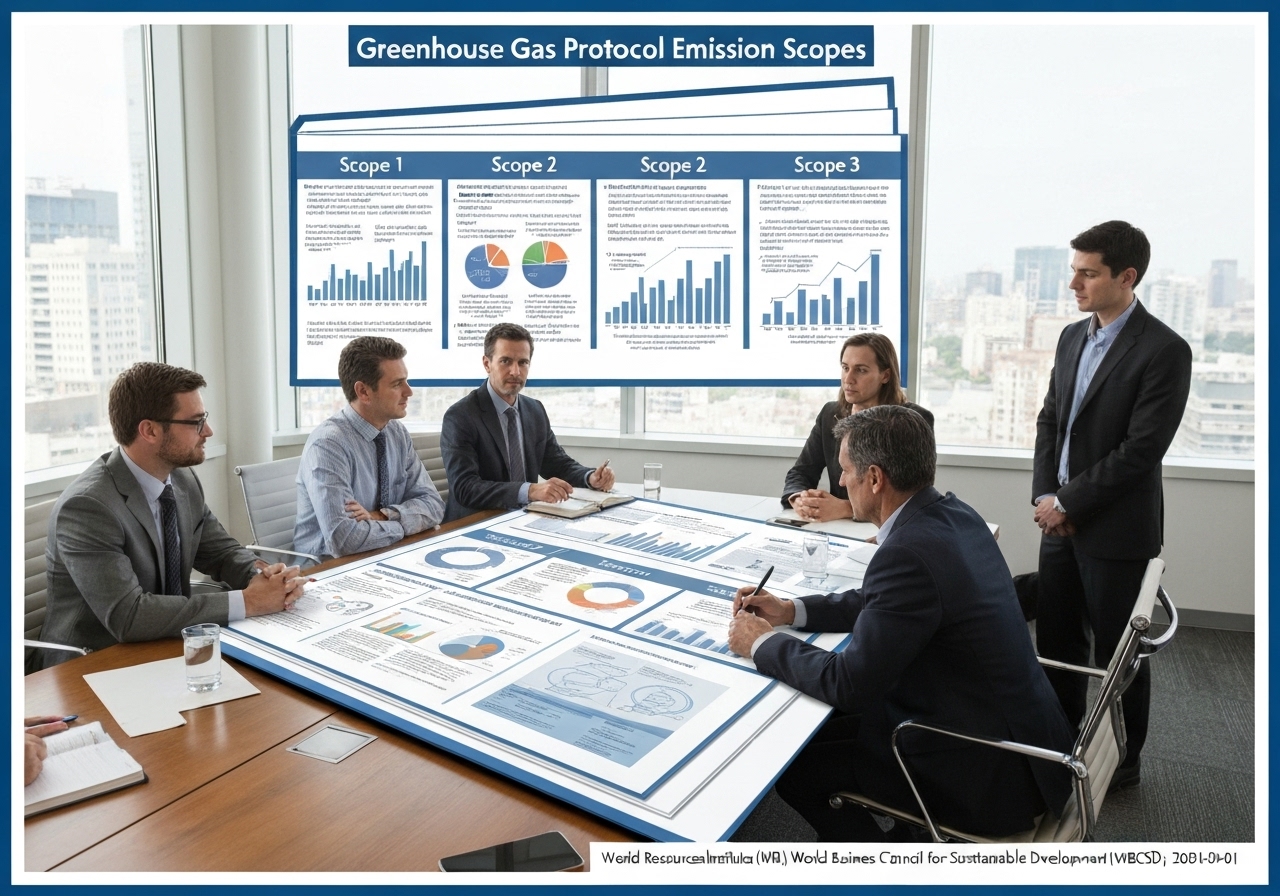
Corporate meeting discussing greenhouse gas emission scopes in environmental management.

(generated image for illustration only)

The Greenhouse Gas (GHG) Protocol categorizes greenhouse gas emissions into three scopes. Scope 1 covers direct emissions from owned or controlled sources. Scope 2 includes indirect emissions from the generation of purchased electricity, steam, heating, and cooling. Scope 3 encompasses all other indirect emissions that occur in a company’s value chain, both upstream and downstream, such as purchased goods, business travel, and product use.
The GHG Protocol’s scoping framework provides a standardized methodology for businesses and organizations to measure and manage their greenhouse gas emissions. This categorization is crucial for avoiding double-counting and for identifying the most significant emission sources within an organization’s sphere of influence. Scope 1 emissions are the most direct, such as emissions from company vehicles or industrial processes. Scope 2 emissions are one step removed, relating to the energy a company purchases. Calculating them involves using emission factors for the specific electricity grid. Scope 3 is the most complex and often the largest category, covering everything from business travel and employee commuting to the emissions from the use of sold products and the extraction of raw materials. Accurately measuring Scope 3 emissions requires extensive data collection from suppliers and customers, making it a significant challenge but also offering the greatest opportunities for emission reduction through value chain engagement. This framework has become the de facto international standard for corporate GHG accounting, forming the basis for most carbon reporting standards worldwide.

UNESCO Nomenclature: 2511
– Environmental sciences

Type

Abstract System

Disruption

Substantial

Usage

Widespread Use

Precursors

  • early corporate environmental reporting initiatives
  • development of life-cycle assessment (lca) methodologies
  • kyoto protocol and the need for standardized emissions accounting
  • growth of corporate social responsibility (csr) movements

Applications

  • corporate sustainability reporting
  • carbon accounting software
  • supply chain management
  • investment screening (esg)
  • product carbon footprinting
  • national and international climate policy

Patents:

NA

Potential Innovations Ideas

Due to scrapping bot traffic, currently more than 40k per day, this content is reserved to community members.
> Login < or > Register < (100% free) to access this, so as all other restricted content and tools.

Related to: GHG protocol, carbon accounting, emissions, greenhouse gas, corporate sustainability, value chain, wri.

Historical Context

1990
1990
1993
2001-09-01
1990
1990
1990
2000
2006

(if date is unknown or not relevant, e.g. "fluid mechanics", a rounded estimation of its notable emergence is provided)

Related Invention, Innovation & Technical Principles

Full size images and downloads are only available, 100% free, for registered members.

> Login <