Product Design, Manufacturing & Innovation Resources
Home » Generalized Hooke’s Law

Generalized Hooke’s Law

1678
  • Robert Hooke
  • Thomas Young
  • Augustin-Louis Cauchy
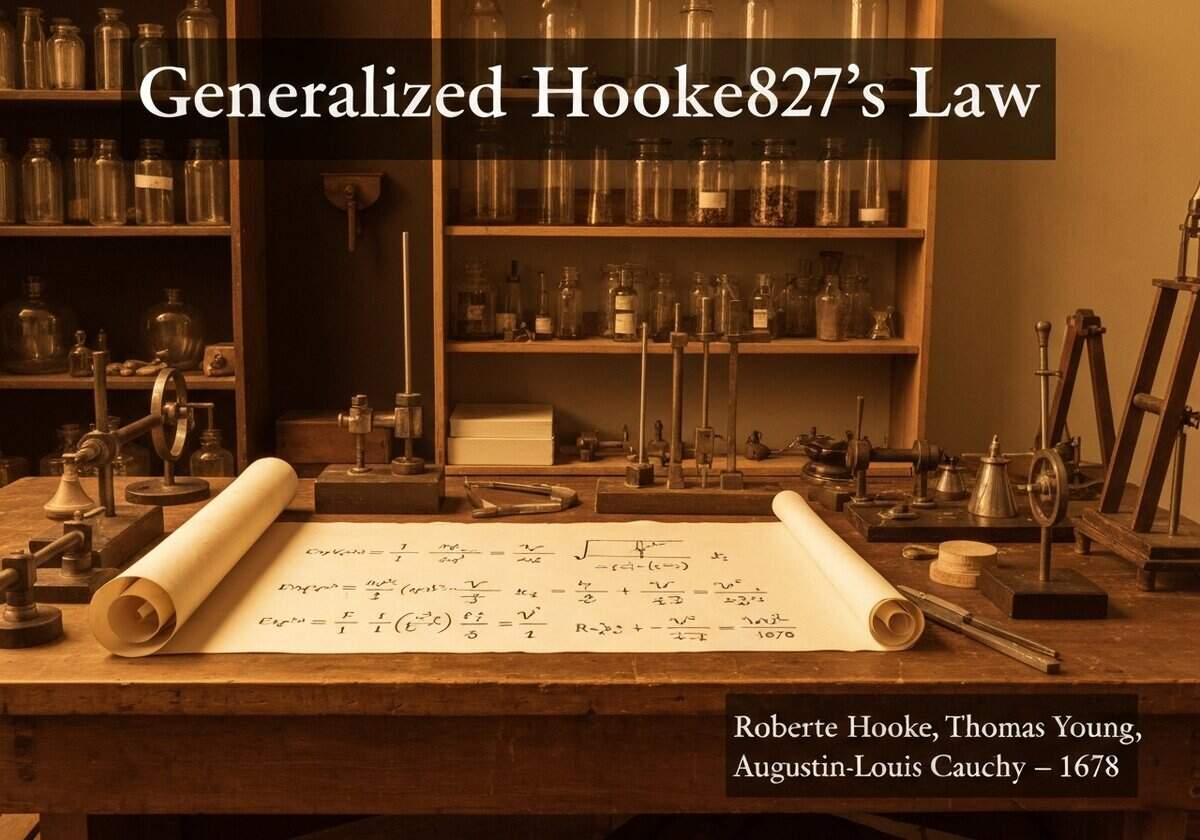
17th-century laboratory with tools for tensile testing and equations of Generalized Hooke's Law.

(generated image for illustration only)

Generalized Hooke’s Law is the constitutive equation for linear elastic materials, stating that the stress tensor is linearly proportional to the strain tensor. The relationship is expressed as \(\sigma = C : \varepsilon\), where \(\sigma\) is the stress tensor, \(\varepsilon\) is the strain tensor, and \(C\) is the fourth-order stiffness tensor containing the material’s elastic constants.

While Robert Hooke’s original 1678 law (“ut tensio, sic vis” – as the extension, so the force) described a simple one-dimensional linear relationship, the generalized Hooke’s Law extends this principle to three dimensions. It forms the mathematical foundation of the theory of linear elasticity. The relationship connects the six independent components of the stress tensor to the six independent components of the infinitesimal strain tensor. This is achieved through the stiffness tensor \(C_{ijkl}\), a fourth-order tensor containing 81 components in its most general form.

Due to the symmetry of the stress and strain tensors, the number of independent components in the stiffness tensor reduces to 36. Furthermore, assuming the existence of a strain energy density function, the stiffness tensor itself becomes symmetric (\(C_{ijkl} = C_{klij}\)), reducing the number of independent elastic constants to 21 for the most general anisotropic material. For materials with higher degrees of symmetry, this number is further reduced. For an isotropic material, which has the same properties in all directions, only two independent elastic constants are needed, such as Young’s Modulus (E) and Poisson’s Ratio (ν). In this common case, the law simplifies significantly, allowing for direct calculation of stresses from strains and vice-versa. This law is only valid within the material’s elastic limit; beyond this point, permanent plastic deformation occurs, and other constitutive models are required.

UNESCO Nomenclature: 2208
– Mechanics

Type

Physical Law

Disruption

Foundational

Usage

Widespread Use

Precursors

  • Observations on the elastic properties of materials
  • Development of the concepts of stress and strain
  • Newton’s laws of motion

Applications

  • finite element analysis (FEA) software for structural design
  • design of springs, beams, and other elastic components
  • material characterization through tensile testing
  • seismology to model the propagation of elastic waves through the Earth

Patents:

NA

Potential Innovations Ideas

Due to scrapping bot traffic, currently more than 40k per day, this content is reserved to community members.
> Login < or > Register < (100% free) to access this, so as all other restricted content and tools.

Related to: Hooke’s law, linear elasticity, constitutive equation, stress-strain relationship, stiffness tensor, Young’s modulus, Poisson’s ratio, isotropic material.

Historical Context

Generalized Hooke’s Law

1600
1650
1650
1678
1687
1687
1738
1750
1650
1650
1672
1687
1687
1738
1750

(if date is unknown or not relevant, e.g. "fluid mechanics", a rounded estimation of its notable emergence is provided)

Related Invention, Innovation & Technical Principles

Full size images and downloads are only available, 100% free, for registered members.

> Login <