Product Design, Manufacturing & Innovation Resources
Home » Eutectic System

Eutectic System

1884
  • Frederick Guthrie
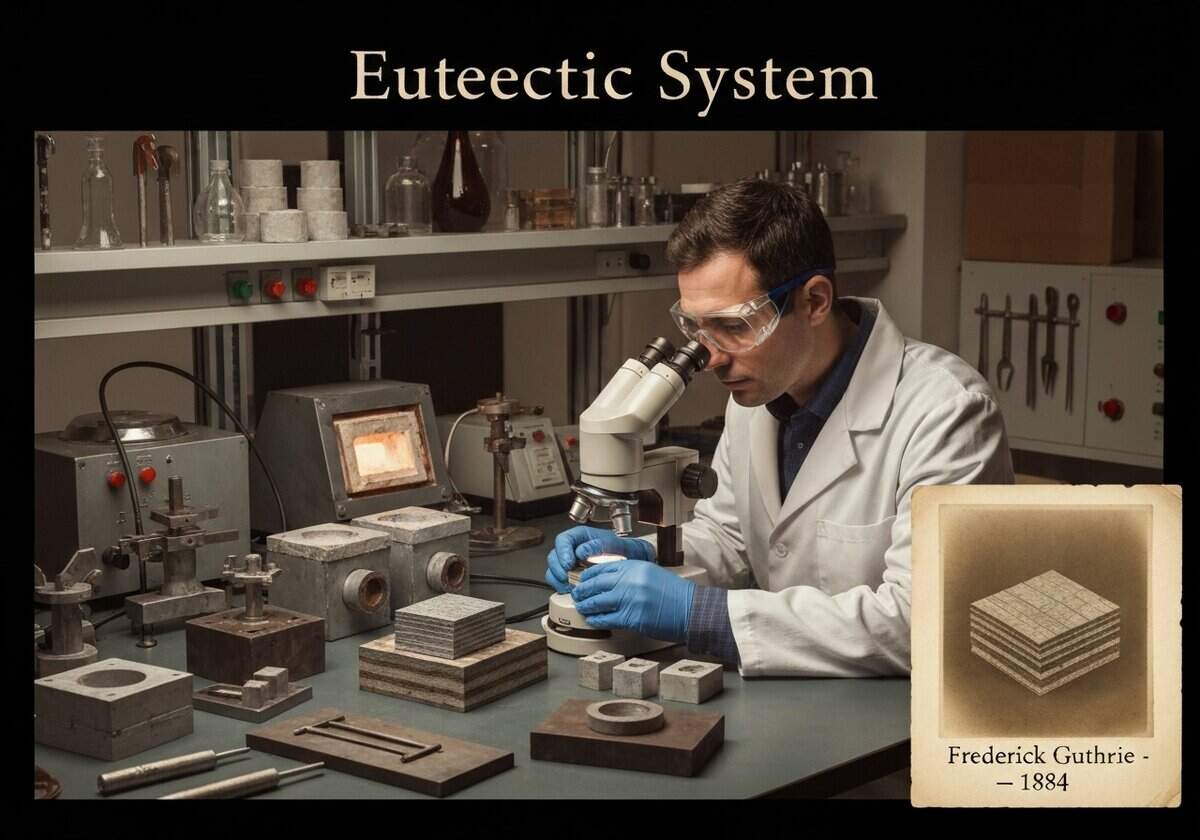
Metallurgist examining eutectic alloy microstructure in a laboratory setting.

(generated image for illustration only)

A eutectic system is a mixture of two or more components that solidifies at a single, sharp temperature that is lower than the melting point of any of the individual components. This specific composition is the eutectic point. Upon cooling, a eutectic liquid transforms into a fine mixture of solid phases, often with a characteristic lamellar (layered) microstructure.
The concept of a eutectic system is best visualized using a binary phase diagram, which plots temperature against composition. The eutectic point is the specific composition and temperature at which the liquid phase is in equilibrium with two solid phases. For a binary system of components A and B, the eutectic reaction is represented as \(L \rightleftharpoons \alpha + \beta\), where L is the liquid phase, and \(\alpha\) and \(\beta\) are two different solid phases (rich in A and B, respectively). This invariant reaction occurs at a constant temperature, the eutectic temperature.

The low melting point of eutectic alloys is highly advantageous for casting, as it reduces the energy required and minimizes thermal stress on molds. The microstructure formed during eutectic solidification is typically a fine, intimate mixture of the solid phases, such as alternating layers (lamellae) of \(\alpha\) and \(\beta\). This fine microstructure can impart unique mechanical properties, such as high strength and wear resistance, as seen in cast iron where the eutectic structure consists of ferrite and cementite. Compositions other than the eutectic are termed hypoeutectic or hypereutectic, and they begin to solidify by precipitating one of the primary solid phases before reaching the eutectic temperature, where the remaining liquid then undergoes the eutectic transformation.

UNESCO Nomenclature: 3308
– Metallurgy

Type

Physical Phenomenon

Disruption

Substantial

Usage

Widespread Use

Precursors

  • studies on freezing-point depression in aqueous solutions
  • development of thermal analysis techniques like calorimetry
  • josiah willard gibbs’ work on phase equilibria and the phase rule
  • early metallography for observing microstructures

Applications

  • lead-tin and lead-free solders for joining electronic components
  • casting of complex shapes using cast iron, which is a near-eutectic iron-carbon alloy
  • brazing alloys for joining dissimilar metals at high temperatures
  • phase-change materials for thermal energy storage
  • production of galinstan, a non-toxic liquid metal alloy at room temperature

Patents:

    Potential Innovations Ideas

    Due to scrapping bot traffic, currently more than 40k per day, this content is reserved to community members.
    > Login < or > Register < (100% free) to access this, so as all other restricted content and tools.

    Related to: eutectic system, eutectic point, phase diagram, melting point depression, solder, cast iron, lamellar structure, solidification, metallurgy, thermodynamics.

    Historical Context

    Eutectic System

    1867
    1875-01-01
    1881
    1884
    1890
    1890
    1899-01-01
    1860
    1870
    1876
    1882-01-01
    1886-04-23
    1890
    1897
    1900

    (if date is unknown or not relevant, e.g. "fluid mechanics", a rounded estimation of its notable emergence is provided)

    Related Invention, Innovation & Technical Principles

    Full size images and downloads are only available, 100% free, for registered members.

    > Login <