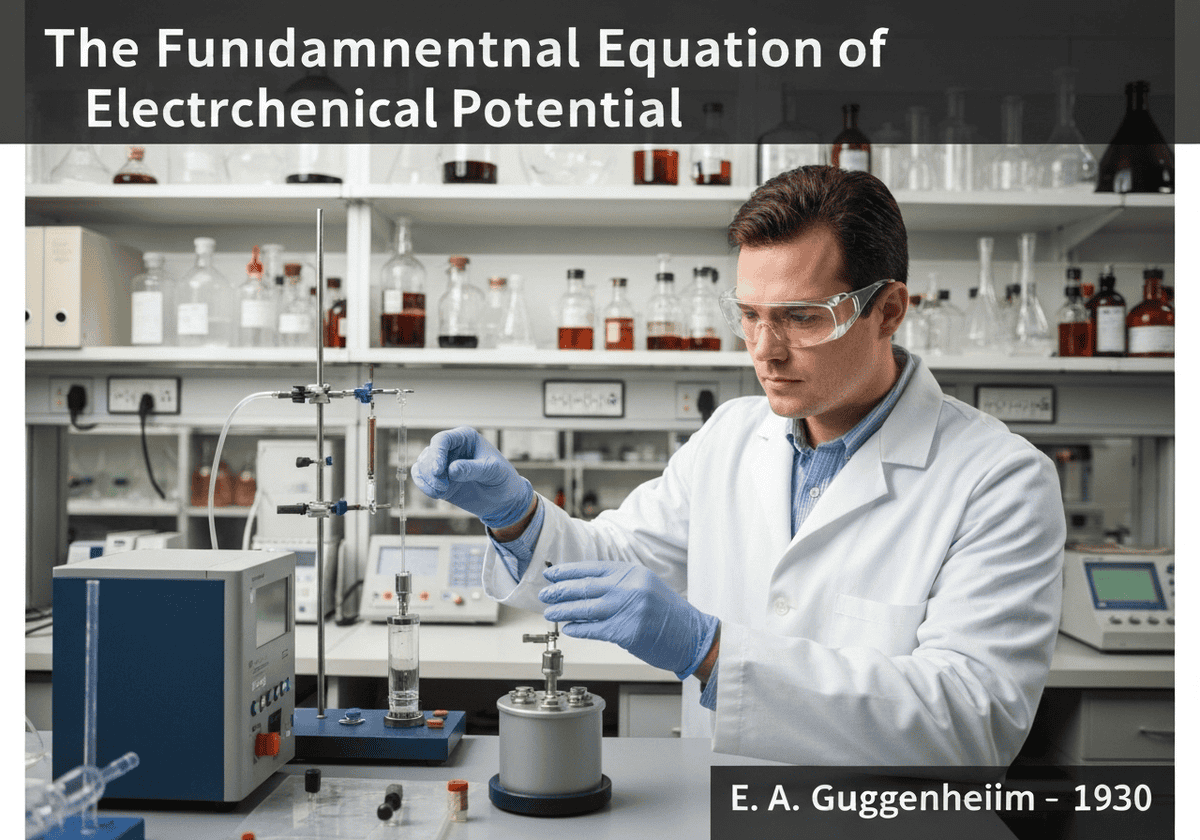
The Fundamental Equation of Electrochemical Potential
Electrochemical potential, \(\bar{\mu}_i\), quantifies the total energy of a charged species `i` in a system. It combines the chemical potential, \(\mu_i\), which accounts for concentration and intrinsic properties, with the electrostatic potential energy, \(z_i F \phi\). The formula is \(\bar{\mu}_i = \mu_i + z_i F \phi\), where \(z_i\) is the ion’s charge, \(F\) is the Faraday constant, and \(phi\) is the local electric potential.
The concept of electrochemical potential is a cornerstone of physical chemistry, extending the idea of chemical potential to systems involving charged species and electrical fields. The governing equation, \(\bar{\mu}_i = \mu_i + z_i F \phi\), elegantly merges chemical and electrical driving forces into a single thermodynamic quantity. The first term, \(\mu_i\), is the chemical potential, representing the energy change associated with adding a mole of species `i` to a system, considering factors like concentration, temperature, and pressure. It is the driving force for diffusion from high to low concentration.
The second term, \(z_i F \phi\), represents the molar electrostatic potential energy. Here, \(z_i\) is the dimensionless integer charge of the ion (e.g., +2 for \(Ca^{2+}\)), \(F\) is the Faraday constant (approximately 96,485 C/mol), which is the charge of one mole of electrons, and \(\phi\) is the local electric potential (Galvani potential). This term quantifies the work required to move a mole of ions against the local electric field.
Fundamentally, the electrochemical potential is the partial molar Gibbs free energy of the species `i`, expressed as \(\bar{mu}_i = (\frac{\partial G}{\partial n_i})_{T,P,n_{j\neq i}}\). This means it represents the total work that can be extracted when one mole of the species is added to the system. The difference in electrochemical potential between two points dictates the direction of spontaneous movement for that ion, encompassing both diffusion down a concentration gradient and drift along an electric field.
UNESCO Nomenclature: 2209
– Physical chemistry
Precursors
- Josiah Willard Gibbs’s work on chemical potential and Gibbs free energy
- Michael Faraday’s laws of electrolysis and the concept of the faraday constant
- Walther Nernst’s development of the Nernst equation
- the development of classical thermodynamics and electrostatics
Applications
- batteries and fuel cells
- electroplating and corrosion science
- semiconductor physics (Fermi level)
- neuroscience (nerve impulses)
- cellular bioenergetics (atp synthesis)
Potential Innovations Ideas
Due to scrapping bot traffic, currently more than 40k per day, this content is reserved to community members.
> Login < or > Register < (100% free) to access this, so as all other restricted content and tools.
Related to: electrochemical potential, chemical potential, electrostatic potential, Faraday constant, Gibbs free energy, Nernst equation, electrochemistry, ion.