Product Design, Manufacturing & Innovation Resources
Home » Earth Overshoot Day (EOD)

Earth Overshoot Day (EOD)

2006
  • Andrew Simms
Environmental awareness campaign highlighting Earth Overshoot Day in human ecology.

(generated image for illustration only)

Earth Overshoot Day (EOD) is the calculated illustrative calendar date on which humanity’s demand for ecological resources and services in a given year exceeds what Earth can regenerate in that year. It marks the point where human consumption shifts from using the planet’s annual ecological interest to depleting its principal natural capital, effectively living on credit.

The concept of Earth Overshoot Day was conceived by Andrew Simms of the New Economics Foundation, a UK-based think tank. The primary goal was to create a simple, powerful, and easily understandable communication tool to highlight the scale of global resource unsustainability. While the underlying data and calculations are complex, framing the result as a specific calendar date makes the abstract notion of ecological deficit tangible and relatable to the general public. Each year, the Global Footprint Network, which partnered with Simms’ organization in 2006 to launch the first global EOD campaign, calculates the date. The campaign uses this date to raise awareness and encourage action from individuals, organizations, and governments. The narrative is compelling: the earlier the date falls in the year, the greater the ecological deficit. For instance, in 1971, the date was in late December, indicating a near balance. By the 2020s, it has consistently fallen in July or August, visually demonstrating that humanity is using approximately 1.7 Earths’ worth of resources annually. This framing helps to catalyze discussions on topics like circular economy, renewable energy, sustainable agriculture, and population growth, making it a cornerstone of modern environmental advocacy.

Calculation

The date for Earth Overshoot Day is determined by a rather simple formula that compares the planet’s ecological supply with human demand. The calculation is: [latex]\frac{\text{World Biocapacity}}{\text{World Ecological Footprint}} \times 365[/latex]. The result is the number of days in the year that Earth’s regeneration is sufficient to provide for humanity’s consumption, with the following day being Earth Overshoot Day.

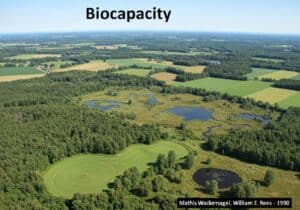
The formula’s two core components are the Ecological Footprint and Biocapacity, both developed by Mathis Wackernagel and William Rees. The Ecological Footprint represents the demand side, quantifying the biologically productive land and sea area required to produce all the resources a population consumes and to absorb its waste, particularly carbon emissions. The Biocapacity represents the supply side, measuring the productivity of a region’s ecological assets, such as forests, croplands, and fishing grounds. Both metrics are measured in a standardized unit called a ‘global hectare’ to allow for aggregation and comparison. The Global Footprint Network calculates these values for the entire world and for individual nations using data from sources like the United Nations Food and Agriculture Organization (FAO) and the International Energy Agency (IEA). The calculation is performed annually using the most recent available data, which typically has a lag of a few years. The result of the fraction (Biocapacity / Footprint) represents the portion of the year that humanity lives within the planet’s means. For example, if the ratio is 0.75, it means humanity’s demand is met for 75% of the year, or approximately 274 days, making the 275th day Earth Overshoot Day.

UNESCO Nomenclature: 2506
– Ecology

Type

Abstract System

Disruption

Substantial

Usage

Widespread Use

Precursors

  • concept of carrying capacity in ecology
  • the limits to growth report (1972)
  • development of ecological footprint accounting
  • development of biocapacity accounting
  • thermoeconomics and energy accounting principles

Applications

  • environmental awareness campaigns by ngos like wwf
  • framework for corporate sustainability reporting
  • educational tool in schools and universities for teaching resource management
  • basis for national and municipal environmental policy discussions
  • visual communication tool for media outlets reporting on climate change and resource depletion

Patents:

NA

Potential Innovations Ideas

Due to scrapping bot traffic, currently more than 40k per day, this content is reserved to community members.
> Login < or > Register < (100% free) to access this, so as all other restricted content and tools.

Related to: earth overshoot day, sustainability, ecological deficit, resource depletion, environmental awareness, new economics foundation, Andrew Simms, global footprint network, natural capital, consumption.

Historical Context

1990
1990
2000
2006
1990
1990
1993
2001-09-01

(if date is unknown or not relevant, e.g. "fluid mechanics", a rounded estimation of its notable emergence is provided)

Related Invention, Innovation & Technical Principles

Full size images and downloads are only available, 100% free, for registered members.

> Login <