Product Design, Manufacturing & Innovation Resources
Home » Critical Temperature of Gases

Critical Temperature of Gases

1869
  • Thomas Andrews
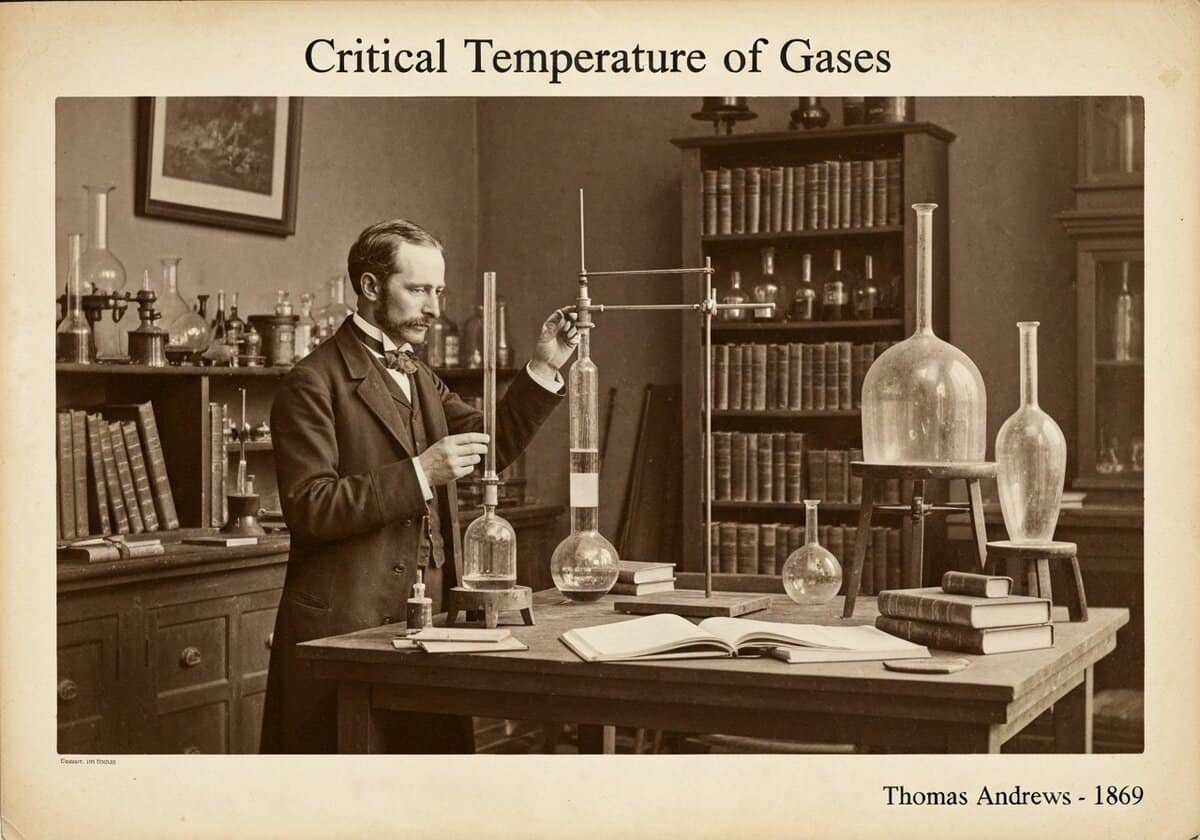
19th-century laboratory scene illustrating the critical temperature of gases in thermodynamics.

(generated image for illustration only)

The critical temperature is the temperature above which a distinct liquid phase cannot be formed, regardless of the applied pressure. Each gas has a unique critical temperature. To liquefy a gas, it must first be cooled below this temperature. This concept, established by Thomas Andrews, is fundamental to understanding the conditions required for any liquefaction process.
Thomas Andrews’ experiments in the 1860s on carbon dioxide were pivotal. He meticulously measured its pressure-volume-temperature (P-V-T) relationships and discovered that above approximately 30.98 °C (304.1 K), CO2 could not be liquefied no matter how much pressure was applied. He termed this the ‘critical temperature.’ Below this temperature, increasing the pressure on the gas would eventually cause it to condense into a liquid. At the critical temperature itself, the gas transitions into a liquid at a specific ‘critical pressure’ and ‘critical volume,’ a state known as the critical point. At this point, the densities of the liquid and gas phases become equal, and the meniscus separating them disappears. The substance becomes a supercritical fluid, possessing properties of both a gas and a liquid. This discovery was crucial because it explained why earlier attempts by scientists like Faraday to liquefy gases such as oxygen, nitrogen, and hydrogen had failed; they were not cooling the gases below their respective, much lower, critical temperatures, a prerequisite for liquefaction by compression.

UNESCO Nomenclature: 2212
– Thermodynamics

Type

Physical Principle

Disruption

Foundational

Usage

Widespread Use

Precursors

  • Boyle’s Law (relationship between pressure and volume)
  • Charles’s Law (relationship between volume and temperature)
  • Amagat’s experiments on gas compressibility at high pressures
  • Michael Faraday’s earlier, partially successful attempts at gas liquefaction

Applications

  • liquefaction of natural gas (LNG)
  • production of liquid oxygen and nitrogen for industrial and medical use
  • refrigeration and air conditioning systems
  • supercritical fluid extraction (e.g., decaffeination of coffee)
  • supercritical fluid chromatography

Patents:

NA

Potential Innovations Ideas

Due to scrapping bot traffic, currently more than 40k per day, this content is reserved to community members.
> Login < or > Register < (100% free) to access this, so as all other restricted content and tools.

Related to: critical temperature, phase transition, liquefaction, Thomas Andrews, critical point, gas, liquid, pressure, thermodynamics, supercritical fluid.

Historical Context

Critical Temperature of Gases

1860
1861
1865
1869
1871
1876
1877
1859
1861
1865
1868
1870
1873
1877
1880

(if date is unknown or not relevant, e.g. "fluid mechanics", a rounded estimation of its notable emergence is provided)

Related Invention, Innovation & Technical Principles

Full size images and downloads are only available, 100% free, for registered members.

> Login <