Product Design, Manufacturing & Innovation Resources
Home » Catalysis

Catalysis

1835
  • Jöns Jacob Berzelius
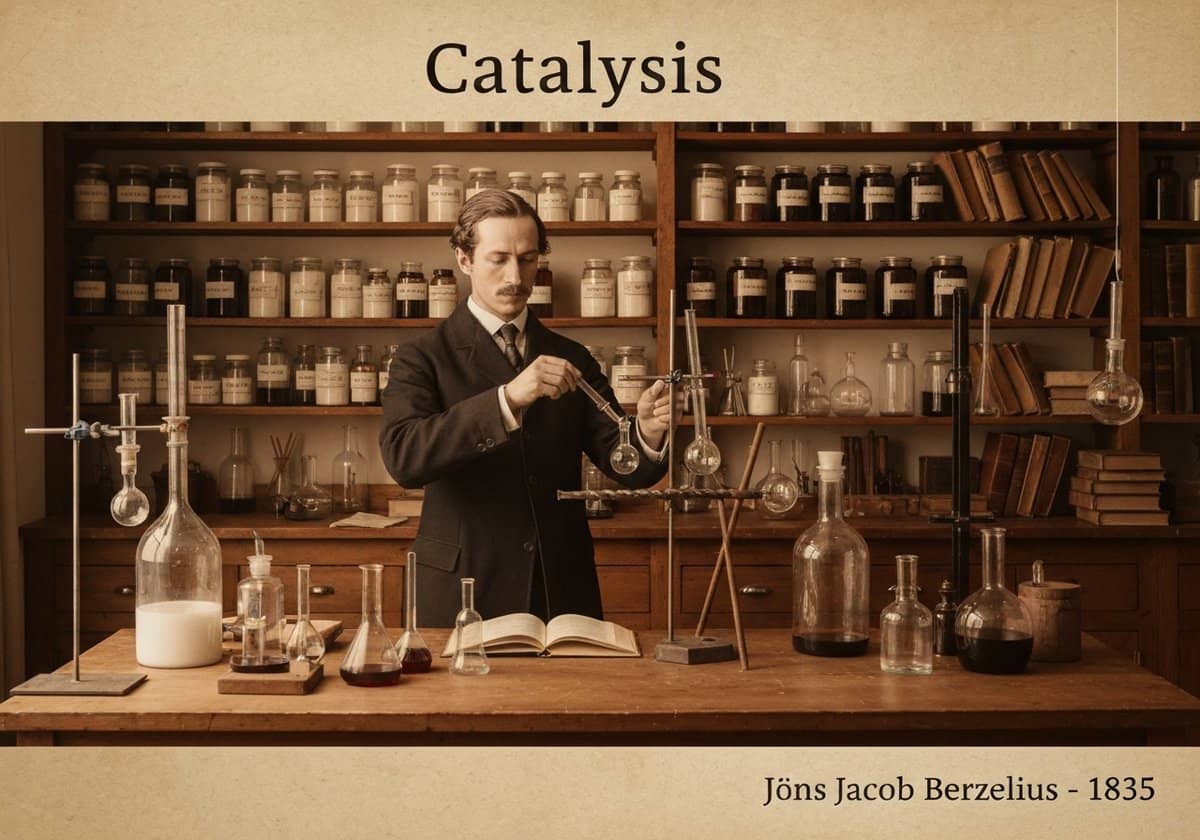
Chemist conducting catalysis experiment in historical laboratory setting.

(generated image for illustration only)

Catalysis is the process of increasing the rate of a chemical reaction by adding a substance known as a catalyst. Catalysts are not consumed in the reaction and remain unchanged. They work by providing an alternative reaction pathway with a lower activation energy (\(E_a\)), thereby accelerating both the forward and reverse reactions without altering the overall thermodynamics (\(\Delta H\)).

The fundamental principle of catalysis lies in its ability to alter the kinetics of a chemical reaction without affecting its thermodynamics. A catalyst introduces a new reaction mechanism, often involving one or more intermediate steps. For a reaction A + B → C, a catalyst C’ might participate as follows: A + C’ → AC’ and then AC’ + B → C + C’. The catalyst C’ is regenerated at the end of the process. This alternative pathway has a lower transition state energy compared to the uncatalyzed reaction. The Arrhenius equation, \(k = Ae^{-E_a/(RT)}\), shows that a lower activation energy (\(E_a\)) leads to an exponential increase in the reaction rate constant (k). Importantly, the catalyst does not change the Gibbs free energy change (\(\Delta G\)) or the equilibrium constant (\(K_{eq}\)) of the reaction. It only affects the speed at which equilibrium is reached. This concept was first formally described by Jöns Jacob Berzelius in 1835, who observed that certain substances could accelerate reactions without being consumed, coining the term “catalysis” from Greek words meaning “to dissolve” or “to break down”.

This principle is visualized using reaction coordinate diagrams, where the catalyzed pathway shows a lower energy peak (transition state) than the uncatalyzed one. While the overall energy difference between reactants and products remains the same, the energy barrier to be overcome is significantly reduced. This allows a greater fraction of reactant molecules to possess sufficient energy to react upon collision, leading to a faster reaction rate at a given temperature.

UNESCO Nomenclature: 2202
– Physical chemistry

Type

Chemical Process

Disruption

Foundational

Usage

Widespread Use

Precursors

  • alchemical concepts of the philosopher’s stone
  • observations of fermentation by Louis Pasteur
  • Humphry Davy’s work on platinum’s effect on gas combustion
  • discovery of chlorine by Carl Wilhelm Scheele, which later found use in catalyzed reactions

Applications

  • industrial chemical synthesis (e.g., ammonia, sulfuric acid)
  • petroleum refining
  • polymer production
  • pollution control (catalytic converters)
  • pharmaceutical manufacturing

Patents:

NA

Potential Innovations Ideas

Due to scrapping bot traffic, currently more than 40k per day, this content is reserved to community members.
> Login < or > Register < (100% free) to access this, so as all other restricted content and tools.

Related to: catalysis, catalyst, activation energy, reaction rate, chemical kinetics, thermodynamics, reaction pathway, Jöns Jacob Berzelius, equilibrium, transition state.

Historical Context

Catalysis

1831
1832
1834
1835
1838
1841
1845
1831
1831
1833
1834
1836
1839-01-01
1842
1847

(if date is unknown or not relevant, e.g. "fluid mechanics", a rounded estimation of its notable emergence is provided)

Related Invention, Innovation & Technical Principles

Full size images and downloads are only available, 100% free, for registered members.

> Login <