Product Design, Manufacturing & Innovation Resources
Home » The Boltzmann Distribution

The Boltzmann Distribution

1868
  • Ludwig Boltzmann
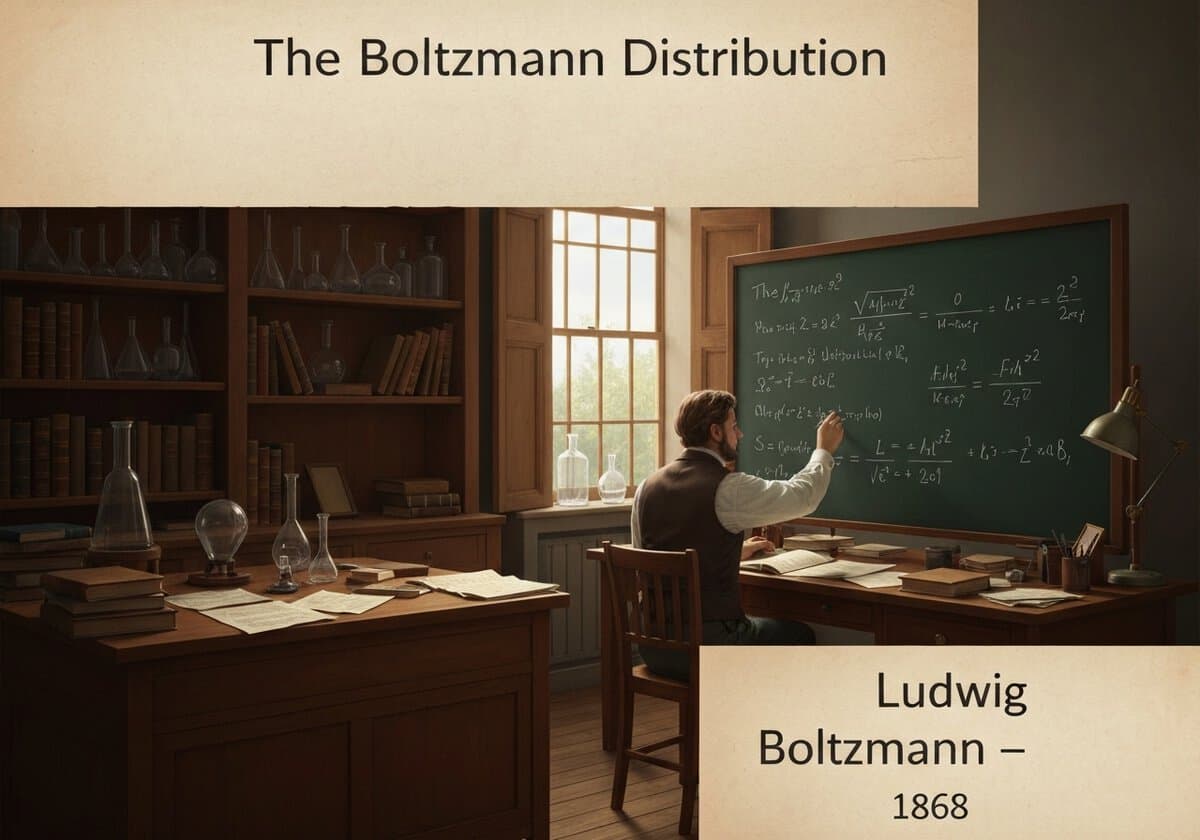
Physicist analyzing Boltzmann Distribution equations in a vintage laboratory setting.

(generated image for illustration only)

The Boltzmann distribution describes the probability that a system in thermal equilibrium at temperature T will be in a specific microstate with energy E. This probability is proportional to the Boltzmann factor, \(e^{-E / k_B T}\). It implies that states with lower energy are exponentially more likely to be occupied than states with higher energy, with temperature modulating this preference.


The Boltzmann distribution is a cornerstone of statistical mechanics and is arguably its most useful result for practical applications. It can be derived by considering a small system in thermal contact with a large heat reservoir. The combined system (system + reservoir) is isolated, and by applying Boltzmann’s entropy principle (\(S = k_B \ln W\)) to the reservoir, one can find the most probable energy distribution for the small system. The result is that the probability of the system being in state ‘i’ with energy \(E_i\) is \(P_i \propto e^{-E_i/k_B T}\).

The term \(k_B T\) represents the characteristic thermal energy available at temperature T. The ratio \(E/k_B T\) is dimensionless and determines the probability. If a state’s energy E is much less than the thermal energy (\(E \ll k_B T\)), the exponential factor is close to 1, and the state is highly probable. If the energy is much greater than the thermal energy (\(E \gg k_B T\)), the factor is very small, and the state is very unlikely to be occupied. This exponential dependence is responsible for many phenomena, such as the rapid increase in chemical reaction rates with temperature, as more molecules possess the necessary activation energy.

UNESCO Nomenclature: 2211
– Thermodynamics

Type

Abstract System

Disruption

Revolutionary

Usage

Widespread Use

Precursors

  • James Clerk Maxwell’s distribution of molecular speeds in a gas (a specific case of the Boltzmann distribution)
  • The kinetic theory of gases, which linked temperature to average kinetic energy
  • Rudolf Clausius’s work on heat and the second law of thermodynamics
  • The development of probability theory

Applications

  • semiconductor physics to determine the density of charge carriers
  • atmospheric science to model pressure variation with altitude (barometric formula)
  • chemical kinetics for the temperature dependence of reaction rates (arrhenius equation)
  • spectroscopy for understanding the doppler broadening of spectral lines

Patents:

NA

Potential Innovations Ideas

Due to scrapping bot traffic, currently more than 40k per day, this content is reserved to community members.
> Login < or > Register < (100% free) to access this, so as all other restricted content and tools.

Related to: Boltzmann distribution, Boltzmann factor, thermal equilibrium, probability distribution, energy states, statistical mechanics, temperature, canonical ensemble.

Historical Context

The Boltzmann Distribution

1859
1861
1865
1868
1870
1873
1877
1859
1860
1861
1865
1869
1871
1876
1877

(if date is unknown or not relevant, e.g. "fluid mechanics", a rounded estimation of its notable emergence is provided)

Related Invention, Innovation & Technical Principles

Full size images and downloads are only available, 100% free, for registered members.

> Login <