Product Design, Manufacturing & Innovation Resources
घर » जैव-सामग्रियों में आणविक स्व-संयोजन

जैव-सामग्रियों में आणविक स्व-संयोजन

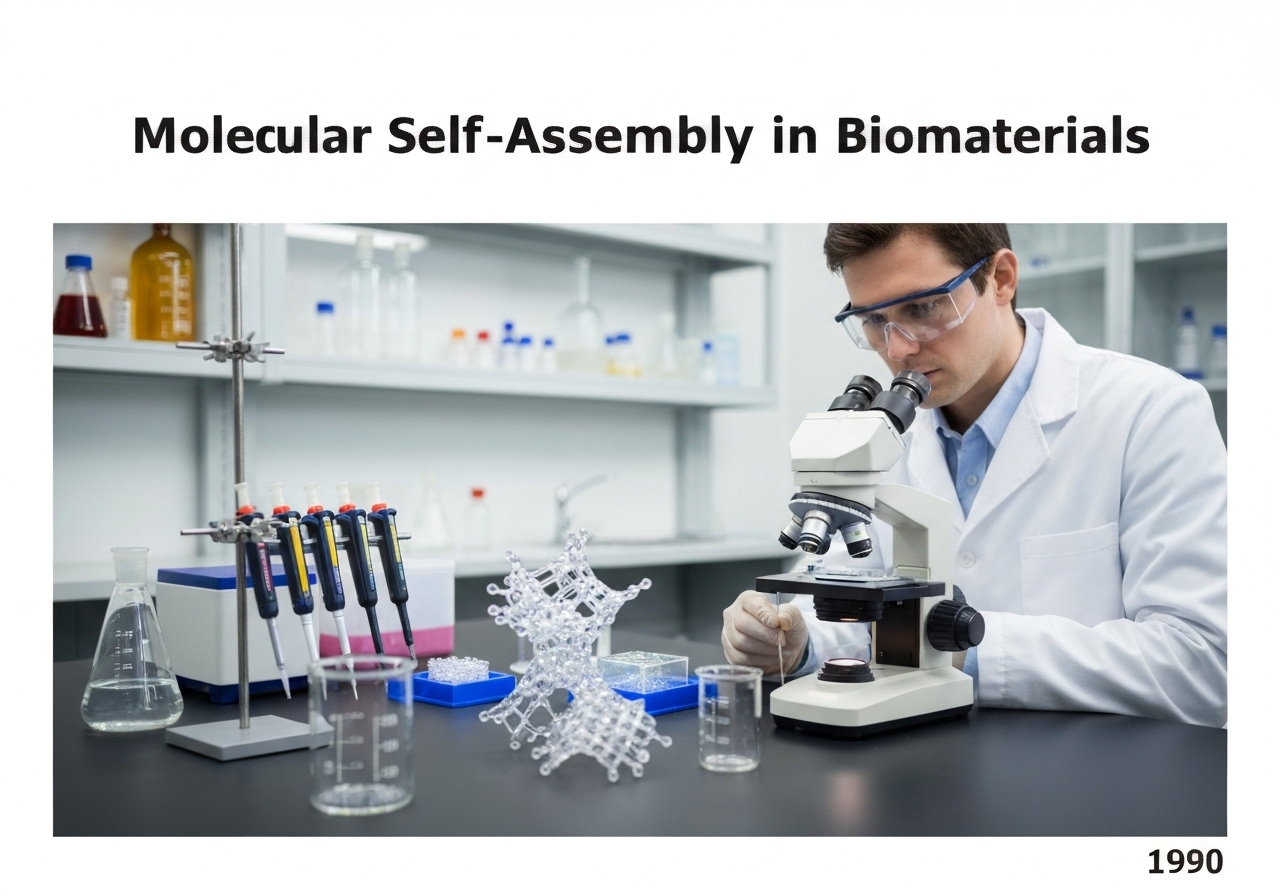
1990
Laboratory scene demonstrating molecular self-assembly in biomaterials for biomedical applications.

(यह छवि केवल उदाहरण के लिए बनाई गई है)

आणविक स्व-संयोजन एक "नीचे से ऊपर" की प्रक्रिया है जहाँ अणु बिना किसी बाहरी मार्गदर्शन के स्वतः ही व्यवस्थित संरचनाओं में संगठित हो जाते हैं। यह घटना हाइड्रोजन बंध, हाइड्रोफोबिक प्रभाव और जैसे गैर-सहसंयोजक अंतःक्रियाओं द्वारा संचालित होती है। वैन डेर वाल्स forces, is fundamental in biology (e.g., protein folding, lipid bilayer formation). In biomaterials, it is harnessed to create complex, nanostructured materials like hydrogels and nanofibers for biomedical applications.

Self-assembly provides a powerful paradigm for creating biomaterials that mimic the hierarchical complexity of biological tissues. The process is thermodynamically driven, seeking a minimum Gibbs free energy state. The design begins with molecular building blocks, often amphiphilic molecules (containing both hydrophilic and hydrophobic parts) such as block copolymers or peptide amphiphiles (PAs). When placed in an aqueous environment above a critical concentration, these molecules arrange themselves to minimize the unfavorable contact between their hydrophobic segments and water. This can lead to various nanostructures, including spherical micelles, cylindrical nanofibers, or planar bilayers, with the final morphology dictated by molecular geometry and packing parameters. A key advantage is the ability to encode biological function directly into the building blocks. For example, a PA can be designed with a peptide sequence containing the RGD motif, a well-known cell adhesion ligand. Upon self-assembly into nanofibers, this motif is displayed on the fiber surface, creating a scaffold that actively promotes cell attachment. These systems are often dynamic and responsive. A change in pH, temperature, or ionic strength can trigger a structural transition, allowing for the creation of ‘smart’ materials. For instance, a self-assembling peptide solution can be designed to be liquid for easy injection but form a solid hydrogel scaffold at body temperature, entrapping cells and drugs at a target site for regenerative medicine आवेदन।

UNESCO Nomenclature: 2209
पॉलिमर रसायन विज्ञान

Type

रासायनिक प्रक्रिया

व्यवधान

मूलभूत

उपयोग

उभरती प्रौद्योगिकी

शगुन

  • understanding of non-covalent forces (hydrogen bonds, van der waals)
  • कोशिका झिल्लियों की लिपिड द्विपरत संरचना की खोज
  • प्रोटीन तह और चतुर्धातुक संरचना पर कार्य
  • पॉलिमर रसायन विज्ञान का विकास, विशेष रूप से ब्लॉक कॉपॉलिमर
  • nobel prize-winning work in supramolecular chemistry by lehn, pedersen, and cram

आवेदन

  • fabrication of nanofibrous scaffolds for tissue engineering that mimic the natural extracellular matrix
  • दवा वितरण और कोशिका संधारण के लिए इंजेक्शन योग्य हाइड्रोजेल का विकास
  • ऐसे प्रतिक्रियाशील "स्मार्ट" पदार्थों का निर्माण करना जो पीएच या तापमान जैसे उद्दीपनों के जवाब में अपने गुणों को बदलते हैं।
  • लक्षित चिकित्सा के लिए माइसेल और वेसिकल जैसे नैनोकैरियर का निर्माण
  • सतह पर ऐसे लेप जो जैव-संदूषण को रोकते हैं

पेटेंट:

NA

संभावित नवाचार विचार

  • self-assembling peptides that form conductive nanowires for neural tissue engineering
  • programmable self-assembling systems that can form different structures based on a sequence of stimuli
  • bio-inks for 3d printing based on self-assembling molecules that form scaffolds post-deposition
  • self-healing materials where damage triggers re-assembly of the molecular components
  • self-assembling coatings that can actively capture or repel specific cells or proteins
  • dna origami techniques to create precisely shaped, self-assembled nanostructures for drug delivery
  • self-assembling systems that mimic enzymatic cascades by co-localizing multiple components
  • materials that self-assemble into photonic crystals for biosensing applications
  • injectable gels that self-assemble into porous structures in vivo to promote tissue infiltration
  • self-assembling टीके that arrange antigens into virus-like particles to enhance immune response
Related to: self-assembly, bottom-up, supramolecular chemistry, non-covalent interactions, हाइड्रोजेल, nanofiber, amphiphile, block copolymer, smart material, peptide amphiphile.

ऐतिहासिक संदर्भ

Testing rare-earth magnets in a solid state physics laboratory.

दुर्लभ-पृथ्वी चुंबक

दुर्लभ-पृथ्वी चुंबक दुर्लभ-पृथ्वी तत्वों के मिश्र धातुओं से बने मजबूत स्थायी चुंबक होते हैं। 1970 और 1980 के दशक में विकसित, सबसे सामान्य प्रकार नियोडिमियम चुंबक (NdFeB) और समैरियम-कोबाल्ट चुंबक (SmCo) हैं। वे बनाए गए स्थायी चुंबकों में सबसे मजबूत प्रकार के होते हैं, जो फेराइट या अलिनको चुंबकों की तुलना में काफी मजबूत चुंबकीय क्षेत्र उत्पन्न करते हैं, जिससे कई प्रौद्योगिकियों में लघुकरण और बेहतर प्रदर्शन संभव हो पाता है। नोट: 'दुर्लभ-पृथ्वी तत्व' शब्द एक ऐतिहासिक भ्रामक नाम है। ये तत्व पृथ्वी की पपड़ी में असाधारण रूप से दुर्लभ नहीं हैं। सीरियम, सबसे प्रचुर मात्रा में, 25वां सबसे प्रचुर तत्व है, जो तांबे के समान है। यहाँ तक कि सबसे कम प्रचुर स्थिर दुर्लभ-पृथ्वी, ल्यूटेशियम, सोने की तुलना में लगभग 200 गुना अधिक सामान्य है। 'दुर्लभ' लेबल इसलिए उत्पन्न हुआ क्योंकि उन्हें अलग करना मुश्किल था।

जैव-सामग्रियों में आणविक स्व-संयोजन

1984
1985
1986
1990
1993-01-01
1995
2000
1980
1984
1986
1986
1991
1994
1997
2002

(यदि तिथि अज्ञात है या प्रासंगिक नहीं है, उदाहरण के लिए "द्रव यांत्रिकी", तो इसके उल्लेखनीय उद्भव का एक अनुमानित आंकड़ा प्रदान किया गया है)

नवीनतम परिवर्धन

शीर्ष पोस्ट और लेख

शीर्ष मूल उपकरण

10वां वर्ष सालगिरह

पंजीकृत सदस्यों के लिए पूर्ण आकार की छवियाँ और डाउनलोड 100% निःशुल्क उपलब्ध हैं।