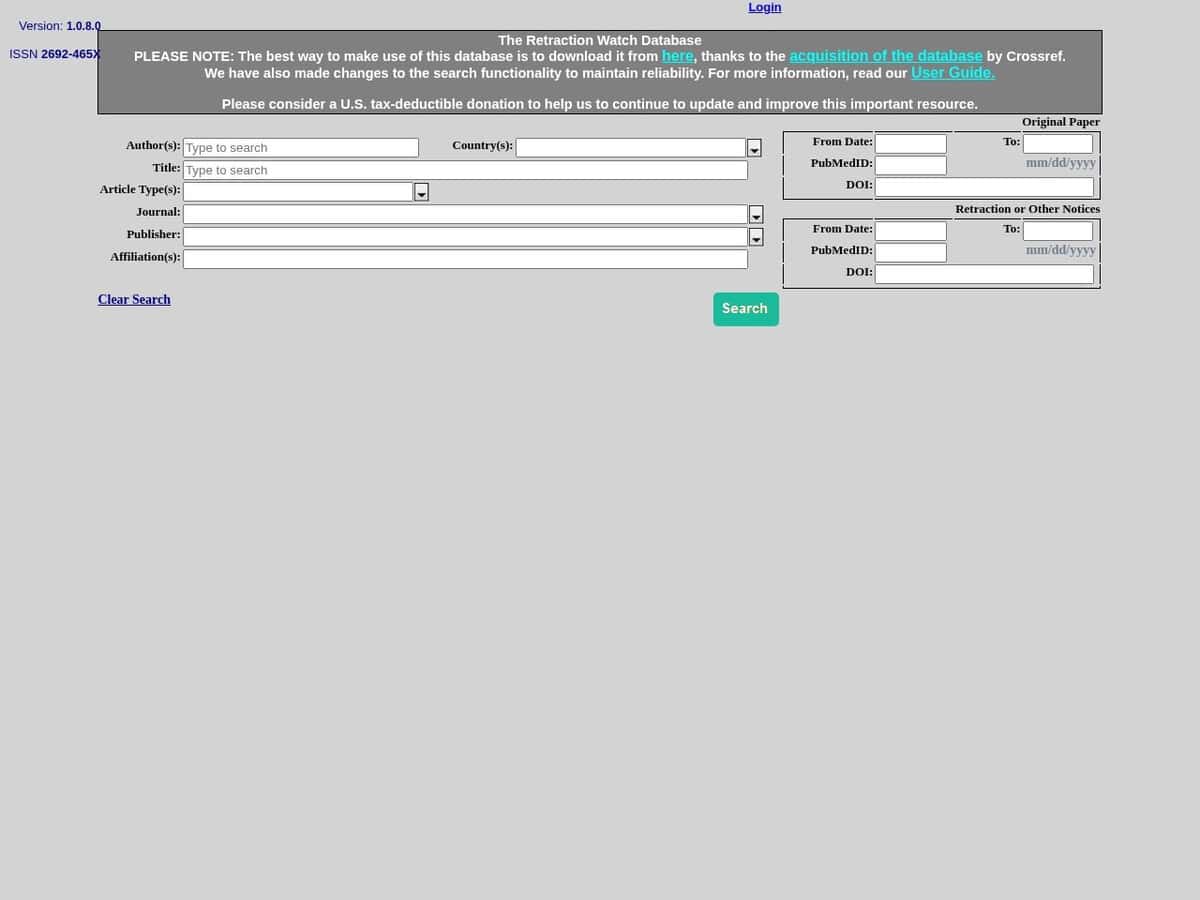
La base de données Retraction Watch sert de plateforme centralisée pour le suivi des recherches scientifiques rétractées, des expressions de préoccupation et des corrections dans toutes les disciplines universitaires. Elle agrège des données fragmentées provenant de milliers de revues dans un répertoire interrogeable, fournissant des métadonnées détaillées telles que l'original. Identifiant d'objet numérique (DOICe service indique les affiliations des auteurs et les raisons précises d'une rétractation, allant de la falsification de données et la manipulation d'images à de simples erreurs méthodologiques. En conservant un registre transparent des modifications post-publication, il permet aux utilisateurs d'identifier les recherches compromises qui pourraient autrement continuer d'être citées ou utilisées au sein de la communauté scientifique.
Conseil: moteur de recherche multicritères efficace, mais un aspect déconcertant Interface graphique interface ; comme les auteurs le suggèrent eux-mêmes, la base de données complète peut être téléchargée et utilisée localement.
Les professionnels des sciences, de l'innovation et de la gestion de la qualité utilisent ces données pour atténuer les risques techniques et juridiques liés aux cycles de vie de la recherche et du développement. En intégrant la vérification des rétractations dans les revues systématiques de la littérature et les processus de diligence raisonnable, les chercheurs s'assurent que les données fondamentales pour les nouveaux projets ou brevet Les applications ne proviennent pas de sources invalidées. Dans des environnements à forts enjeux tels que la fabrication et l'ingénierie pharmaceutiques, l'assurance qualité est essentielle. équipes utiliser la base de données pour :
- Vérifier l'intégrité des spécifications techniques tierces et essai clinique données avant la mise en œuvre.
- Vérifier les bibliographies internes afin d'éviter la propagation de conclusions erronées dans les documents réglementaires.
- Surveillez le publication Historique des collaborateurs potentiels ou des cibles d'acquisition afin d'évaluer la fiabilité institutionnelle.











