Product Design, Manufacturing & Innovation Resources
Lar » Ferramentas online » Mecanismo de busca do banco de dados RetractionWatch

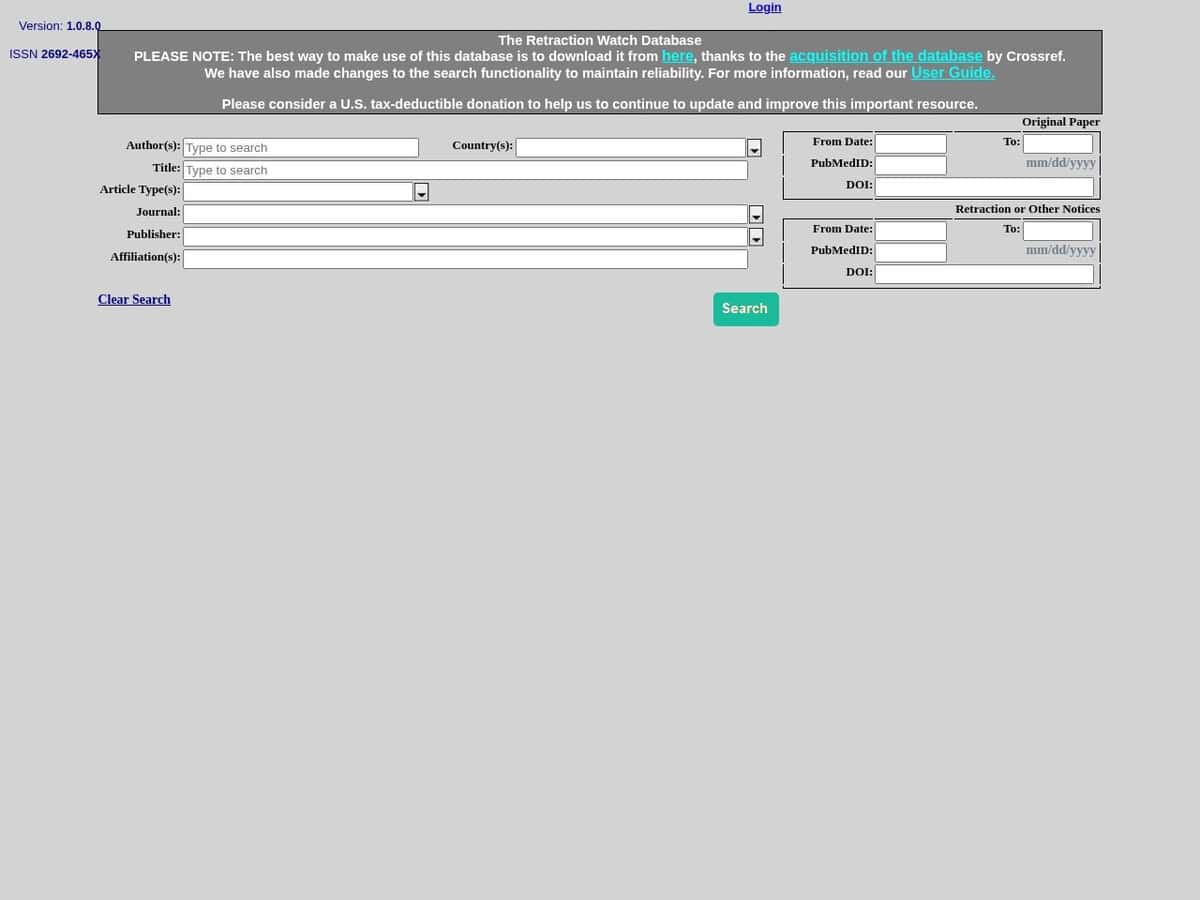
Mecanismo de busca do banco de dados RetractionWatch

O Banco de Dados de Monitoramento de Retratações serve como um repositório centralizado para rastrear pesquisas acadêmicas retratadas, manifestações de preocupação e correções em todas as disciplinas acadêmicas. Ele agrega dados fragmentados de milhares de periódicos em um repositório pesquisável, fornecendo metadados detalhados, como o original. Identificador de Objeto Digital (DOI), afiliações dos autores e as razões específicas para uma retratação — que variam desde a fabricação de dados e manipulação de imagens até erros metodológicos honestos. Ao manter um registro transparente das alterações pós-publicação, o serviço permite que os usuários identifiquem pesquisas comprometidas que, de outra forma, poderiam continuar sendo citadas ou utilizadas na comunidade científica.

Dica: efficient multi criteria search engine, but a stark GUI interface; as authors suggest them self, the whole database can be downloaded and used locally.

Professionals in science, innovation, and quality management apply this data to mitigate technical and legal risks within research and development lifecycles. By integrating retraction checks into systematic literature reviews and due diligence workflows, researchers ensure that foundational data for new projects or patent applications is not derived from invalidated sources. In high-stakes environments such as pharmaceutical manufacturing and engineering, quality assurance teams utilize the database to:

  • Verificar a integridade das especificações técnicas de terceiros e clinical trial dados antes da implementação.
  • Auditar as bibliografias internas para evitar a propagação de conclusões errôneas em documentos regulatórios.
  • Acompanhe o publicação Histórico de potenciais colaboradores ou alvos de aquisição para avaliar a confiabilidade institucional.
Disciplinas: Pesquisa acadêmica, Publicação científica, Integridade na pesquisa, Jornalismo, Medicina.
Free alternative to PubPeer, Referência cruzada.
Banco de dados de observação de retração comparado com PubPeer e Crossref
Banco de Dados de Monitoramento de RetrataçõesPubPeerReferência cruzada
What it records: The database is described as the most comprehensive source on retractions. Expressions of concern and corrections are included mainly when linked to retractions, blog posts or high-profile studies, so another source is advised for those.What it records: PubPeer hosts open discussion of published papers, from minor remarks to major criticism.What it records: Crossref is a registry of scholarly metadata. Retractions appear in the update-to field of its JSON records, and the source is either the publisher or Retraction Watch.
Search and inputs: Searchable fields include author, title, journal, publisher, affiliation, country, article type, date ranges, and PMID or DOI. Since October 2024 every search needs at least one criterion, and results show at most 50 entries.Search and inputs: Articles are found through an identifier the site recognizes, such as a DOI, PubMed ID or arXiv ID. Metadata comes mainly from Crossref, so a paper with a badly indexed DOI may not appear.Search and inputs: The REST API returns JSON and supports search, filters, facets and sampling. A filter such as update-type:retraction selects records with retraction updates.
Data access and licence: The full dataset is free through a Crossref-hosted GitLab repository, and the CSV has 20 fields including Reason, RetractionNature and the original and retraction DOIs. No licence is stated on the pages checked.Data access and licence: PubPeer states that an API is planned and that developers must contact the site to request a key.Data access and licence: No sign-up is required for the REST API. Crossref states that almost none of the metadata is subject to copyright and that it may be used for any purpose, with some abstracts excepted.
Contributors and moderation: Entries are compiled by Retraction Watch, with retraction reasons taken from the notice or from its own investigations and those of trusted sources.Contributors and moderation: Anyone can comment, anonymously or under a pseudonym. Anonymous and new pseudonym comments are moderated before display, and author replies must come from a signed account with a plausible institutional email address.Contributors and moderation: Retraction Watch data are carried in Crossref records alongside publisher-supplied data. The Retraction Watch database is updated every working day.
Use in a workflow: The database can be searched online or obtained as a CSV. It changes over time, and a change log has been kept since July 2020.Use in a workflow: Browser plugins for Firefox, Chrome and Safari highlight discussed papers on PubMed results and journal sites. A Zotero plugin does the same inside a reference library.

Mais OSINT ferramentas

Sugira a melhor ferramenta online:

Você conhece um site melhor, complementar ou substituto para o listado acima?

> Sugira aqui <

10º ano aniversário

Imagens em tamanho real e downloads estão disponíveis apenas, 100% gratuitos, para membros registrados.