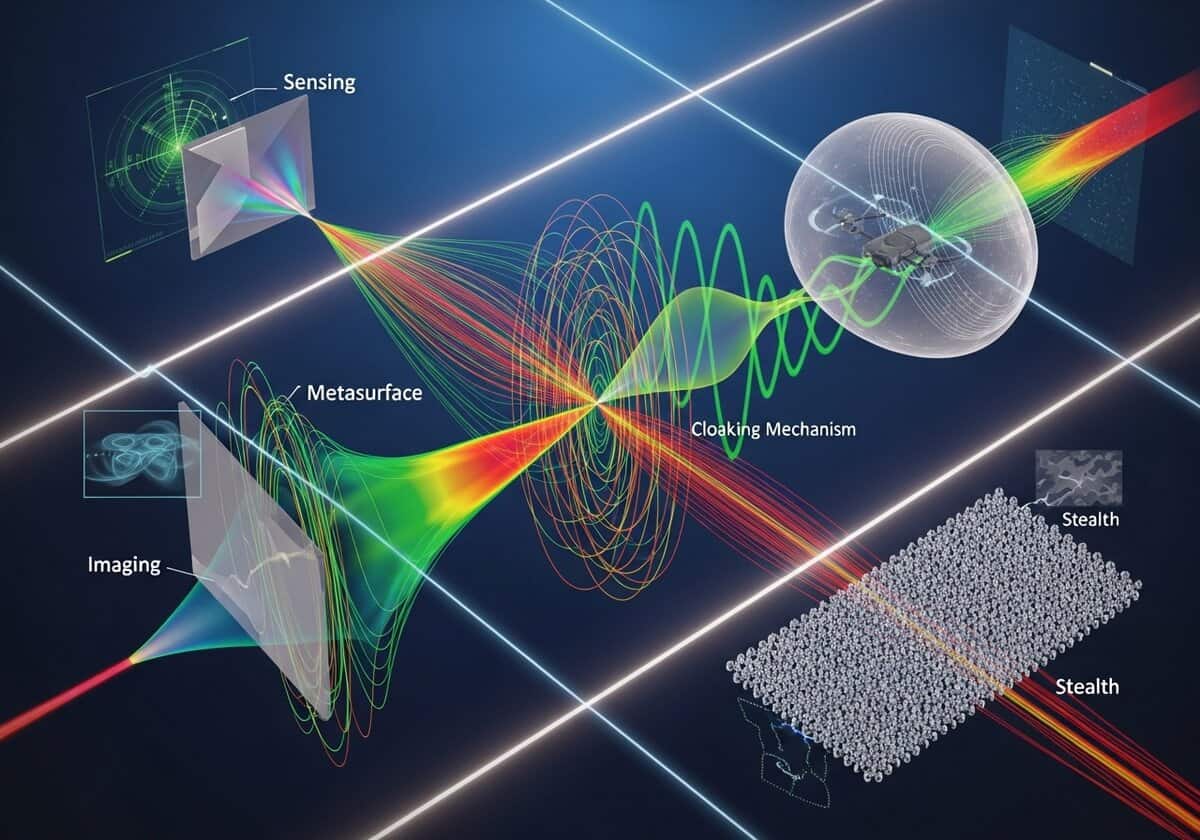

Les métamatériaux sont des structures artificielles qui présentent des propriétés électromagnétiques, acoustique, or mechanical properties unattainable in natural materials, achieved through subwavelength patterning and tailored unit cell design. This domain explores negative refractive indices, cloaking, superlensing, tunable responses, and anisotropic behavior across microwave, terahertz, optical, and acoustic regimes. Advances in metasurfaces, plasmonics, chiral configurations, and nonlinear effects enable unprecedented control over wave propagation, polarization, and dispersion. Our continuously updated compilation hereafter presents the latest peer-reviewed research and patented technologies addressing fabrication techniques, theoretical modeling, device integration, and application-specific innovations critical for next-generation sensing, imaging, communication, and stealth technologies:
Voici notre dernière sélection de publications et de brevets mondiaux en anglais sur les métamatériaux, parmi de nombreuses revues scientifiques en ligne, classées et axées sur l'indice de réfraction négatif, les métamatériaux électromagnétiques, les métamatériaux acoustiques, les cristaux photoniques, les métamatériaux plasmoniques, les métasurfaces, les métamatériaux chiraux, les métamatériaux hyperboliques, les métamatériaux accordables, les métamatériaux non linéaires, les absorbeurs à métamatériaux, les antennes à métamatériaux, les métamatériaux, l'occultation par métamatériaux, les filtres à métamatériaux, les résonateurs à métamatériaux, la dispersion des métamatériaux, la bande interdite des métamatériaux, le contrôle de la polarisation des métamatériaux et les superlentilles à métamatériaux.
Near-eye display module with metasurface structure
Patent published on the 2026-07-02 in US under Ref US20260186168 by NATIONAL YANG MING CHIAO TUNG UNIV [TW] (Chuang I Hsuan [tw], Liang Wenteng [tw], Yu Peichen [tw], Lin Chuanen [tw])
Abstract: A near-eye display module with metasurface structures includes a transparent substrate, a light incouple-outcouple structure and at least a metasurface structure. The light incouple-outcouple structure is located on a first surface of the transparent substrate. The metasurface structure is located on the first surface of the transparent substrate, in which the metasurface structure is configured for focusing or for two-dimensional exit pupil expansion, the metasurface structure comprises a plura[...]
Our summary: The near-eye display module features a metasurface structure for focusing and exit pupil expansion. It includes a transparent substrate with a light incouple-outcouple structure on its first surface. The metasurface comprises metaatoms with varying dimensions along a specific direction.
metasurface, near-eye display, light incouple-outcouple, transparent substrate
Patent
Metrology tool and components therefor
Patent published on the 2026-06-24 in EP under Ref EP4764700 by ASML NETHERLANDS BV [NL] (De Vocht David Johan Y [nl], Jiao Yuqing [nl], Setija Irwan Dani [nl], Bente Erwin Antonius Josephus Maria [nl], Liu Tianran [nl])
Abstract: [0001] An optical coupler for a photonic integrated circuit comprising a first channel waveguide configured to guide electromagnetic radiation comprising a first wavelength. The optical coupler comprises a second channel waveguide configured to guide electromagnetic radiation comprising a second wavelength that is different to the first wavelength. The optical coupler comprises a slab waveguide optically coupled to the first and second channel waveguides and configured to guide electromagnetic r[...]
Our summary: The content describes an optical coupler designed for a photonic integrated circuit. It includes a first and second channel waveguide for different wavelengths. Additionally, it features a slab waveguide, a computer-generated waveguide hologram, and a metasurface for enhanced optical coupling.
optical coupler, photonic integrated circuit, waveguide, metasurface
Patent
Electrically-reconfigurable metasurface with fully printed varactors
Patent published on the 2026-06-24 in EP under Ref EP4765493 by DAS PHOTONICS S L [ES] (GarcÍa Meca Carlos [es], Moreno Gallego De La Sacristana David [es])
Abstract: [0001] Electrically-Reconfigurable Metasurface with fully printed vertical varactors with a substrate, a plurality of unit cells, each cell comprising resonators and a vertical varactor coupling the resonators, the varactor having at least a lower electrode, at least an upper electrode, a tunable dielectric material between the lower and upper electrodes, the electrodes and tunable dielectric material being manufactured solely by an additive process.[...]
Our summary: This paper discusses an electrically-reconfigurable metasurface utilizing fully printed vertical varactors. Each unit cell consists of resonators coupled with a varactor featuring a tunable dielectric material. The entire structure is fabricated using an additive manufacturing process.
metasurface, varactors, additive manufacturing, tunable dielectric
Patent
Phase shifters including an electro-optic material
Patent published on the 2026-06-18 in US under Ref US20260169319 by GLOBALFOUNDRIES U S INC [US] (Bian Yusheng [us])
Abstract: [0000] Structures for a phase shifter and methods of forming such structures. The structure comprises a waveguide core and a metamaterial structure laterally adjacent to the waveguide core. The metamaterial structure includes a first plurality of portions and a second plurality of portions that alternate with the first plurality of portions. The waveguide core comprises an electro-optic material, the first plurality of portions comprise a first material having a first refractive index, and the s[...]
Our summary: The content describes a phase shifter structure that includes a waveguide core made of electro-optic material. It features a metamaterial structure adjacent to the waveguide core, consisting of alternating portions of two materials with different refractive indices. This design aims to enhance the functionality of phase shifters in optical applications.
phase shifters, electro-optic material, waveguide core, metamaterial structure
Patent
A sim-enabled wireless transmitter and communication system using unsupervised online learning
Patent published on the 2026-06-17 in EP under Ref EP4761121 by COMMISSARIAT ENERGIE ATOMIQUE [FR] (Mabrouk Asma [fr], Zayani Rafik [fr])
Abstract: There is provided a SIM-enabled transmitter comprising a base station, Stacked Intelligent Metasurfaces, SIM and a controller for jointly control the phase shifts of the electromagnetic waves passing through the meta-atoms of the SIM layers and the power allocated to each user equipment, using an unsupervised online dual-task deep-learning neural network. In response to the determination of an online channel estimation by the neural network, the transmitter implements iterations, each iteration [...]
Our summary: The system features a SIM-enabled transmitter with a base station and Stacked Intelligent Metasurfaces. It employs an unsupervised online dual-task deep learning neural network for channel estimation and control of electromagnetic wave phase shifts and power allocation. The process includes iterations of forward propagation, loss function determination, and backpropagation.
wireless communication, unsupervised learning, deep learning, metasurfaces
Patent
Dissipative engineering of non-hermitian skin effect photonics for non-magnetic chiral optical couplers
Patent published on the 2026-06-04 in US under Ref US20260153672 by REGENTS OF THE UNIV OF MICHIGAN [US] (Lee Chulwon [us], Deng Hui [us])
Abstract: [0000] An optical device is disclosed. The optical device includes a pair of optical waveguide structures forming an optical chiral router. The pair of optical waveguide structures includes a first optical waveguide structure formed of a first set of photonic crystal nanocavities, a second optical waveguide structure formed of a second set of photonic crystal nanocavities, the first optical waveguide structure being offset relative to the second optical waveguide structure to form auxiliary opti[...]
Our summary: The optical device features a pair of optical waveguide structures that create an optical chiral router. It utilizes photonic crystal nanocavities and auxiliary optical cavity modes. The design induces a chiral skin effect through loss-induced coupling and Z2 symmetry breaking.
non-hermitian, chiral optical couplers, photonic crystal, optical waveguide structures
Patent
Construction of near-? multiple chiral exceptional points in momentum space of photonic crystal slabs
Published on 2026-06-03 by Jingyu Zhang, Yang Gao, Tianfu Ma, Wenjia Li, Weimin Ye and Jianlong Liu @IOP SCIENCE
Abstract: Exceptional points (EPs) in optical systems have attracted considerable attention because of their nontrivial topological properties and unusual physical effects. Among them, scattering EPs are particularly appealing for describing chiral response through the scattering matrix. Photonic crystal slabs offer a versatile platform for studying chiral scattering EPs in momentum space, where their topological evolution can be conveniently accessed and engineered. In this work, a convenient approach is[...]
Our summary: This study presents a method to construct multiple chiral exceptional points (EPs) in the momentum space of photonic crystal slabs. The research identifies and analyzes the evolution of these EPs near the Γ point, highlighting their potential for polarization conversion. The findings suggest practical applications for controlling chiral EPs in optical metadevices.
chiral exceptional points, photonic crystal slabs, momentum space, topological properties
Publication
Topological phase transition induced by modulating unit cells in photonic Lieb lattice
Published on 2026-05-12 by Zhi-Kang Xiong, Y Liu (???), Xiying Fan and Bin Zhou @IOP SCIENCE
Abstract: Topological photonics was embarked from realizing the first-order chiral state in gyromagnetic media, but its higher-order states were mostly studied in dielectric lattice instead. In this paper we theoretically unveil a hierarchy of topological phases under broken time-reversal symmetry, which include the first-order Chern, and the second-order dipole, quadrupole phases. Concretely, by relaxing a certain spatial symmetry of unit cell, versatile topological phases including both edge and corner [...]
Our summary: This study reveals a hierarchy of topological phases in a photonic Lieb lattice under broken time-reversal symmetry. It identifies first-order Chern and second-order dipole and quadrupole phases by modulating unit cell symmetry. The findings may enhance sublattice engineering for robust waveguides and integrated photonic circuits.
Topological phase transition, Photonic Lieb lattice, Time-reversal symmetry, Gyromagnetic photonic crystals
Publication