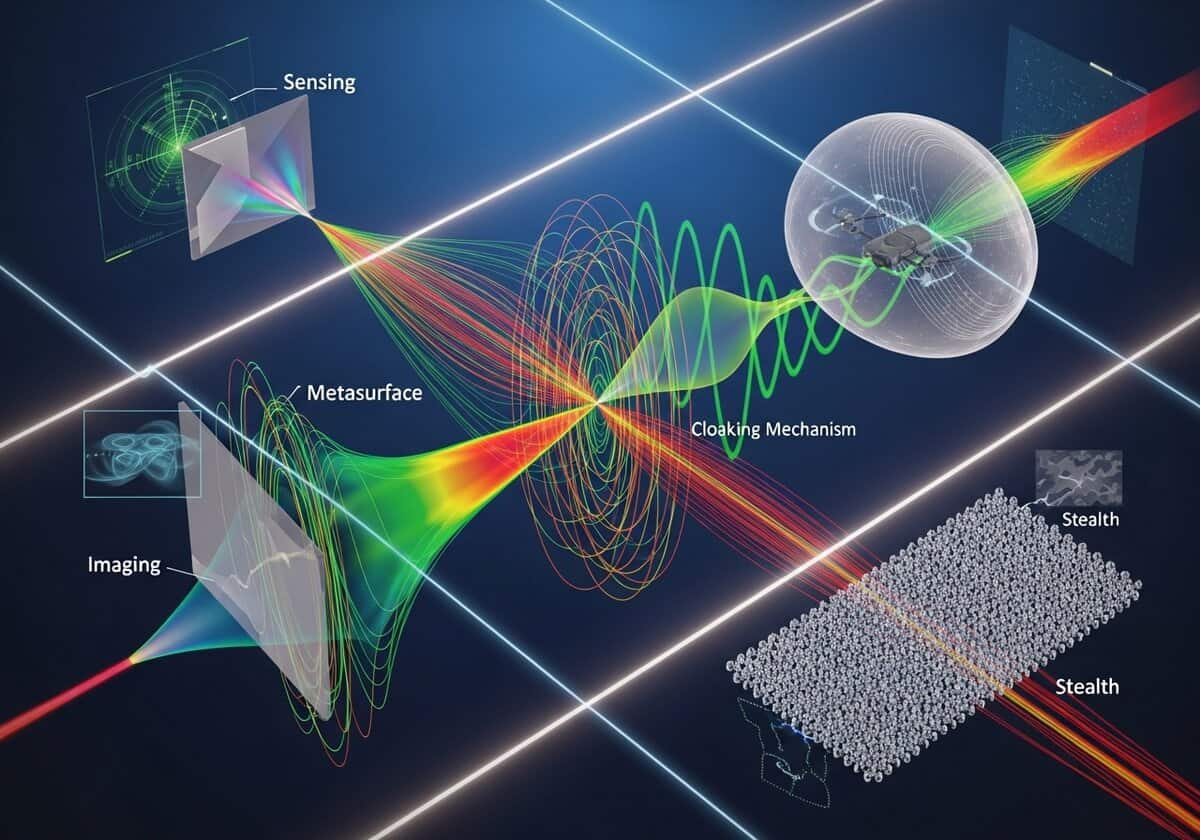

मेटासामग्री कृत्रिम रूप से निर्मित संरचनाएं होती हैं जो प्राकृतिक सामग्रियों में न पाए जाने वाले विद्युत चुम्बकीय, ध्वनिक या यांत्रिक गुणों को प्रदर्शित करती हैं, जिन्हें उप-तरंगदैर्ध्य पैटर्न और अनुकूलित इकाई कोशिका डिजाइन के माध्यम से प्राप्त किया जाता है। यह क्षेत्र माइक्रोवेव, टेराहर्ट्ज़, ऑप्टिकल और ध्वनिक क्षेत्रों में नकारात्मक अपवर्तक सूचकांक, आवरण, सुपरलेंसिंग, ट्यूनेबल प्रतिक्रियाओं और विषमदैशिक व्यवहार का अन्वेषण करता है। मेटासर्फेस, प्लास्मोनिक्स, चिरल विन्यास और गैर-रेखीय प्रभावों में प्रगति तरंग प्रसार, ध्रुवीकरण और फैलाव पर अभूतपूर्व नियंत्रण सक्षम बनाती है। हमारा निरंतर अद्यतन संकलन आगे अगली पीढ़ी की संवेदन, इमेजिंग, संचार और गुप्त तकनीकों के लिए महत्वपूर्ण निर्माण तकनीकों, सैद्धांतिक मॉडलिंग, उपकरण एकीकरण और अनुप्रयोग-विशिष्ट नवाचारों से संबंधित नवीनतम सहकर्मी-समीक्षित अनुसंधान और पेटेंट प्रौद्योगिकियों को प्रस्तुत करता है।
मेटासामग्रियां अपने गुणधर्म रसायन विज्ञान के बजाय ज्यामिति से प्राप्त करती हैं, इसलिए कई संबंधित क्षेत्र लागू होते हैं। तरंग व्यवहार को इसमें शामिल किया गया है। अप्टिक्स और ध्वनि-विज्ञानएंटीना और रडार डिजाइनरों को भी इसे पढ़ना चाहिए। 5जी और 6जी वायरलेस नेटवर्कसूक्ष्म पैमाने पर निर्माण प्रक्रिया निम्नलिखित पर आधारित है: एडिटिव मैन्युफैक्चरिंग.
यह मेटामटेरियल्स पर अंग्रेजी में विश्वव्यापी प्रकाशनों और पेटेंटों का हमारा नवीनतम चयन है, जिसमें कई वैज्ञानिक ऑनलाइन जर्नल शामिल हैं, और यह ऋणात्मक अपवर्तक सूचकांक, विद्युत चुम्बकीय मेटामटेरियल्स, ध्वनिक मेटामटेरियल्स, फोटोनिक क्रिस्टल, प्लास्मोनिक मेटामटेरियल्स, मेटासतह, काइरल मेटामटेरियल्स, हाइपरबॉलिक मेटामटेरियल्स, ट्यून करने योग्य मेटामटेरियल्स, गैर-रेखीय मेटामटेरियल्स, मेटामटेरियल अवशोषक, मेटामटेरियल एंटेना, मेटामटेरियल, मेटामटेरियल क्लोकिंग, मेटामटेरियल फिल्टर, मेटामटेरियल रेज़ोनेटर, मेटामटेरियल फैलाव, मेटामटेरियल बैंडगैप, मेटामटेरियल ध्रुवीकरण नियंत्रण और मेटामटेरियल सुपरलेंस पर केंद्रित है।
Metasurface Feature Detection and Related Methods
Patent published on the 2026-11-19 in US under Ref US20260368854 by FORCHERIO GREGORY [US] (Valentine Jason G [us], Swartz Brandon [us], Forcherio Gregory [us], Zheng Hanyu [us])
Abstract: A device may image an object through a first optic to obtain a first image, wherein the first optic comprises a first refractive lens. A device may image the object through a second optic to obtain a second image, wherein the second optic comprises a second refractive lens and a metasurface. A device may subtract the first image and the second image to obtain a feature-encoded image.[...]
Our summary: This content discusses a device that uses two optics to capture images of an object. The first optic is a refractive lens, while the second optic incorporates a metasurface. By subtracting the first image from the second, a feature-encoded image is produced.
Metasurface, Feature Detection, Image Subtraction, Optical Imaging
Patent
Dynamic metasurface for differential magnetic resonance imaging enhancement
Patent published on the 2026-11-19 in WO under Ref WO2026241343 by UNIV PENNSYLVANIA [US] (Jacobs Paul [us], Elliott Mark [us], Reddy Ravinder [us], Mizsei Gabor [us])
Abstract: A metasurface component, comprising: a plurality of unit cells, a unit cell comprising a plurality of variable capacitors in electronic communication with one another, a unit cell defining a conductive edge along which a variable capacitor is located, and the plurality of unit cells comprising a first unit cell and a second unit cell that share therebetween a common conductive edge and share a variable capacitor located along the common conductive edge, and the plurality of unit cells optionally[...]
Our summary: A dynamic metasurface component enhances differential magnetic resonance imaging. It consists of multiple unit cells with variable capacitors and a shared conductive edge. The system integrates a magnetic resonance scanner with the metasurface to improve imaging quality.
metasurface, magnetic resonance imaging, variable capacitors, differential enhancement
Patent
Photonic crystal laser
Patent published on the 2026-11-19 in WO under Ref WO2026239119 by VECTOR PHOTONICS LTD [GB] (Carr Andrew [gb], Orchard Jonathan Robert [gb], Ivanov Pavlo [gb], Taylor Richard [gb])
Abstract: A photonic crystal laser comprising an active layer within which radiation is generated and coupled into a photonic crystal layer is provided. The photonic crystal layer comprises a first region with an equilateral triangular shaped area having an array of scattering centres configured to define fundamental lattice vectors of the photonic crystal layer. A reflector borders the photonic crystal layer wherein the relative orientation of the fundamental lattice vectors and the reflectors act to cro[...]
Our summary: A photonic crystal laser features an active layer generating radiation coupled into a photonic crystal layer. The crystal layer includes a triangular region with scattering centres defining lattice vectors. The design enables strong cross-coupling of light modes within the photonic crystal.
Photonic crystal, laser technology, scattering centres, optical coupling
Patent
Reconfigurable photonic computing processor
Patent published on the 2026-11-19 in WO under Ref WO2026241270 by COLORADO SCHOOL OF MINES [US] (Abou-Hamdan Loubnan [us], Genevet Patrice [us], Marinov Emil [us], Juliano Martins Renato [fr])
Abstract: A system for nonlinear optical computation includes one or more reconfigurable metasurface structures arranged along an optical propagation axis, each reconfigurable metasurface structures including an array of individually addressable pixels, at least some of the individually addressable pixels including voltage-actuated liquid-crystal unit cells configured to provide tunable modulation in response to drive voltages, wherein the structures are configured to receive photonic radiation; a multich[...]
Our summary: The system utilizes reconfigurable metasurfaces for nonlinear optical computation. It employs voltage-actuated liquid-crystal unit cells for tunable modulation. A multichannel electrical controller applies drive voltages based on learned and input-data-dependent phase profiles.
Reconfigurable metasurfaces, Nonlinear optical computation, Liquid-crystal unit cells, Photonic radiation
Patent
cuboctahedral-lattice devices and methods for falsifiable metrology, auditable volumetric
Patent published on the 2026-11-19 in WO under Ref WO2026239166 by HILL BRADLEY B [US] (Hill Bradley [us])
Abstract: A unified family of cuboctahedral-lattice devices and methods is disclosed. Four foundational primitives — discrete cuboctahedral unit (CU) substrate; Scale Coupling Constant SCC = exp(2π/13) implemented as a thirteen-element coordination cadence derived from CU coordination geometry; boundary-versus-volume information accounting axiom; and falsifier discipline embedding measurable engineering acceptance criteria — are reduced to seven device groups: ringdown spectral comb metrology (RSCM);[...]
Our summary: A unified family of cuboctahedral-lattice devices and methods is presented. It includes foundational primitives and seven device groups for various applications. Each device supports tamper-evident Conservation Receipts for auditable deployments.
cuboctahedral-lattice, metrology, auditable, devices
Patent
Electromagnetic control articles
Patent published on the 2026-11-19 in US under Ref US20260371543 by 3M INNOVATIVE PROPERTIES CO [US] (Manuilov Sergei A [us], Lemesh Ivan [us], Kim Jaewon [us], Eckel Joseph B [us], Graff Michael S [us])
Abstract: Articles to control an electromagnetic (EM) radiation in the range of 1 GHz to 100 GHz, and methods of making and using the same are provided. An EM controlling sheet structure includes a dielectric carrier layer and an array of metallic resonant elements supported by the dielectric carrier layer to form an EM metamaterial structure in a non-random pattern. The metallic resonant elements are oriented such that each metallic resonant element has an axis substantially parallel to each other and su[...]
Our summary: This content discusses articles for controlling electromagnetic radiation from 1 GHz to 100 GHz. It describes an electromagnetic controlling sheet structure with a dielectric carrier layer and metallic resonant elements. The elements are arranged in a non-random pattern to form an effective metamaterial structure.
Electromagnetic control, metamaterials, dielectric carrier, resonant elements
Patent
Expansion of Bragg reflection width in elastomer-immobilized colloidal photonic crystals via binary monomer mixing
Published on 2026-10-16 by Miyu Makino, Momoko Kobori, Toshimitsu Kanai @NATURE
Abstract: Polymer Journal, Published online: 16 October 2026; doi:10.1038/s41428-026-01262-6A simple method for expanding the Bragg reflection width of elastomer-immobilized, nonclose-packed colloidal photonic crystal films using a mixture of two types of elastomer precursors was proposed. For the elastomer-immobilized, nonclose-packed colloidal photonic crystal film exclusively prepared using 4-hydroxybutyl acrylate (4HBA), the full width at half maximum of the Bragg reflection peak was 19 nm; this val[...]
Our summary: A method for expanding the Bragg reflection width in elastomer-immobilized colloidal photonic crystals was developed using a binary mixture of elastomer precursors. The addition of 2-hydroxyethyl methacrylate significantly increased the Bragg reflection peak width from 19 nm to 186 nm. This technique aims to enhance the use of these crystals in structural color applications and optical filtering.
Bragg reflection, colloidal photonic crystals, elastomer precursors, optical filters
Publication
Autonomous physics-guided discovery of functionally graded metamaterials
Published on 2026-09-21 by @OXFORD
Abstract: AbstractDesigning functionally graded lattices requires control of the architecture under complex loading, yet conventional workflows often rely on static datasets and sequential simulations. We developed VortexOp, a physics-informed active-learning framework for the automated design of functionally graded triply periodic minimal surface (TPMS) lattices. The workflow combines implicit TPMS generation, a GPU-accelerated finite element solver, and constrained Bayesian optimization. Gaussian Proces[...]
Our summary: VortexOp is a physics-informed framework for designing functionally graded metamaterials. It combines TPMS generation, a GPU-accelerated solver, and Bayesian optimization. The approach improves structural reliability and material efficiency, achieving significant reductions in failure indices compared to uniform lattices.
metamaterials, active-learning, optimization, finite-element
Publication