Even a very basic 2 parts mold fly swatter can have design flaws. The major defect here is constraint concentration due to the design of aesthetical shapes, damaging the product after just a couple of usages.
Disclaimer: innovation.world has no financial incentive whatsoever, nor any ownership in the product reviewed. Products are chosen based on the only factor of having interesting or original designs to share with other industries. These products are on the market for years; Innovation.world has not and does not disclose any special or confidential information, but only what is visible by dismounting, observation and knowledge from similar technologies. Note however that these designs may be patented by their respective owners.
We could not find copyright info for this product
The product is in fact very basic. A one-part molded swatter consisting of a branch (the user interface) plus the net (the actuator!).
Requirements are minimal in the design phase:
- some flexibility in the arm as in the net (the net will never impact the wall perfectly parallel; as the user is not expected to stop exactly when hitting the target, this is somehow also a security feature for objects in the user’s house)
- the net has to be hollowed as much as possible to let air pass through and not around to have speed so as to keep the fly in the center instead of flowing it aside; this plus the thin shape, requires of course a more-than-usual injection pressure for a part of this size
- low cost means no assembly and no additional packaging. A label will just be attached to the net in the shop
- very high volume production
Design and Manufacture
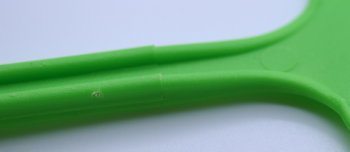
It is in fact reasonably well produced for a product of this price category.
Of course not too much attention to what is probably mold modification (see junctions of likely modified surfaces to have rigidity)
The euro sign on the net is still a choice mystery (do you get paid for each fly caught?); probably just to “have something” and look a bit more elaborate.
TIP: not critical, but any other shape (a fly, a bug, a star, a smiley … ) would have permit to sell that outside Europe also without too much question on that
Crack Propagation Due to Shapes
After 5-6 usages … well that’s how the product fails:

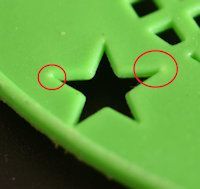
The star shapes put around the net start to crack, either a real crack or some white discoloration, proving the plastic is over-stressed.
And in the star closest to the handle, where the constraint is maximal, the cracks just propagate to the diagonal of holes making the net.
The product is damaged in less than a day.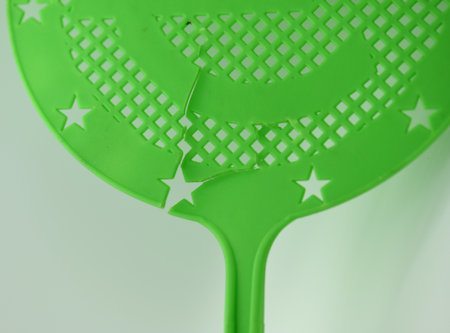
The rest of this article is reserved for members
To limit scraping bots (currently 40,000 hits per day!),
we had to restrict access to full articles and tools to registered members only.
to access all the rest.