Product Design, Manufacturing & Innovation Resources
Hogar » Túnel cuántico

Túnel cuántico

1927
  • Friedrich Hund
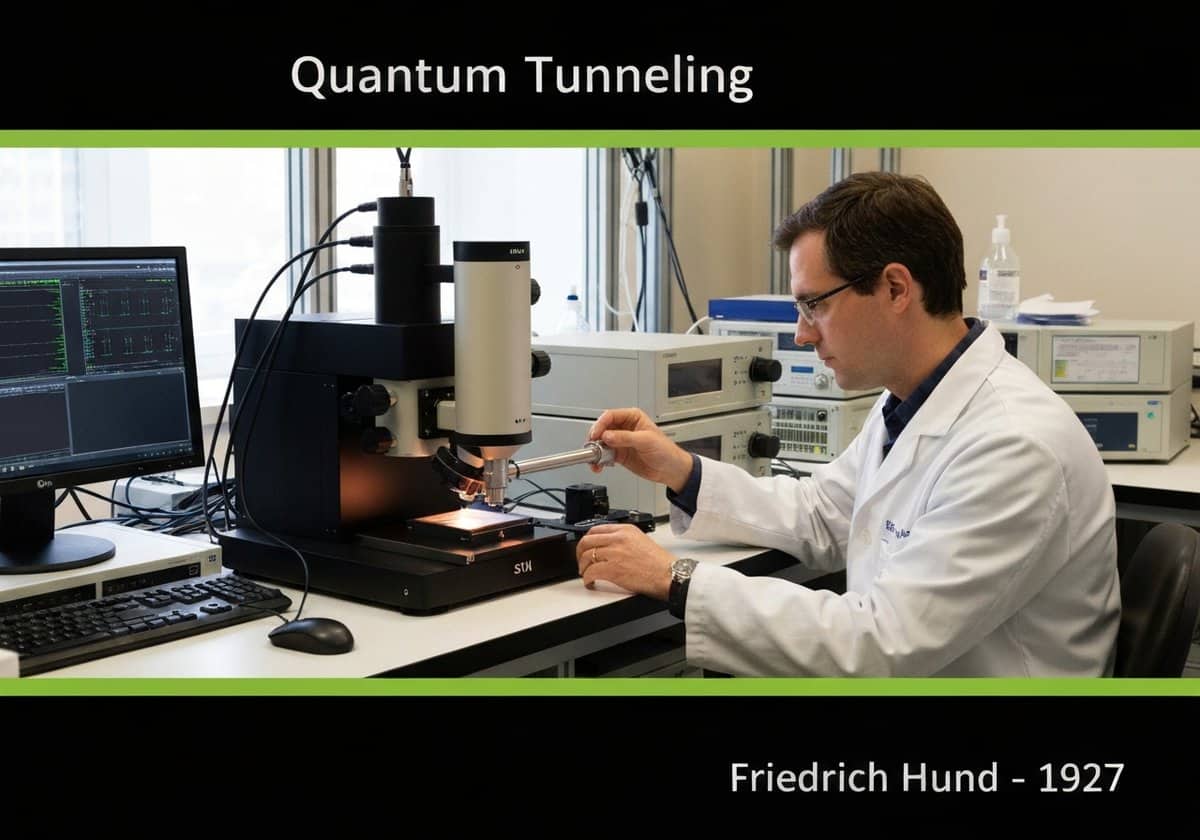
Microscopio de efecto túnel de barrido en un laboratorio para demostrar los principios del efecto túnel cuántico.

(Imagen generada únicamente con fines ilustrativos)

Fenómeno cuántico en el que una función de onda puede propagarse a través de una barrera de energía potencial. Clásicamente, una partícula que carece de la energía suficiente para superar una barrera se reflejaría. Sin embargo, debido a la naturaleza ondulatoria de las partículas, existe una probabilidad no nula de que la partícula aparezca al otro lado de la barrera, atravesándola efectivamente mediante un efecto túnel.

Quantum tunneling is a direct consequence of the Heisenberg uncertainty principle and the probabilistic nature of a particle’s location described by its wavefunction. When a particle’s wavefunction encounters a potential barrier, it does not abruptly drop to zero. Instead, it decays exponentially inside the barrier. If the barrier is thin enough, the wavefunction can have a small but non-zero amplitude on the other side. Since the probability of finding the particle is related to the square of the wavefunction’s amplitude, there is a finite probability of the particle being detected on the far side of the barrier.

The probability of tunneling decreases exponentially with the thickness of the barrier and the square root of the barrier’s height and the particle’s mass. This is why tunneling is significant for microscopic particles like electrons but negligible for macroscopic objects. For example, in nuclear fusion within the Sun, protons do not have enough thermal energy to overcome their mutual electrostatic repulsion (the Coulomb barrier). Fusion is only possible because the protons can tunnel through this barrier, allowing the strong nuclear force to bind them together. Similarly, the scanning tunneling microscope (STM) works by measuring the tunneling current of electrons between a sharp metallic tip and a sample surface, allowing for imaging with atomic resolution.

UNESCO Nomenclature: 2210
- Física cuántica

Tipo

Sistema abstracto

Ruptura

Sustancial

Uso

Uso generalizado

Precursores

  • Schrödinger equation (1926)
  • Dualidad onda-partícula
  • Estudios de radiactividad (desintegración alfa)
  • Principio de incertidumbre de Heisenberg (1927)

Aplicaciones

  • microscopio de efecto túnel (STM)
  • diodos túnel en electrónica
  • memoria flash (transistores de puerta flotante)
  • fusión nuclear en las estrellas
  • Desintegración alfa de núcleos atómicos

Patentes:

NA

Ideas para posibles innovaciones

Debido al bloqueo del tráfico generado por bots, que actualmente supera los 40.000 al día, este contenido está reservado para los miembros de la comunidad.
> Iniciar sesión < o > Registrarse < (100% gratis) para acceder a esto, al igual que a todo el demás contenido y herramientas restringidos.

Relacionado con: tunelización cuántica, función de onda, barrera de potencial, microscopio de efecto túnel, fusión nuclear, desintegración alfa, mecánica cuántica, probabilidad.

Contexto histórico

Túnel cuántico

1925
1926
1927
1927
1930
1930
1930
1925
1926
1926
1927
1930
1930
1930
1931

(Si la fecha es desconocida o no es relevante, por ejemplo "mecánica de fluidos", se proporciona una estimación redondeada de su aparición notable)

Invención, innovación y principios técnicos relacionados.

Las imágenes a tamaño completo y las descargas sólo están disponibles, 100% gratis, para los miembros registrados.

> Acceso <