Micromecanizado masivo para MEMS
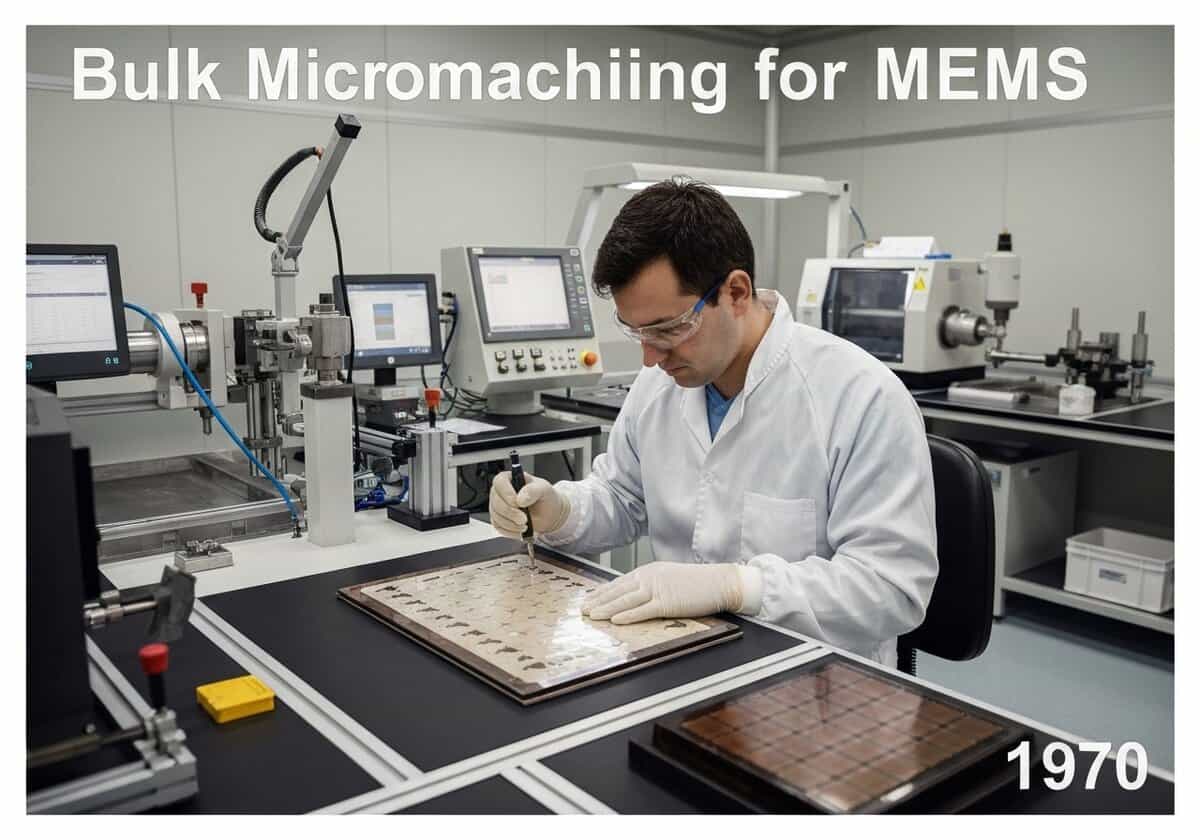
El micromecanizado volumétrico es un proceso de fabricación sustractiva que crea MEMS Este proceso crea estructuras mediante el grabado selectivo de un sustrato, generalmente una oblea de silicio. Se utilizan técnicas de grabado húmedo o seco para dar forma al material. Es común emplear grabadores anisotrópicos como el hidróxido de potasio (KOH), ya que graban los distintos planos cristalinos del silicio a diferentes velocidades, lo que permite crear ranuras en V y cavidades precisas.
El micromecanizado volumétrico es uno de los métodos más antiguos y consolidados para la creación de MEMS. Como proceso sustractivo, consiste en esculpir las características del dispositivo directamente a partir del volumen de un sustrato, generalmente una oblea de silicio monocristalino. La técnica se basa en gran medida en el grabado, que puede clasificarse en húmedo (químico) o seco (a base de plasma).
Wet etching is the more traditional approach. It can be isotropic, etching at the same rate in all directions, which results in rounded, undercut features. More commonly for MEMS, anisotropic wet etching is used. This method exploits the fact that the etch rate in single-crystal silicon depends on the crystallographic orientation. Etchants like potassium hydroxide (KOH), tetramethylammonium hydroxide (TMAH), and ethylenediamine pyrocatechol (EDP) etch the (100) and (110) crystal planes much faster than the (111) planes. By aligning the mask pattern with the crystal axes on a (100)-oriented wafer, this property can be used to create precisely defined structures with angled sidewalls, such as V-grooves for fiber optics or pyramidal pits. The (111) planes act as natural etch-stops, allowing for excellent control over the final geometry. Diaphragms for pressure sensors are a classic application, formed by etching from the backside of a wafer until an etch-stop layer (like a heavily doped boron layer or an electrochemical stop at a p-n junction) is reached.
El grabado en seco, en particular el grabado iónico reactivo profundo (DRIE), se ha convertido en una técnica dominante de micromecanizado en masa. El DRIE permite la creación de estructuras muy profundas y de alta relación de aspecto con paredes laterales casi verticales, algo imposible con el grabado húmedo. El método más común es el «proceso Bosch», que alterna entre una etapa de grabado (utilizando un plasma como el SF6) y una etapa de pasivación (utilizando un gas polimerizante como el C4F8). La capa de pasivación protege las paredes laterales del grabado, lo que obliga a que este se produzca principalmente en dirección vertical. Este ciclo se repite cientos o miles de veces para alcanzar profundidades de cientos de micras. El DRIE es esencial para la fabricación de sensores inerciales modernos de alto rendimiento, dispositivos microfluídicos y vías pasantes de silicio (TSV) para el apilamiento de chips 3D.
UNESCO Nomenclature: 3313
- Ingeniería industrial
Precursores
- crystal orientation knowledge in silicon wafers
- development of chemical etchants for silicon
- photolithography for pattern definition
- masking materials resistant to etchants (e.g., silicon nitride)
Aplicaciones
- pressure sensor diaphragms
- inkjet printer nozzles
- microfluidic channels
- atomic force microscope (AFM) cantilevers
- v-grooves for optical fiber alignment
Ideas para posibles innovaciones
Debido al bloqueo del tráfico generado por bots, que actualmente supera los 40.000 al día, este contenido está reservado para los miembros de la comunidad.
> Iniciar sesión < o > Registrarse < (100% gratis) para acceder a esto, al igual que a todo el demás contenido y herramientas restringidos.
Relacionado con: micromecanizado volumétrico, MEMS, grabado, silicio, grabado anisotrópico, KOH, DRIE, grabado iónico reactivo profundo, proceso sustractivo, microfabricación.