양자역학적 현상 중 하나로, 파동 함수가 퍼텐셜 에너지 장벽을 통과할 수 있는 현상입니다. 고전 역학적으로, 장벽을 넘을 만큼 충분한 에너지가 없는 입자는 반사됩니다. 그러나 입자의 파동적 성질 때문에, 입자가 장벽 반대편에 도달할 확률이 0이 아니며, 이를 효과적으로 '터널링'이라고 합니다.

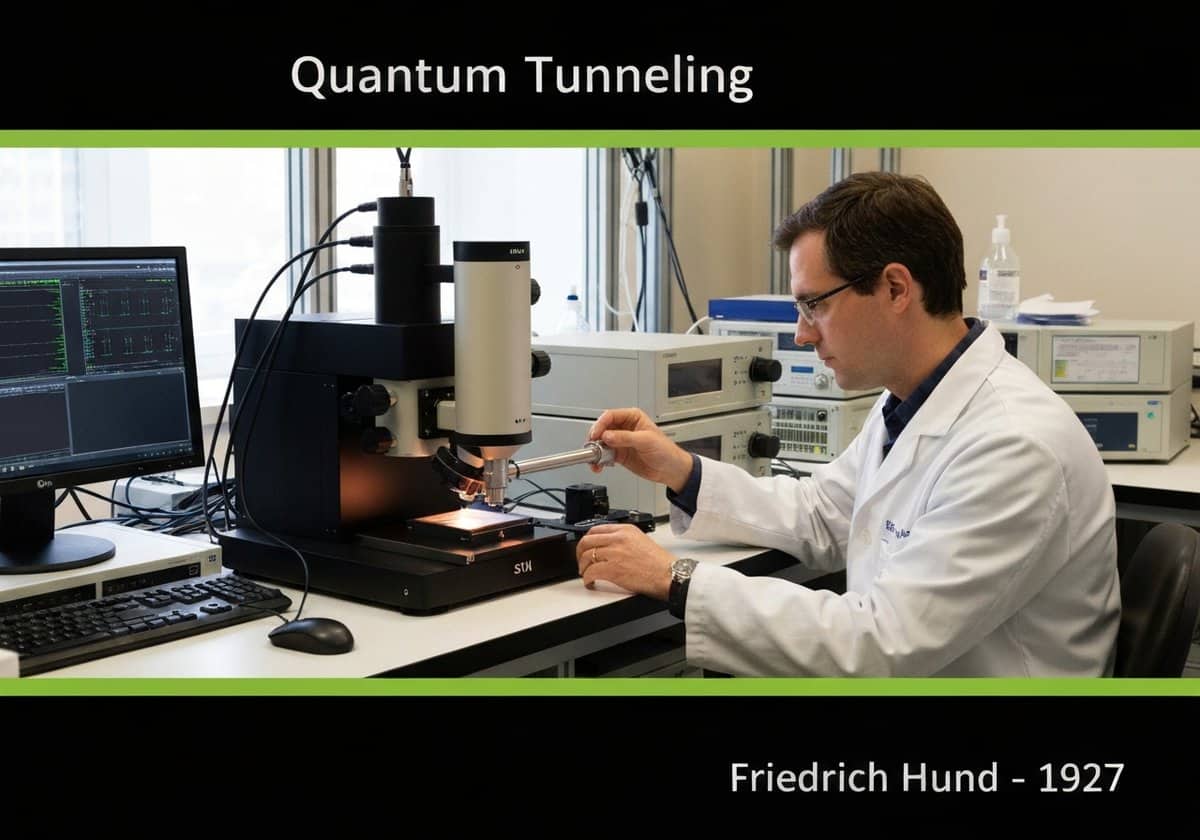
(설명을 위한 생성된 이미지입니다)
양자역학적 현상 중 하나로, 파동 함수가 퍼텐셜 에너지 장벽을 통과할 수 있는 현상입니다. 고전 역학적으로, 장벽을 넘을 만큼 충분한 에너지가 없는 입자는 반사됩니다. 그러나 입자의 파동적 성질 때문에, 입자가 장벽 반대편에 도달할 확률이 0이 아니며, 이를 효과적으로 '터널링'이라고 합니다.
Quantum tunneling is a direct consequence of the Heisenberg uncertainty principle and the probabilistic nature of a particle’s location described by its wavefunction. When a particle’s wavefunction encounters a potential barrier, it does not abruptly drop to zero. Instead, it decays exponentially inside the barrier. If the barrier is thin enough, the wavefunction can have a small but non-zero amplitude on the other side. Since the probability of finding the particle is related to the square of the wavefunction’s amplitude, there is a finite probability of the particle being detected on the far side of the barrier.
The probability of tunneling decreases exponentially with the thickness of the barrier and the square root of the barrier’s height and the particle’s mass. This is why tunneling is significant for microscopic particles like electrons but negligible for macroscopic objects. For example, in nuclear fusion within the Sun, protons do not have enough thermal energy to overcome their mutual electrostatic repulsion (the Coulomb barrier). Fusion is only possible because the protons can tunnel through this barrier, allowing the strong nuclear force to bind them together. Similarly, the scanning tunneling microscope (STM) works by measuring the tunneling current of electrons between a sharp metallic tip and a sample surface, allowing for imaging with atomic resolution.
현재 하루 4만 건이 넘는 봇 트래픽을 차단하기 위해 이 콘텐츠는 커뮤니티 회원만 이용할 수 있습니다.
> 로그인 < 또는 >등록 < 이 콘텐츠를 비롯한 모든 제한된 콘텐츠와 도구는 (100% 무료로) 이용할 수 있습니다.
양자 터널링
(날짜를 알 수 없거나 관련이 없는 경우, 예를 들어 "유체역학"의 경우, 주목할 만한 등장 시기를 대략적으로 추정하여 제공합니다.)
고화질 이미지 및 다운로드는 등록된 회원에게만 100% 무료로 제공됩니다.
> 로그인 <