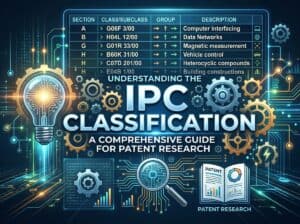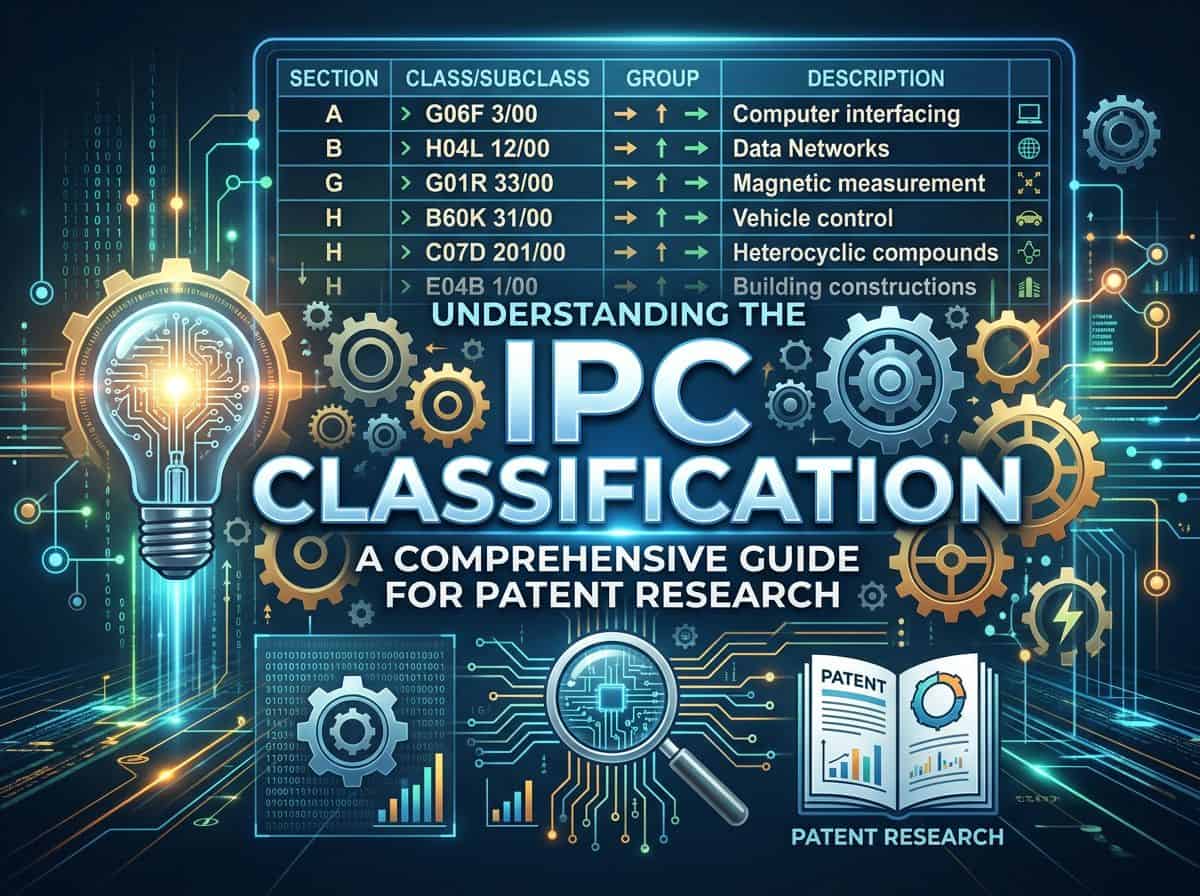
The IPC classification (International Patent Classification) is the common language that patent offices around the world use to sort inventions by technical field. Every patent document carries one or more IPC codes, and knowing what those codes mean is the fastest way to run a precise patent classification search, map a technology, or check how crowded a field is.
This page gives you the complete list of IPC codes of the 2026.01 edition, with their level, parent code, official title and full path, in one searchable and sortable table.
Whether you are a patent attorney, an R&D engineer, a technology scout, an examiner or a student, you can look up any IPC code in seconds and find out which technical field it covers.
IPC codes list: search all 80,145 IPC classification symbols
Type a keyword (for example Batterie, neuronales Netzwerk oder Schweißen) in the search box to find every IPC code whose title contains it, or type a code or a code prefix (for example H02M oder G06N3) in the column filters under the table. Click any column header to sort.
| Code | Ebene | Parent code | Titel | Full path |
|---|---|---|---|---|
| A | 1 | HUMAN NECESSITIES | HUMAN NECESSITIES | |
| A01 | 2 | A | AGRICULTURE; FORESTRY; ANIMAL HUSBANDRY; HUNTING; TRAPPING; FISHING | AGRICULTURE; FORESTRY; ANIMAL HUSBANDRY; HUNTING; TRAPPING; FISHING |
| A01B | 3 | A01 | SOIL WORKING IN AGRICULTURE OR FORESTRY; PARTS, DETAILS, OR ACCESSORIES OF AGRICULTURAL MACHINES OR IMPLEMENTS, IN GENERAL | SOIL WORKING IN AGRICULTURE OR FORESTRY; PARTS, DETAILS, OR ACCESSORIES OF AGRICULTURAL MACHINES OR IMPLEMENTS, IN GENERAL |
| A01B1/00 | 4 | A01B | Hand tools | Hand tools |
| A01B1/02 | 5 | A01B1/00 | Spades; Shovels | Hand tools › Spades; Shovels |
| A01B1/04 | 5 | A01B1/02 | with teeth | Hand tools › Spades; Shovels › with teeth |
| A01B1/06 | 5 | A01B1/00 | Hoes; Hand cultivators | Hand tools › Hoes; Hand cultivators |
| A01B1/08 | 5 | A01B1/06 | with a single blade | Hand tools › Hoes; Hand cultivators › with a single blade |
| A01B1/10 | 5 | A01B1/06 | with two or more blades | Hand tools › Hoes; Hand cultivators › with two or more blades |
| A01B1/12 | 5 | A01B1/06 | with blades provided with teeth | Hand tools › Hoes; Hand cultivators › with blades provided with teeth |
| A01B1/14 | 5 | A01B1/06 | with teeth only | Hand tools › Hoes; Hand cultivators › with teeth only |
| A01B1/16 | 5 | A01B1/00 | Tools for uprooting weeds | Hand tools › Tools for uprooting weeds |
| A01B1/18 | 5 | A01B1/16 | Tong-like tools | Hand tools › Tools for uprooting weeds › Tong-like tools |
| A01B1/20 | 5 | A01B1/00 | Combinations of different kinds of hand tools | Hand tools › Combinations of different kinds of hand tools |
| A01B1/22 | 5 | A01B1/00 | Attaching the blades or the like to handles; Interchangeable or adjustable blades | Hand tools › Attaching the blades or the like to handles; Interchangeable or adjustable blades |
| A01B1/24 | 5 | A01B1/00 | for treating meadows or lawns | Hand tools › for treating meadows or lawns |
| A01B11/00 | 4 | A01B | Ploughs with oscillating, digging or piercing tools | Ploughs with oscillating, digging or piercing tools |
| A01B13/00 | 4 | A01B | Ploughs or like machines for special purposes | Ploughs or like machines for special purposes |
| A01B13/02 | 5 | A01B13/00 | for making or working ridges, e.g. with symmetrically arranged mouldboards | Ploughs or like machines for special purposes › for making or working ridges, e.g. with symmetrically arranged mouldboards |
| A01B13/04 | 5 | A01B13/00 | for working in vineyards, orchards, or the like | Ploughs or like machines for special purposes › for working in vineyards, orchards, or the like |
| A01B13/06 | 5 | A01B13/04 | Arrangements for preventing damage to the vines, or the like | Ploughs or like machines for special purposes › for working in vineyards, orchards, or the like › Arrangements for preventing damage to the vines, or the like |
| A01B13/08 | 5 | A01B13/00 | for working subsoil | Ploughs or like machines for special purposes › for working subsoil |
| A01B13/10 | 5 | A01B13/08 | Special implements for lifting subsoil layers | Ploughs or like machines for special purposes › for working subsoil › Special implements for lifting subsoil layers |
| A01B13/12 | 5 | A01B13/10 | Means for distributing the layers on the surface | Ploughs or like machines for special purposes › for working subsoil › Special implements for lifting subsoil layers › Means for distributing the layers on the surface |
| A01B13/14 | 5 | A01B13/00 | for working soil in two or more layers | Ploughs or like machines for special purposes › for working soil in two or more layers |
| A01B13/16 | 5 | A01B13/00 | Machines for combating erosion, e.g. basin-diggers, furrow-dammers | Ploughs or like machines for special purposes › Machines for combating erosion, e.g. basin-diggers, furrow-dammers |
| A01B15/00 | 4 | A01B | Elements, tools, or details of ploughs | Elements, tools, or details of ploughs |
| A01B15/02 | 5 | A01B15/00 | Plough blades; Fixing the blades | Elements, tools, or details of ploughs › Plough blades; Fixing the blades |
| A01B15/04 | 5 | A01B15/02 | Shares | Elements, tools, or details of ploughs › Plough blades; Fixing the blades › Shares |
| A01B15/06 | 5 | A01B15/04 | Interchangeable or adjustable shares | Elements, tools, or details of ploughs › Plough blades; Fixing the blades › Shares › Interchangeable or adjustable shares |
| Code | Ebene | Parent code | Titel | Full path |
How to read an IPC code
An IPC code is a hierarchy written as a short string. Take H02M 1/00 (written H02M1/00 without spaces in this table):
- H is the Abschnitt: Electricity.
- H02 is the class: generation, conversion or distribution of electric power.
- H02M is the subclass: apparatus for conversion between AC and DC, and so on.
- H02M 1/00 is the main group: details of apparatus for conversion.
- H02M 1/088 ist eine subgroup, a more precise topic inside that main group.
In the table, the Ebene column gives this depth: 1 = section, 2 = class, 3 = subclass, 4 = main group, 5 = subgroup. The Parent code column tells you where a code sits in the tree, and the Full path column chains the titles of the main group and its subgroups, so a short title such as Learning methods (G06N3/08) always reads in context: Neural networks › Learning methods.
The 8 IPC sections at a glance
Every IPC code starts with one of eight letters. Use them as a first filter when you explore a field:
- A – Human necessities (agriculture, food, health, medicine)
- B – Performing operations; transporting
- C – Chemistry; metallurgy
- D – Textiles; paper
- E – Fixed constructions
- F – Mechanical engineering; lighting; heating; weapons; blasting
- G – Physics (including computing and measurement)
- H – Electricity
The 2026.01 edition counts 8 sections, 132 classes, 655 subclasses, 7,668 main groups and 71,682 subgroups, 80,145 symbols in total.
Practical tips for an IPC code search
Start from a keyword, then move up the tree
Search a plain word to find the most specific codes, then use the Parent code to climb to the broader main group or subclass. Searching a subclass (level 3) is the best way to cover a whole field without missing neighbouring topics.
List all the subclasses in one click
Enter 3 in the Level filter to list the 655 subclasses only. This is the quickest overview of every technology field covered by the classification.
Use the code prefix to stay inside a field
Typing B60L in the Code filter returns everything about electric propulsion and charging of vehicles. Typing G06N returns machine learning, neural networks and other computing models based on specific computational models.
Do not rely on one code only
A patent is often given several IPC codes, and the examiner may use a main group (a code ending in /00) when no subgroup is precise enough. For a reliable patent landscape, search the main group and its subgroups together.
How to use the IPC classification in practice
The IPC classification is more than a catalogue: it is a working tool for four everyday tasks.
1. Prior-art and patentability searches
Keywords alone miss documents that describe the same invention with different words. Searching by IPC code finds them regardless of the vocabulary, in any language. A good routine is to run a keyword search, read the IPC codes of the best hits, then repeat the search with those codes.
2. Freedom-to-operate and competitor monitoring
Follow the main groups of your product or process, and list who files in them. A new applicant appearing in your subclass is an early signal worth watching.
3. Technology landscapes and trend analysis
Counting patent publications per subclass or main group over time shows which fields grow and which fade. Group at subclass level (4 characters, such as H02M) for a stable view, because the same invention may sit at main-group or subgroup level in different documents.
4. Filing and portfolio management
Applicants and attorneys use IPC codes to prepare the claims, choose the right offices and examiners, and organise an internal portfolio by technical field.
IPC vs other patent classifications: pros and cons
Several classification systems exist next to the IPC. The table compares the main ones.
| System | Vorteile | Nachteile |
|---|---|---|
| IPC (WIPO) | Used by almost every patent office; one code works in any country; free and published in several languages; stable structure, easy to learn. | Less detailed than CPC; fewer subdivisions in fast-moving fields such as software and batteries; updated once a year. |
| CPC (EPO and USPTO) | Much finer detail (about 250,000 entries); revised more often; indexing tags such as Y02 for climate technologies; used by the EPO, the USPTO and many other offices. | Not applied everywhere, so older or smaller-office documents may have IPC only; far larger and harder to master. |
| FI and F-term (Japan) | Very detailed, with extra viewpoints for searching Japanese documents. | Used mainly for Japanese documents; codes are not understood abroad. |
| USPC (United States) | Long history of fine-grained US classes. | Retired for new US utility patents in favour of CPC; useful only for older documents. |
When to choose the IPC
Pick the IPC for worldwide searches, for statistics that must be comparable between countries, and when you want a simple, stable structure. Pick the CPC when you need the finest detail on a technology, especially for documents from the EPO and the USPTO. In practice, professionals use both: start broad with the IPC, then refine with the CPC.
Der CPC (Cooperative Patent Classification) is built on top of the IPC. It keeps the IPC structure and adds many more subdivisions, plus tags such as the Y02 codes for climate change mitigation technologies. The IPC remains the international reference used by almost every patent office, which makes it the best starting point.
Who uses IPC codes and what for?
- Patent searchers and attorneys: prior-art and freedom-to-operate searches.
- R&D and innovation teams: technology monitoring and competitor analysis.
- Investors and analysts: measuring activity in a technology field.
- Students and researchers: understanding how technical fields are organised.
- … you: when you use some of the innovation.world patent tools, to filter out results.
Häufig gestellte Fragen
Who created and maintains the IPC classification?
The IPC was established by the Strasbourg Agreement of 1971, which entered into force in 1975, and it is administered by WIPO, the World Intellectual Property Organization. Its first edition dates back to 1968, and the Agreement has more than 60 contracting states.
Who decides how the IPC changes?
The revisions are prepared by the IPC Committee of Experts and its revision working group, with proposals coming mainly from national and regional patent offices, and they are adopted by the IPC Union, the group of Strasbourg Agreement members.
How often is the IPC updated?
Since 2010 the IPC has been revised every year, and each new version enters into force on 1 January (for example IPC 2026.01). Before that, new editions appeared roughly every five years.
How big is the IPC?
The 2026.01 edition contains 8 sections, 132 classes, 655 subclasses, 7,668 main groups and 71,682 subgroups, which makes 80,145 classification symbols in total.
How is an IPC symbol built?
It combines a section letter, a two-digit class number, a subclass letter, a main group number, a slash and a subgroup number, for example H02M 1/088. The hierarchy comes from the indentation dots of the subgroups in the official scheme, not from the numbers themselves, so a subgroup title only makes sense with its parent titles.
What is the difference between a main group and a subgroup?
A main group has a symbol ending in /00 and covers a broad topic, while subgroups below it narrow that topic down. An examiner uses a main group alone when no subgroup describes the invention precisely enough.
Who assigns IPC codes to a patent document?
The patent office that examines or publishes the document assigns them, not WIPO and not the applicant. The applicant may propose codes, but the office decides, which is why the same invention can carry different codes in different offices.
What is the “first” IPC code of a patent?
It is the main classification, the code that best represents the invention as a whole, followed by further codes for other aspects. Practices differ between offices, so the first code should be treated as the office’s best choice and not as a legal fact.
What do the letters after an IPC symbol in official data mean (for example “A I”)?
In the WIPO ST.8 data standard, they describe how the code was assigned. The classification level and “I” means invention information, as opposed to “N” for non-invention (additional) information. Since the core and advanced levels were abolished in 2016, these flags carry little analytical value.
How does the IPC differ from the CPC?
The CPC, launched in 2013 by the EPO and the USPTO, is built on the IPC structure but has about 250,000 entries and is revised more often. It also adds tags such as Y02 for climate change mitigation technologies. The IPC is the international baseline, and the CPC is the finer, more detailed layer.
In which languages is the IPC published?
WIPO publishes the official English and French versions, and national offices and international bodies provide translations, for example in Chinese, Japanese, Korean, Russian, German, Spanish and Portuguese.
What happens to old documents when a symbol is deleted or split?
Symbols can be created, moved, split or deleted in each revision, and WIPO publishes validity data that records the period when each symbol existed. Offices reclassify part of their backlog, but older documents may still carry symbols from earlier versions, so a long-term analysis must handle these changes.
How should I count patents by IPC code in statistics?
A patent usually has several codes, so you must choose between full counting (the patent counts once in every class it appears in) and fractional counting (it counts as 1 divided between its classes). Grouping at subclass level gives the most stable results over time.
Is there an official way to group IPC codes into technology fields?
Yes. WIPO publishes an IPC-technology concordance table that maps IPC symbols to 35 technology fields grouped into five sectors (electrical engineering, instruments, chemistry, mechanical engineering and other fields), widely used in economic and innovation studies.
Where can I get the official IPC data?
WIPO publishes the full scheme, the definitions and the validity files for download (XML) on its IPC site, and offers an online IPC publication browser. WIPO’s classification-suggestion tool PATCAT replaced the older IPCCAT service in 2025.