Abzählbarkeit rationaler Zahlen
Despite being dense, meaning between any two distinct rational numbers there is another, the set of all rational numbers [latex]\mathbb{Q}[/latex] is countably infinite. This means that all rational numbers can be put into a one-to-one correspondence with the natural numbers [latex]\mathbb{N} = \{1, 2, 3, …\}[/latex]. This surprising result demonstrates that [latex]\mathbb{Q}[/latex] has the same cardinality as [latex]\mathbb{N}[/latex] and [latex]\mathbb{Z}[/latex].
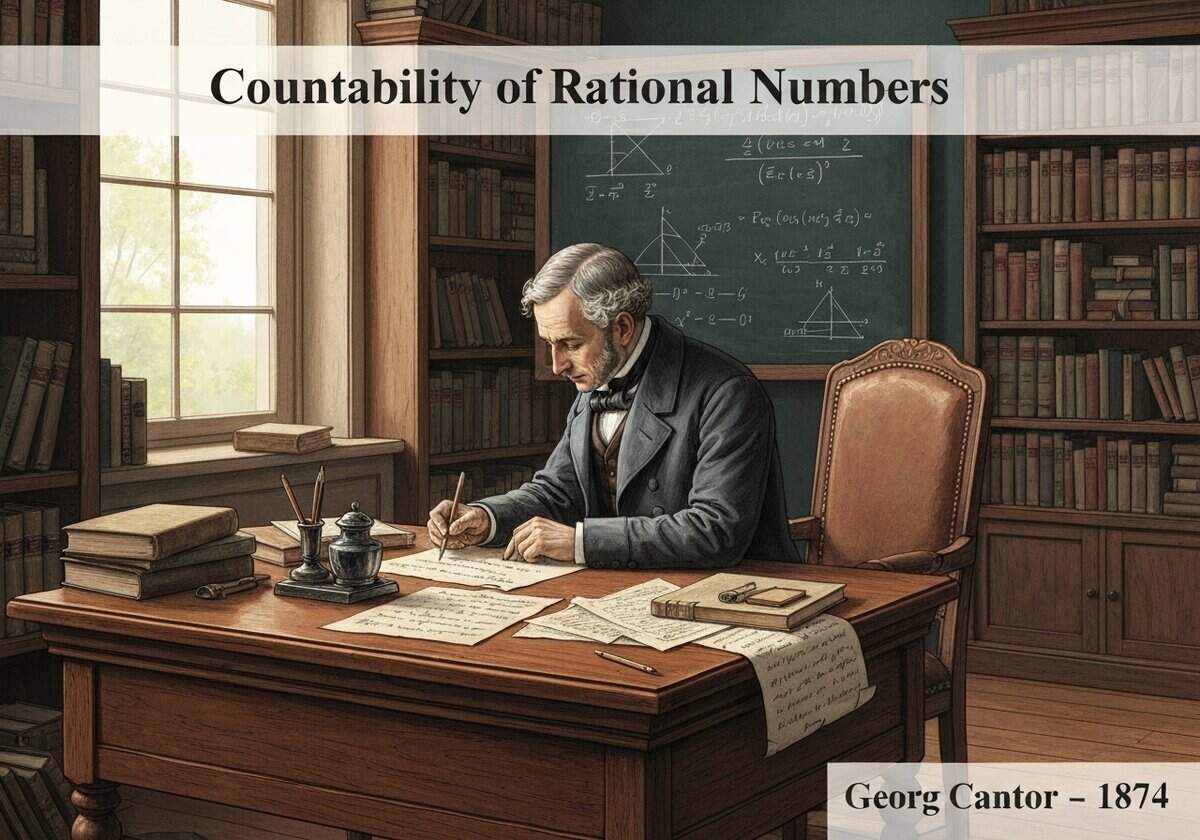
Georg Cantor’s proof of the countability of rational numbers was a landmark in the development of set theory and our understanding of infinity. The proof is constructive and elegant. One common method is to arrange all positive rational numbers [latex]p/q[/latex] in a two-dimensional grid where the row index is [latex]p[/latex] and the column index is [latex]q[/latex]. Then, one can traverse this grid diagonally, starting from [latex]1/1[/latex], then [latex]2/1, 1/2[/latex], then [latex]3/1, 2/2, 1/3[/latex], and so on. This path, known as Cantor’s diagonal argument (though the term is more famous for his proof of the uncountability of the reals), systematically lists every positive rationale Zahl.
During the traversal, any fraction that is not in lowest terms (like [latex]2/2[/latex] or [latex]2/4[/latex]) is skipped to ensure each rational number is counted only once. This process creates an ordered list of all positive rational numbers. To include all rationals, one can interleave the positive list with its negative counterpart and place zero at the beginning: [latex]0, 1, -1, 1/2, -1/2, 2, -2, …[/latex]. This explicitly constructs a bijection between the set of natural numbers and the set of rational numbers, proving [latex]\mathbb{Q}[/latex] is countable.
This result is counter-intuitive because the rationals are dense. Between any two rationals, one can always find another (e.g., their average), suggesting they are “more numerous” than the integers, which have clear gaps. Cantor’s proof showed that this intuition is misleading and that the “size” of an infinite set (its cardinality) is more subtle. He later proved that the set of real numbers is uncountable, establishing a hierarchy of infinities.
UNESCO Nomenclature: 1101
– Algebra, Zahlentheorie und Gruppentheorie
Verwendung
Konzeptuell/Theoretisch
Vorläufer
- Konzept der Eins-zu-Eins-Korrespondenz (Bijektion)
- frühere Arbeiten über unendliche Mengen von Bolzano
- Entwicklung einer strengen mathematischen Analyse
- das Konzept eines Sets
Anwendungen
- Grundlagen der Mengenlehre
- Informatik: Theorie der Berechenbarkeit (z. B. der Nachweis, dass die Menge aller möglichen Computerprogramme abzählbar ist)
- Maßtheorie, in der abzählbare Mengen das Maß Null haben
- Unterscheidung verschiedener Größen unendlicher Mengen (z. B. rationale Zahlen vs. reelle Zahlen)
Potenzielle Innovationsideen
- Ein Aufgabenplanungsalgorithmus für verteiltes Rechnen, der eine Cantor-ähnliche Aufzählung verwendet, um Aufträge einem scheinbar unendlichen Strom von Prozessoren zuzuweisen.
- ein Datenserialisierungsformat, das jede rationale Datenstruktur eindeutig in eine einzelne ganze Zahl kodieren kann
- ein theoretisches Modell für eine universelle Rechenmaschine mit abzählbar unendlich vielen Zuständen
- ein Netzwerkadressierungsprotokoll, das mithilfe einer rationalen Zahlenaufzählung potenziell unendlich vielen Geräten eine eindeutige Adresse zuweisen kann
- Eine Methode zur Indizierung von Elementen in einer dynamisch wachsenden, mehrdimensionalen Datenbank durch Zuordnung von Koordinaten zu einem einzigen zählbaren Index
- a procedural content generation algorithm for Videospiele that creates an infinitely large but navigable world by mapping locations to rational numbers
- eine formale Sprachdefinition, in der gültige Aussagen rationalen Zahlen entsprechen, was eine eindeutige Aufzählung aller möglichen Programme ermöglicht.
- a proof-of-stake Blockchain protocol where validator selection is based on a deterministic traversal of the set of rational numbers
- ein Kompressionsverfahren für dünnbesetzte Matrizen durch Abbildung von Koordinaten nicht-nullwertiger Elemente auf einen einzelnen ganzzahligen Index
- Ein genetischer Algorithmus, der einen Lösungsraum durchläuft, indem er ein rationales Gitter durchläuft und sicherstellt, dass alle potenziellen fraktionalen Parameter schließlich getestet werden.
Related to: countability, set theory, Georg Cantor, infinite set, cardinality, bijection, natural numbers, dense set, diagonal argument, aleph-null.