Product Design, Manufacturing & Innovation Resources
Heim » Logarithmische mittlere Temperaturdifferenz (LMTD)

Logarithmische mittlere Temperaturdifferenz (LMTD)

1910
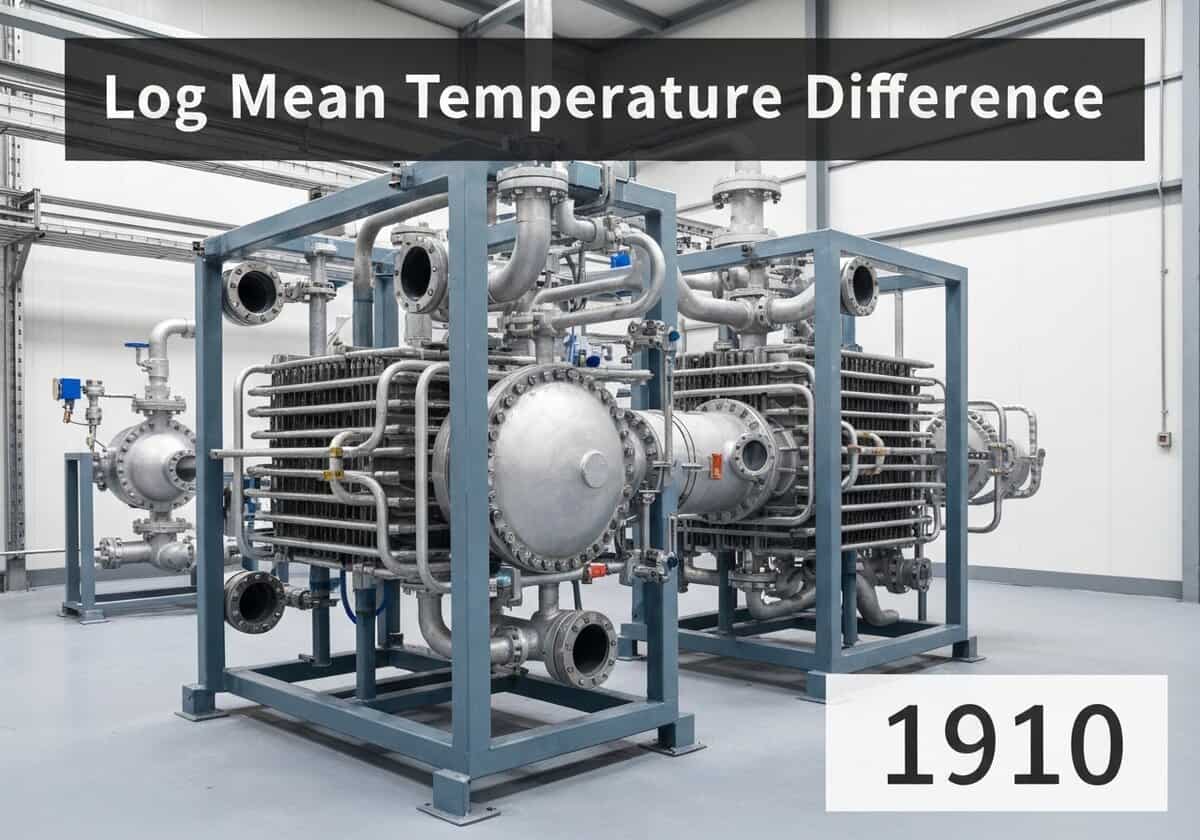
Rohrbündelwärmetauscher zur Veranschaulichung der logarithmischen mittleren Temperaturdifferenz in der Thermodynamik.

(Abbildung dient nur zur Veranschaulichung)

Die logarithmische mittlere Temperaturdifferenz (LMTD) ist die effektive mittlere Temperaturdifferenz für den Wärmeaustausch in Wärmetauschern, insbesondere bei Gegenstrom- und Gleichstromanordnungen. Sie ist der logarithmische Mittelwert der Temperaturdifferenz zwischen dem heißen und dem kalten Fluid an jedem Ende. Die LMTD wird mit folgender Formel berechnet: [latex]Delta T_{LM} = frac{Delta T_A – Delta T_B}{ln(Delta T_A / Delta T_B)}[/latex].

The LMTD method is a cornerstone of heat exchanger analysis. It arises from the integration of the heat transfer rate equation along the length of the exchanger, assuming constant fluid properties and overall heat transfer coefficient. The fundamental heat transfer equation is [latex]Q = U A \Delta T_{LM}[/latex], where Q is the rate of heat transfer, U is the overall heat transfer coefficient, and A is the heat transfer surface area. The LMTD correctly accounts for the non-linear temperature profile of the fluids as they flow through the exchanger. For a counter-current flow exchanger, [latex]\Delta T_A[/latex] and [latex]\Delta T_B[/latex] are the temperature differences at the two ends of the exchanger. For a parallel flow exchanger, the same formula applies, but the temperature differences are calculated differently based on the inlet and outlet positions. The counter-flow arrangement is generally more efficient as it yields a higher LMTD for given inlet and outlet temperatures, allowing for a smaller required surface area A for the same heat duty Q. However, when the temperature difference at one end is equal to the other, the LMTD is simply that temperature difference. If one of the temperature differences is zero, the LMTD is mathematically undefined, but in practice, this represents a limit where heat transfer ceases to be effective. For more complex geometries like cross-flow or multi-pass shell-and-tube exchangers, a correction factor F is applied to the LMTD, such that [latex]\Delta T_{eff} = F \cdot \Delta T_{LM, counterflow}[/latex].

UNESCO Nomenclature: 3328
- Thermodynamik

Typ

Abstraktes System

Störung

Inkremental

Verwendung

Weitverbreitete Verwendung

Vorläufer

  • Fouriers Gesetz der Wärmeleitung (1822)
  • erster Hauptsatz der Thermodynamik (Energieerhaltung)
  • Newtons Abkühlungsgesetz
  • Entwicklung der Analysis für Integrations- und Logarithmusfunktionen

Anwendungen

  • Auslegung und Leistungsanalyse von Rohrbündelwärmetauschern
  • Dimensionierung von Industriekesseln und Kondensatoren
  • Optimierung von HLK-Systemen
  • Wärmemanagement in Kraftwerken
  • Berechnungen in der chemischen Verfahrenstechnik

Patente:

NA

Potenzielle Innovationsideen

Aufgrund des hohen Datenverkehrs durch Web-Scraping-Bots, der derzeit mehr als 40.000 Anfragen pro Tag umfasst, ist dieser Inhalt ausschließlich Community-Mitgliedern vorbehalten.
> Anmelden < oder > Registrieren < (100% kostenlos) Zugriff darauf sowie auf alle anderen eingeschränkten Inhalte und Tools.

Verwandt mit: LMTD, logarithmische mittlere Temperaturdifferenz, Wärmetauscher, Thermodynamik, Wärmeübertragung, Gegenstrom, Gleichstrom, Wärmetechnik, Nusselt-Gleichung, Gesamtwärmeübergangskoeffizient.

Historischer Kontext

Logarithmische mittlere Temperaturdifferenz (LMTD)

1910
1910
1910
1910
1920
1920
1920
1906
1910
1910
1910
1920
1920
1920
1922

(wenn das Datum unbekannt oder nicht relevant ist, z. B. „Strömungsmechanik“, wird eine gerundete Schätzung seines bemerkenswerten Auftretens bereitgestellt)

Verwandte Erfindungen, Innovationen und technische Prinzipien

Bilder in voller Größe und Downloads sind nur für registrierte Mitglieder 100% kostenlos verfügbar.

> Login <