Nernst-Gleichung für das Brennstoffzellenpotential
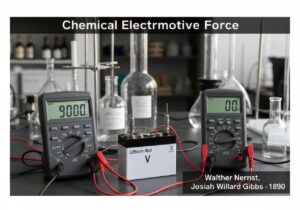
Der Nernst equation quantifies the reversible elektromotorische Kraft (EMF) or open-circuit voltage of a Brennstoffzelle under non-standard conditions. It links the cell potential ([latex]E[/latex]) to its standard potential ([latex]E^0[/latex]), temperature, and the activities (approximated by partial pressures) of reactants and products. The equation is [latex]E = E^0 – \frac{RT}{nF} \ln Q[/latex], where Q is the reaction quotient.
The Nernst equation is a cornerstone of electrochemistry, derived from the relationship between the change in Gibbs free energy and the cell potential, [latex]\Delta G = -nFE[/latex]. In the equation [latex]E = E^0 – \frac{RT}{nF} \ln Q[/latex], [latex]R[/latex] is the universal gas constant, [latex]T[/latex] is the absolute temperature in Kelvin, [latex]n[/latex] is the number of moles of electrons transferred per mole of reaction, and [latex]F[/latex] is the Faraday constant (charge per mole of electrons). The reaction quotient [latex]Q[/latex] for a hydrogen-oxygen fuel cell ([latex]H_2 + \frac{1}{2}O_2 \rightarrow H_2O[/latex]) is [latex]Q = \frac{p_{H_2O}}{p_{H_2} \cdot p_{O_2}^{1/2}}[/latex], where [latex]p[/latex] represents the partial pressures of the gaseous species.
This equation reveals several key aspects of fuel cell behavior. Firstly, it shows that the cell voltage increases with higher reactant partial pressures ([latex]p_{H_2}[/latex], [latex]p_{O_2}[/latex]) and decreases as product partial pressure ([latex]p_{H_2O}[/latex]) builds up. Secondly, it describes the temperature dependence of the ideal voltage. While the Nernst equation defines the maximum theoretical voltage, the actual operating voltage of a fuel cell is always lower due to irreversible losses known as overpotentials (or polarizations), which arise from reaction kinetics, internal resistance, and mass transport limitations once current is drawn from the cell.
UNESCO Nomenclature: 2203
- Physikalische Chemie
Verwendung
Weitverbreitete Verwendung
Vorläufer
- Gesetze der Thermodynamik, insbesondere die Arbeiten von Gibbs über das chemische Potential
- Faradaysche Gesetze der Elektrolyse
- das Konzept des chemischen Gleichgewichts und das Massenwirkungsgesetz
Anwendungen
- Vorhersage der maximal möglichen Spannung einer Brennstoffzelle unter bestimmten Betriebstemperaturen und -drücken
- Modellierung der Brennstoffzellenleistung und der Spannungsverluste aufgrund von Reaktantenverbrauch
- Entwicklung von Hochdruck-Brennstoffzellensystemen zur Steigerung von Spannung und Effizienz
- Grundlagenforschung in der Elektrochemie und Batteriewissenschaft
- Kalibrierung von ionenselektiven Elektroden und pH-Metern
Potenzielle Innovationsideen
Aufgrund des hohen Datenverkehrs durch Web-Scraping-Bots, der derzeit mehr als 40.000 Anfragen pro Tag umfasst, ist dieser Inhalt ausschließlich Community-Mitgliedern vorbehalten.
> Anmelden < oder > Registrieren < (100% kostenlos) Zugriff darauf sowie auf alle anderen eingeschränkten Inhalte und Tools.
Related to: Nernst equation, electrochemistry, cell potential, voltage, Gibbs free energy, reaction quotient, partial pressure, thermodynamics, walther nernst, open-circuit voltage.