Product Design, Manufacturing & Innovation Resources
Heim » Euklidsches Lemma

Euklidsches Lemma

-300
  • Euclid of Alexandria
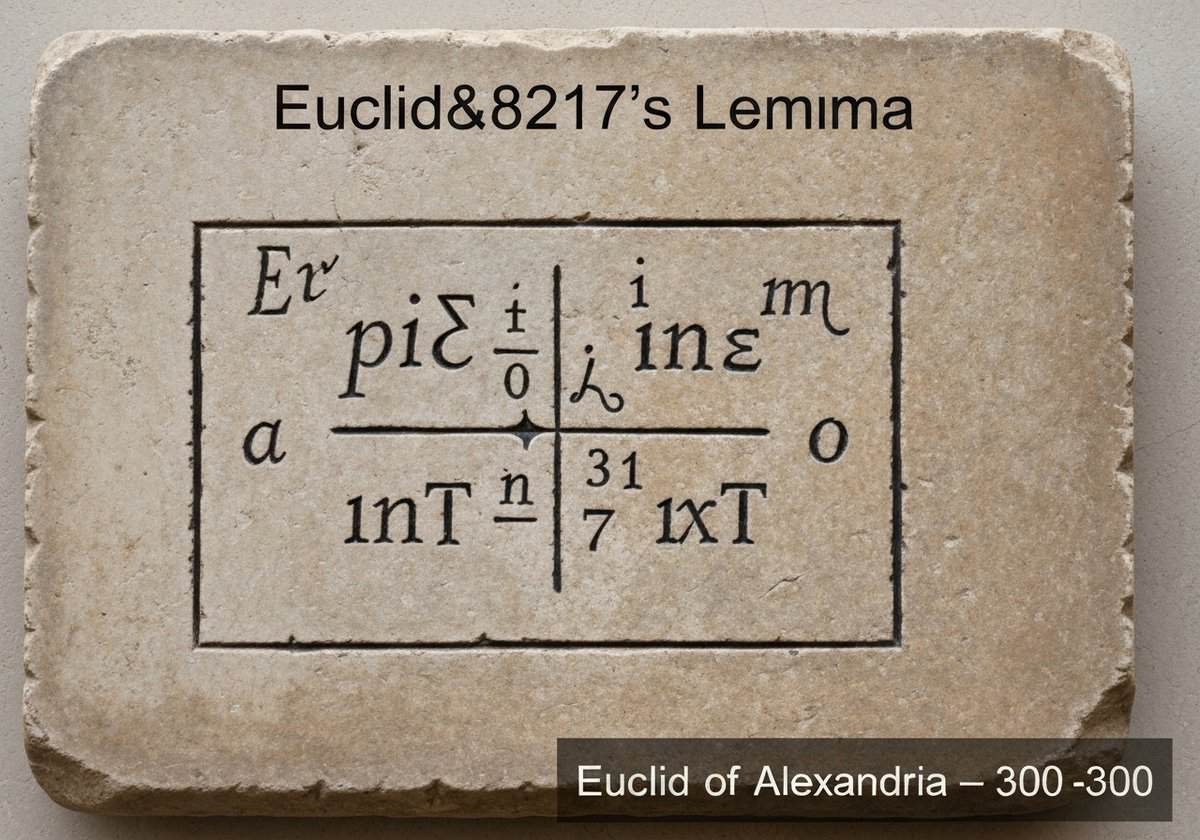
Stone tablet inscribed with Euclid's Lemma in ancient Greek, number theory concept.

(Abbildung dient nur zur Veranschaulichung)

Ein zentrales Ergebnis der Zahlentheorie besagt, dass, wenn eine Primzahl p das Produkt zweier ganzer Zahlen a und b teilt, p mindestens eine dieser Zahlen teilen muss. Das heißt: Wenn p | ab, dann ist p | a oder p | b. Diese Eigenschaft ist wesentlich für den Beweis der Eindeutigkeit des Fundamentalsatzes. Satz der Arithmetik.
Euclid’s Lemma is Proposition 30 in Book VII of his *Elements*. Its proof typically relies on another fundamental result, Bézout’s identity, which states that the greatest common divisor (GCD) of two integers `a` and `b` can be expressed as a linear combination `ax + by` for some integers `x` and `y`. The proof of the lemma proceeds as follows: Assume a prime `p` divides `ab`. If `p` does not divide `a`, then `p` and `a` are coprime (their GCD is 1), since the only divisors of `p` are 1 and `p`. By Bézout’s identity, there exist integers `x` and `y` such that `px + ay = 1`. Multiplying this entire equation by `b` gives `pbx + aby = b`. We know that `p` divides `pbx` (trivially) and `p` divides `aby` (by our initial assumption that `p` divides `ab`). Therefore, `p` must divide their sum, which is `b`. This completes the proof.

This lemma is the critical step in establishing the uniqueness of prime factorizations. Without it, one could potentially have two different sets of prime factors for the same number. The lemma ensures that if a prime appears in one factorization, it must also appear in any other factorization of the same number. The property described in the lemma is now used to define the more general concept of a ‘prime element’ in abstract algebra and ring theory, distinguishing it from an ‘irreducible element’.

UNESCO Nomenclature: 1101
– Reine Mathematik

Typ

Abstraktes System

Störung

Grundlegendes

Verwendung

Weitverbreitete Verwendung

Vorläufer

  • Konzept der Primzahlen
  • Konzept der Teilbarkeit
  • Euklidischer Algorithmus zum Finden des größten gemeinsamen Teilers
  • Bézouts Identität (obwohl die Konzepte oft zu ihrem Beweis herangezogen werden, sind sie eng miteinander verflochten)

Anwendungen

  • Beweis der Eindeutigkeit der Primfaktorzerlegung
  • Entwicklung der Ringtheorie (Definition von Primelementen)
  • Lösen linearer diophantischer Gleichungen
  • modulare arithmetische Berechnungen

Patente:

NA

Potenzielle Innovationsideen

Aufgrund des hohen Datenverkehrs durch Web-Scraping-Bots, der derzeit mehr als 40.000 Anfragen pro Tag umfasst, ist dieser Inhalt ausschließlich Community-Mitgliedern vorbehalten.
> Anmelden < oder > Registrieren < (100% kostenlos) Zugriff darauf sowie auf alle anderen eingeschränkten Inhalte und Tools.

Verwandt mit: Euklids Lemma, Primzahl, Teilbarkeit, Zahlentheorie, Bézoutsche Identität, teilerfremd, größter gemeinsamer Teiler, Fundamentalsatz der Arithmetik, Euklids Elemente, Beweis.

Historischer Kontext

Euklidsches Lemma

-300
-450
1585
1779
1799
1801
1850
1875
-300
-550
1750
1790
1800
1844
1874

(wenn das Datum unbekannt oder nicht relevant ist, z. B. „Strömungsmechanik“, wird eine gerundete Schätzung seines bemerkenswerten Auftretens bereitgestellt)

Verwandte Erfindungen, Innovationen und technische Prinzipien

Bilder in voller Größe und Downloads sind nur für registrierte Mitglieder 100% kostenlos verfügbar.

> Login <