Product Design, Manufacturing & Innovation Resources
Heim » Elektrophorese

Elektrophorese

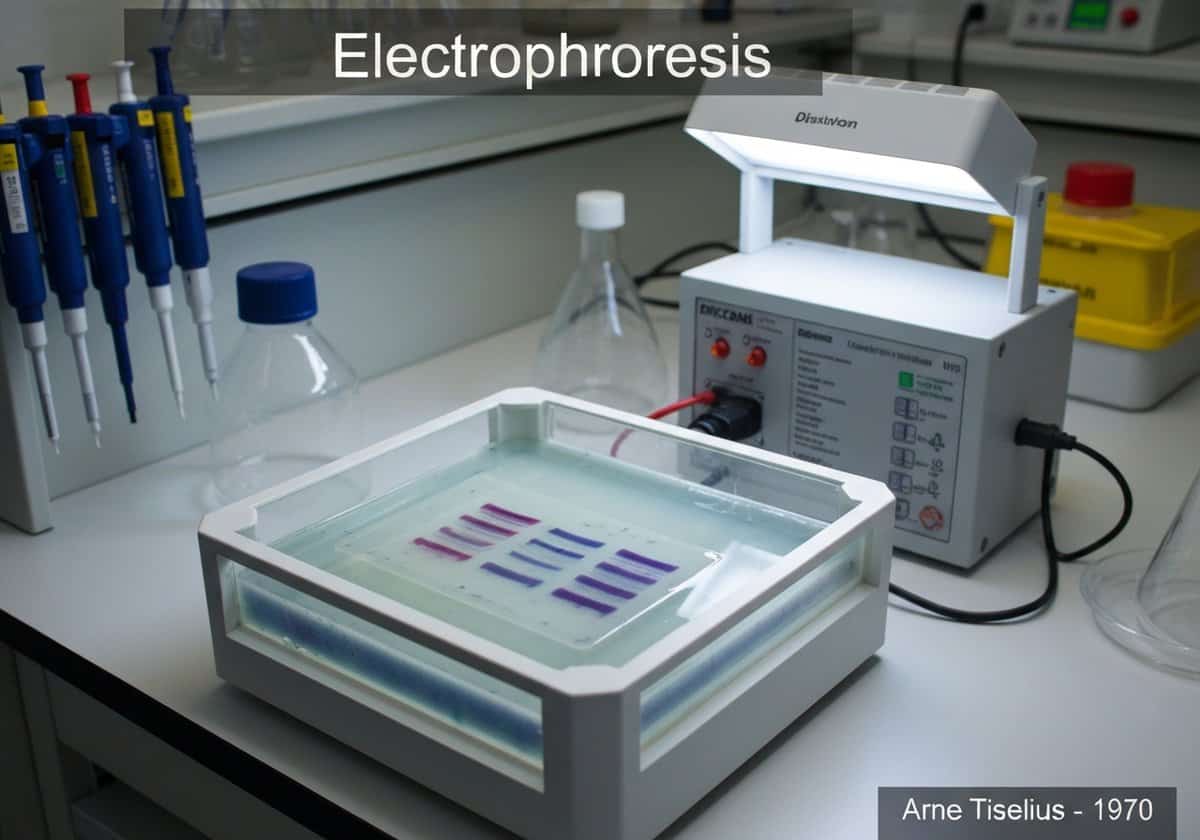
1970
  • Arne Tiselius
Labor-Gelelektrophoresegerät zur Trennung von DNA-Proben nach Größe.

(Abbildung dient nur zur Veranschaulichung)

Die Gelelektrophorese ist eine Technik zur Trennung von Makromolekülen wie DNA, RNA und Proteinen anhand ihrer Größe und Ladung. Ein elektrisches Feld wird an eine Gelmatrix angelegt, wodurch negativ geladene Moleküle (wie DNA) in Richtung der positiven Elektrode wandern. Kleinere Moleküle wandern schneller und weiter durch die Poren des Gels als größere Moleküle.
Gel electrophoresis is a cornerstone technique in molecular biology for the separation and analysis of macromolecules, primarily DNA, RNA, and proteins. The principle behind the technique is the migration of charged molecules through a porous gel matrix under the influence of an electric field. Since nucleic acids (DNA and RNA) have a consistently negative charge due to their phosphate backbone, they will naturally migrate towards the positive electrode (anode) when a current is applied. The gel itself, typically made of agarose for larger molecules like genomic DNA fragments or polyacrylamide for smaller fragments and proteins (in a technique called PAGE), acts as a molecular sieve. The matrix is composed of a network of pores through which the molecules must travel. Smaller molecules navigate this maze more easily and quickly than larger molecules, which are impeded more by the gel matrix. Consequently, the molecules are separated based on their size, with the smallest traveling the farthest from the starting point (the well) in a given amount of time. To perform DNA electrophoresis, a sample is first loaded into wells at one end of the gel. A ‘DNA ladder,’ a mixture of DNA fragments of known sizes, is run in a separate lane to serve as a reference for estimating the size of the unknown fragments. After the electric current is applied for a period, the separated fragments are visualized. Because DNA is invisible to the naked eye, a fluorescent dye that intercalates with the DNA, such as ethidium bromide or SYBR Green, is used. When placed under UV light, the dye fluoresces, revealing the DNA as distinct bands, each band representing a collection of fragments of the same size.

UNESCO Nomenclature: 2401
- Biochemie

Typ

Physikalischer Prozess

Störung

Grundlegendes

Verwendung

Weitverbreitete Verwendung

Vorläufer

  • Die Elektrolysegesetze von Michael Faraday
  • Entdeckung der Elektrizität
  • Arne Tiselius' Entwicklung der Elektrophorese mit beweglicher Grenze
  • Entwicklung von Trägermedien wie Papier, Stärke und schließlich Agarose/Polyacrylamid-Gelen
  • Entdeckung der DNA und ihrer negativen Ladung

Anwendungen

  • DNA-Fingerabdruck
  • Vaterschaftstest
  • Diagnose genetischer Störungen
  • Reinigung von DNA-Fragmenten zum Klonen
  • Analyse von PCR-Produkten
  • Proteinanalyse (SDS-PAGE)

Patente:

NA

Potenzielle Innovationsideen

Aufgrund des hohen Datenverkehrs durch Web-Scraping-Bots, der derzeit mehr als 40.000 Anfragen pro Tag umfasst, ist dieser Inhalt ausschließlich Community-Mitgliedern vorbehalten.
> Anmelden < oder > Registrieren < (100% kostenlos) Zugriff darauf sowie auf alle anderen eingeschränkten Inhalte und Tools.

Verwandt mit: Gelelektrophorese, DNA-Trennung, Agarosegel, Polyacrylamid, SDS-PAGE, DNA-Fingerprinting, Molekulargewicht, Restriktionsfragmente, Nukleinsäuren, Proteine.

Historischer Kontext

Elektrophorese

1954
1960
1967
1970
1975
1977
1983
1951
1958
1960
1970
1973
1975
1979
1983

(wenn das Datum unbekannt oder nicht relevant ist, z. B. „Strömungsmechanik“, wird eine gerundete Schätzung seines bemerkenswerten Auftretens bereitgestellt)

Verwandte Erfindungen, Innovationen und technische Prinzipien

Bilder in voller Größe und Downloads sind nur für registrierte Mitglieder 100% kostenlos verfügbar.

> Login <