How to find patents or search patents ? For any engineer engaged in research, development, and the creation of novel solutions, possessing the know-how to unearth relevant patents offers significant advantages. This capability allows to survey the existing technological terrain, preventing the unnecessary replication of efforts and providing a clear view of what has already been established. Discovering prior inventions can illuminate pathways for new inventive steps, stimulate creative thinking by showcasing diverse approaches, and offer insights into the activities of other organizations within a specific domain. Such awareness directly informs development strategies and contributes to more robust design decisions.
While a specialized براءة اختراع attorney provides indispensable legal acumen for matters of patent validity, infringement, and the formal application process, engineers themselves must benefit from a foundational competence in patent searching. An engineer can perform preliminary explorations, grasp the technical substance of patents discovered, and identify documents that appear pertinent to their work. This groundwork prepares them for more productive interactions with legal counsel, enabling them to articulate their findings and contribute technical understanding to the legal strategy. The 25+ tricks below will help in this R&D task.

Have in Mind
While we do advocate for free search methods here, engineers must still understand what a patent attorney or dedicated company can bring:
Engaging a patent attorney or a dedicated البحث عن براءات الاختراع firm introduces a distinct level of proficiency to the discovery process: these specialists possess deep familiarity with patent laws, classification systems across numerous jurisdictions, and advanced search methodologies honed through continuous practice.
They often subscribe to sophisticated, proprietary databases that aggregate global patent information and offer analytical capabilities far beyond free public tools.
Our Best Tricks for Patents Search
- Master Google patents Advanced Search: you just can’t ignore this one .. to do this in detail, go to patents.google.com and click on “Advanced search” below the main search bar. You’ll see fields like “Search terms,” “Inventor,” “Assignee,” “Before/After Priority/Publication date,” and “Patent office.” Use Boolean operators (AND, OR, NOT) directly in the “Search terms” field, for example: (screen OR display) AND (flexible OR foldable) NOT oled. This is best when you have some specific known parameters (like an inventor or a date range) or when you want to combine multiple concepts precisely from the outset to narrow down a potentially large field of results.
- Leverage Espacenet’s SmartSearch: access Espacenet (worldwide.espacenet.com) and find the “Smart search” option. This is most useful when you want to build complex, targeted queries with high precision. For example, to find patents with “solar panel” in the title and “photovoltaic” in the abstract, filed by “ABC Corp,” you would type: ti=”solar panel” AND ab=photovoltaic AND pa=”ABC Corp”. This طريقة is best for experienced searchers or when initial keyword searches yield too many irrelevant results, as it allows searching within specific bibliographic data fields.
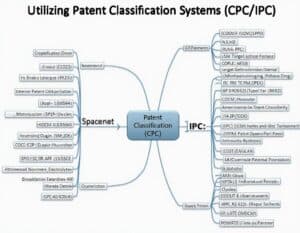
- Utilize patent classification systems (CPC/IPC): when you find a few highly relevant patents, look for their CPC (Cooperative Patent Classification) or IPC (International Patent Classification) codes, usually listed on the front page or in the bibliographic data section. For example, if a key patent for a new type of battery is classified under H01M 10/0562 (related to electrolytes), you can then search for other patents also classified under H01M 10/0562 in Google Patents or Espacenet. This is best for uncovering patents that use different terminology for the same technology or for broadening your search within a specific technical niche once you’ve found a good starting point.
- “Mine” forward citations: once you have a relevant patent (Patent X), look for a section often labeled “Cited by,” “Forward citations,” or “Referenced by.” These are patents published after Patent X that reference it as الفن السابق. For instance, if Patent X was published in 2015, its forward citations will be from 2015 onwards. This technique is best for tracking the evolution of an invention, finding improvements, or identifying competitors who are building upon that specific technology. It’s particularly useful for understanding the current state-of-the-art related to a foundational patent.
- “Mine” backward citations: on the same relevant patent (Patent X), find the “References Cited,” “Backward citations,” or “Prior art cited” section. These are older documents (patents or non-patent literature) that Patent X’s examiner or applicant considered relevant. Reviewing these can help you understand the technological foundation upon which Patent X was built and identify earlier, potentially more fundamental patents in the field. This is best for historical context, understanding the novelty arguments for Patent X, and finding seminal works.
- Search by inventor and assignee/applicant names: if you know key individuals or companies active in your subject area (e.g., “John Smith” as inventor, “Innovatech Corp” as assignee), use these names in the dedicated inventor/assignee fields in advanced search interfaces. Be mindful of variations (e.g., “Innovatech Corporation,” “Innovatech Inc.”). This is best when you are tracking the output of specific R&D entities or prolific inventors, or when trying to understand a company’s technological focus or patent portfolio in a certain area.
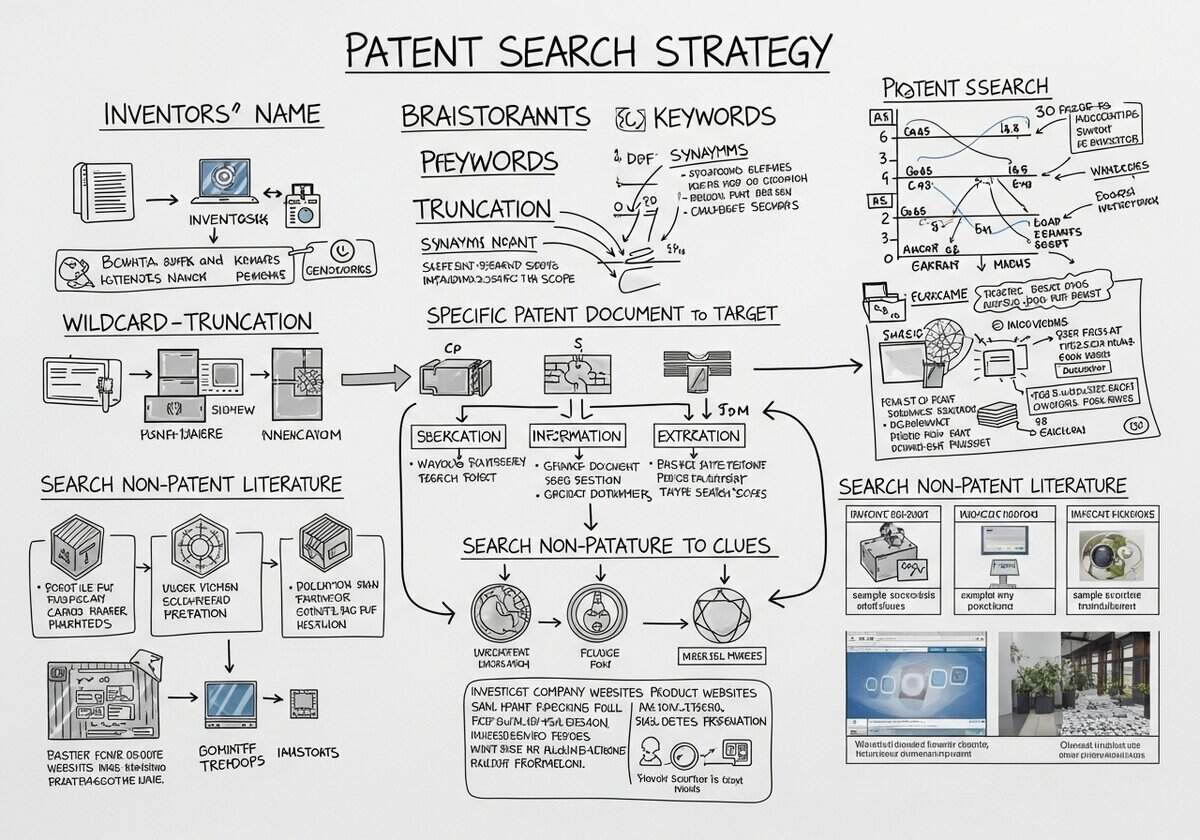
- Brainstorm and use extensive synonyms & keywords: before starting, and during your search, list all possible terms related to the invention’s components, function, application, and the problem it solves. For a “self-watering plant pot,” think: “automated irrigation container,” “moisture-controlled planter,” “plant hydration system,” “wicking bed.” This is crucial in all search stages, especially when initial simple keyword searches fail. It’s best for ensuring comprehensive coverage and overcoming the limitations of inventors using varied terminology.
- Employ wildcards and truncation: use * for multiple characters (truncation) and ? for a single character wildcard. For example, nano* could find “nanotube,” “nanoparticle,” “nanotechnology.” colo?r would find “color” and “colour.” This is best used when you want to capture variations in word endings or spellings without listing every single variant. It’s particularly useful for technical terms with common prefixes or suffixes, or when searching across databases with content from different English-speaking regions.
- Target specific patent document sections: instead of a full-text search, which can be noisy, use advanced options to search keywords only within the “Title,” “Abstract,” or “Claims.” For example, searching “quantum computing” in the title is likely to yield more directly relevant patents than finding it buried deep in the specification. This is best for initial, high-relevance searches or when you want to quickly vet if a technology area is being patented with a specific focus as indicated by its most prominent sections. The claims are crucial for understanding the exact scope of legal protection.
- Search Non-Patent Literature (NPL) for clues: use Google Scholar, IEEE Xplore, PubMed, etc., to search for scientific papers and conference proceedings using keywords related to your subject. Academic publications often precede patent filings or use different language, and they may identify key inventors or institutions. Some patent databases (like Espacenet) also list NPL documents cited during examination. This is best when you’re exploring emerging التقنيات where academic research is prominent or when patent keyword searches are not yielding enough leads.
- Investigate company websites and product literature: visit the websites of companies known to be innovating in your target area. Look for “Intellectual Property,” “Patents,” or “Technology” sections. Product brochures or technical specifications might mention “patent pending” or list patent numbers. While this may not give the latest information, this is best for directly linking commercial products to their underlying patents or for finding application numbers of pending patents that might not yet be easily searchable by keyword, or applicant or lawyer names to be search for other patents.
- Explore patent families: when you find a key patent document (e.g., a US patent), look for its “patent family” information (often a tab or link in Google Patents or Espacenet). This will show you all equivalent patents filed for the same invention in different countries or as different application types (e.g., PCT application, European patent). This is best for understanding the geographical scope of protection for an invention and for finding a version of the patent in a language you understand, or one with a more detailed search report.
- Consider international equivalents and machine translations: if you suspect an invention originates from a country where English is not the primary language (e.g., China, Japan, Germany), try searching for the patent in its native patent office database if possible, or use PATENTSCOPE (WIPO) and Espacenet which offer machine translation features for titles, abstracts, and sometimes full text. This is best when you know a key competitor or technology hub is non-English speaking, as it helps uncover patents you might otherwise miss.
- Systematically review patent drawings/figures: many patent databases allow you to quickly view thumbnails or scroll through the drawings/figures. Often, a quick glance at the diagrams can tell you more about the invention’s nature than the title or abstract, especially for mechanical or device-related inventions. This is best for rapidly screening a large set of search results to identify potentially relevant patents before investing time in reading the full text.
نصيحة: despite any patent attorney will warn you before a deposit, the figures must only represent the principles and just be an illustration, we have seen cases where the figures where the original product كاد drawings at scale.
- Utilize USPTO Patent Public Search (PatFT and AppFT): for US patents and applications, the USPTO’s own platform (patentcenter.uspto.gov) offers powerful search capabilities, though with a different syntax than Google Patents. PatFT is for granted patents, AppFT for published applications. This is best when you need the most definitive source for US patent information, including file wrappers (prosecution history) for granted patents, or when you need to perform very specific field-coded searches within the US database.
- Explore WIPO PATENTSCOPE: the World الملكية الفكرية Organization’s PATENTSCOPE (patentscope.wipo.int) is the go-to for searching international PCT applications (the common route for seeking patent protection in multiple countries simultaneously). It also includes national collections from many patent offices. Its cross-lingual search and machine translation tools are excellent. This is best for finding inventions at an earlier stage of international filing or when focusing on global patenting strategies.
- Think “Problem/Solution” not just keywords: instead of just listing features of an invention, consider the underlying problem it aims to solve or the specific advantage or solution it provides. For example, instead of “stronger adhesive tape,” search for terms related to “joining dissimilar materials under stress” or “preventing delamination in flexible displays.” This is best when direct keyword searches are too narrow or when inventors might describe their invention in terms of its benefits or applications rather than its specific components.
- Combine classification codes with keywords: this is a highly effective way to refine searches. First, identify relevant CPC/IPC codes (Trick #3). Then, conduct a new search within that classification code(s) and add specific keywords. For example, in Espacenet SmartSearch: cpc=H01L21/67 AND ab=(wafer AND cleaning). This significantly narrows results to only those within a defined technical area that also mention your specific terms. This is best for drilling down into a known technology area to find very specific innovations
- Utilize The Lens (lens.org) for integrated search and analysis: the Lens (lens.org) is a powerful, free, and open platform that integrates patent data with scholarly works. Beyond keyword and classification searching, it offers features like analyzing patent landscapes, visualizing inventor/assignee networks, and exploring citation networks. To use it, create a free account, then use its structured search or “Patinformatics” tools to filter and analyze results. This is best when you need to go beyond simple searching to understand broader trends, identify key players in a field, or see connections between patents and academic research without subscribing to expensive analytical tools.
- Search for design patents for ornamental innovations: if your subject of interest involves a unique visual appearance, shape, or ornamentation rather than just functional utility, remember to search for design patents (e.g., “D” patents in the US, or Registered Community Designs in Europe). These are distinct from utility patents. Databases like Google Patents and Espacenet allow filtering by patent type, or you can use specific design patent databases (e.g., USPTO design search, WIPO’s Hague Express for international designs). Search using keywords describing the appearance, or by designer/assignee if known. This is crucial when the innovation lies in the product’s aesthetic appeal, as this protection is different and often overlooked if only utility patents are searched.
- Investigate university and research institution patent portfolios: many foundational technologies originate from academic research. Identify universities or non-profit research institutions known for work in your target field. You can then search for patents where these institutions are listed as the “assignee” or “applicant” in patent databases. Many universities also have “technology transfer” offices with websites that showcase their patented technologies available for licensing, which can be another starting point. This method is best for finding early-stage, cutting-edge, or fundamental inventions that may not yet be heavily commercialized.
- Access USPTO’s Public PAIR for U.S. prosecution histories: for any US patent or published application number you find, you can use the USPTO’s Public Patent Application Information Retrieval (Public PAIR) system (accessible via patentcenter.uspto.gov). After entering the patent/application number, you can view the “Image File Wrapper,” which contains the complete correspondence between the applicant and the USPTO examiner. This includes office actions (examiner’s rejections/objections), applicant’s responses and arguments, amendments to claims, and lists of prior art cited. This is invaluable for understanding the scope of the claims, why certain limitations were introduced, and what prior art was overcome, providing deep context beyond the published patent document itself. This is best for detailed analysis of specific US patents of high interest.
Bonus: 5 Tricks for Finding Patents Where the Author Tried to Hide the Real Subject
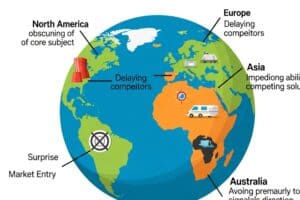
Strategically obscuring the core subject of a patent as much as legally permissible within the descriptive sections, while still ensuring the claims clearly define the invention for تصديق, is primarily important for gaining a competitive advantage. This approach is often employed when an applicant wants to delay competitors from fully discerning the invention’s true nature, significance, or specific commercial application, thereby impeding their ability to quickly develop competing solutions or design-arounds. It’s particularly used in highly competitive industries, for disruptive technologies where early disclosure could undermine a surprise market entry, or during the early stages of a technology’s دورة الحياة when the full strategic implications are still unfolding and the company wishes to avoid prematurely signaling its direction. And there fore, finding them is even harder; but here are our five additional tricks, especially for that (these 5 tips are for free members only) :
- Scrutinize the Claims above all else: while an inventor might use vague language in the title, abstract, or even the detailed description to obscure the core invention, the claims of a validated patent must “particularly point out and distinctly claim the subject matter which the applicant regards as his invention” (in US law, similar principles apply elsewhere). Therefore, methodically read each independent and dependent claim. Look for the specific elements, steps, and their relationships that define the legal boundaries of the invention. This is the ultimate place to find what was actually patented, regardless of obfuscation elsewhere, and is essential when you suspect misdirection.
- Look for unexpected or broad primary classifications with revealing secondary classifications: an inventor attempting to obscure might ensure their application is initially assigned a very broad or seemingly tangential primary CPC/IPC code. However, patent examiners are experts and will add more specific, relevant secondary classifications during the examination process if the invention warrants it. So, when you find a patent with a vague primary code, always check its full list of classifications (often viewable in the bibliographic data). A secondary code like A61B 5/00 (Diagnosis; Surgery; Identification) on a patent primarily classified under something like G06F 17/00 (Digital computing or data processing equipment or methods, specially adapted for specific functions) might reveal a hidden medical application of a seemingly general computing invention. This is best for uncovering the true technical field when the main classification seems off.
- Analyze the “Field of the Invention” and “Background Art” sections for mismatches or euphemisms: these introductory sections set the stage for the invention. If the title and abstract are deliberately vague, these sections might still need to describe a legitimate technical problem or existing solutions to provide context for the invention’s novelty and inventive step. Look for subtle cues, unusual phrasing, or euphemisms that, when cross-referenced with your suspected “hidden” subject, start to make sense. For example, a patent for a controversial technology might describe the “field” as “systems for modifying environmental conditions” rather than explicitly stating its true, more specific purpose. A validated patent had to define some context for its utility.
- Search for functional outcomes or solutions to problems using abstract language: if the inventor avoided naming the specific device or composition, they still had to describe what it does or what problem it solves to get the patent validated for utility. Instead of searching for the “thing” itself, search for patents that claim to achieve a particular functional outcome or provide a solution to a specific challenge, even if described in broad or conceptual terms. For instance, if you suspect a hidden weapon technology, instead of the weapon’s name, search for terms related to “systems for rapidly neutralizing remote targets” or “methods for achieving kinetic impact at a distance.” The claims, in particular, must outline how this outcome is achieved, even if the preferred embodiments are sparse.
- Investigate seemingly unrelated patents by known innovators/assignees in broader technical areas: if you know a specific company or inventor is a leader in Field X (e.g., pharmaceuticals) but you find a patent by them in a seemingly unrelated Field Y (e.g., agricultural methods) with a vague title, it warrants deeper investigation. They might be attempting to patent a novel application of their core expertise in a new domain without drawing immediate attention, or it could be a “skunkworks” project. The fact that it was validated means it met patentability criteria in Field Y, implying a genuine, albeit perhaps disguised, inventive contribution there. This requires cross-referencing assignee/inventor searches with broad subject matter searches and looking for outliers.
The rest of this article is reserved for members
To limit scraping bots (currently 40,000 hits per day!),
we had to restrict access to full articles and tools to registered members only.
to access all the rest.