Product Design, Manufacturing & Innovation Resources
بيت » Heisenberg Uncertainty Principle

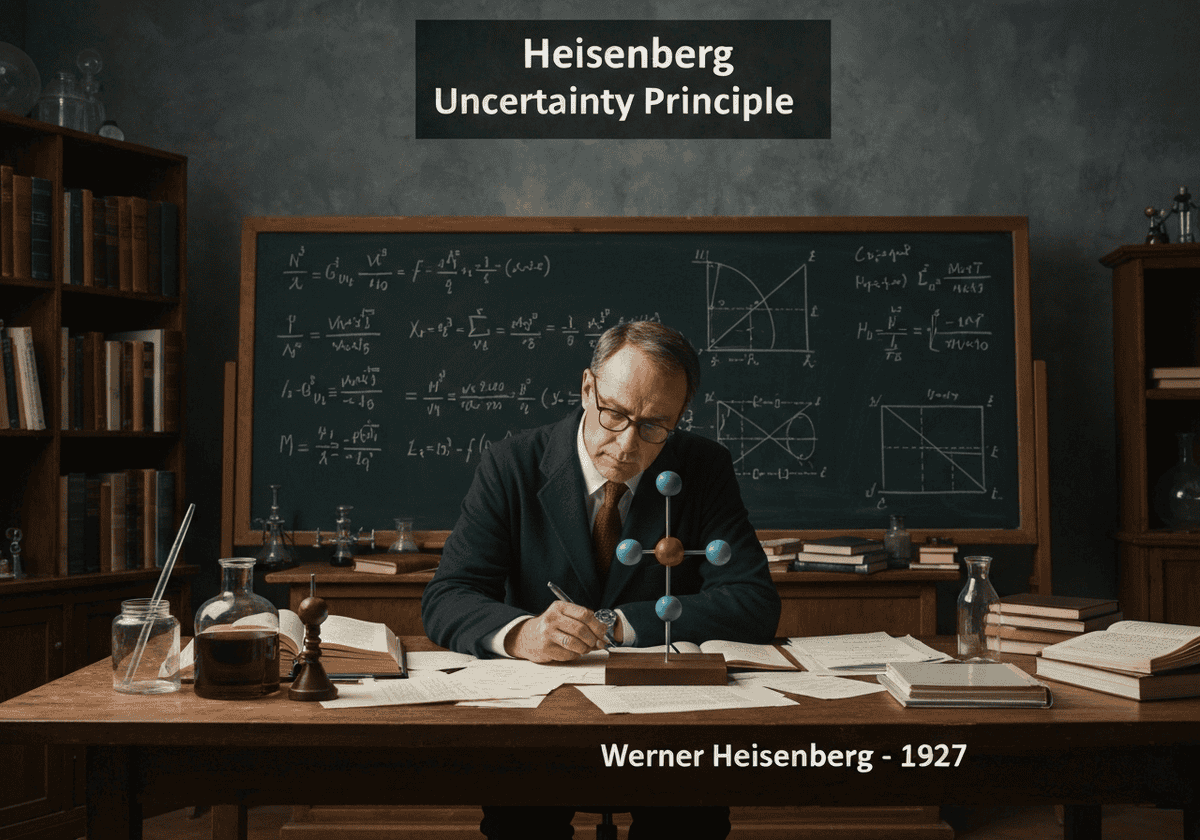
Heisenberg Uncertainty Principle

1927
  • Werner Heisenberg
Physicist analyzing particle model in vintage laboratory, Heisenberg Uncertainty Principle.

(صورة توضيحية فقط)

It is impossible to simultaneously know with perfect accuracy certain pairs of complementary physical properties of a particle. The most common example is the position [latex]x[/latex] and momentum [latex]p[/latex]. The principle states that the product of their uncertainties, [latex]\Delta x[/latex] and [latex]\Delta p[/latex], يجب be greater than or equal to a specific value: [latex]\Delta x \Delta p \ge \frac{\hbar}{2}[/latex].

The Heisenberg Uncertainty Principle is a fundamental tenet of quantum mechanics, not a statement about the limitations of measurement technology. It reflects an inherent property of quantum systems. The principle arises from the wave-like nature of all quantum objects. A particle’s position and momentum are described by its wavefunction. A wavefunction that is highly localized in space (small [latex]\Delta x[/latex]) is necessarily composed of a wide superposition of many different momentum waves, resulting in a large uncertainty in momentum (large [latex]\Delta p[/latex]). Conversely, a wavefunction with a well-defined momentum (small [latex]\Delta p[/latex]) must be a spatially spread-out wave, leading to a large uncertainty in position (large [latex]\Delta x[/latex]).

The principle applies to any pair of ‘conjugate variables,’ which are related through Fourier transforms in the mathematical formalism of quantum mechanics. Another important pair is energy ([latex]E[/latex]) and time ([latex]t[/latex]), with the relation [latex]\Delta E \Delta t \ge \frac{\hbar}{2}[/latex]. This implies that the energy of a state that exists for only a short time cannot be precisely determined. This has profound consequences, such as allowing for the temporary creation of ‘virtual particles’ in quantum field theory, which mediate fundamental forces. The uncertainty principle fundamentally limits the determinism envisioned by classical physics, replacing it with a probabilistic description of nature at the smallest scales.
UNESCO Nomenclature: 2210
– Quantum Physics

يكتب

نظام مجرد

خلل

Revolutionary

الاستخدام

استخدام واسع النطاق

مقدمات

  • Matrix mechanics (1925)
  • Wave mechanics (شرودنجر, 1926)
  • Fourier analysis
  • Born rule (probabilistic interpretation of wavefunction, 1926)

التطبيقات

  • understanding the stability of atoms
  • explaining quantum tunneling
  • estimating the size and energy of atomic ground states
  • fundamental limits in quantum measurement and معالجة الإشارات
  • quantum التشفير

براءات الاختراع:

NA

أفكار ابتكارية محتملة

  • unclonable physical keys for cryptography based on quantum states
  • sensors that exploit quantum fluctuations for ultra-sensitive detection
  • noise-cancellation technology for quantum computers
  • methods for ‘squeezing’ quantum uncertainty for precision measurement
  • stochastic computing architectures inspired by quantum indeterminacy
  • virtual particle-based energy generation concepts
  • quantum random number generators
  • secure communication protocols that detect eavesdropping via measurement disturbance
Related to: uncertainty principle, Werner Heisenberg, quantum mechanics, conjugate variables, position, momentum, wavefunction, quantum measurement.

السياق التاريخي

Heisenberg Uncertainty Principle

1925
1926
1926
1927
1927
1930
1930
1924
1925
1926
1927
1927
1930
1930
1930

(إذا كان التاريخ غير معروف أو غير ذي صلة، على سبيل المثال "ميكانيكا الموائع"، يتم توفير تقدير تقريبي لظهوره الملحوظ)

أحدث الإضافات

أهم المنشورات والمقالات

أفضل الأدوات الأصلية

السنة العاشرة عيد

الصور والتنزيلات بالحجم الكامل متاحة فقط، ومجانية تمامًا، للأعضاء المسجلين.