المعادلة الأساسية للجهد الكهروكيميائي
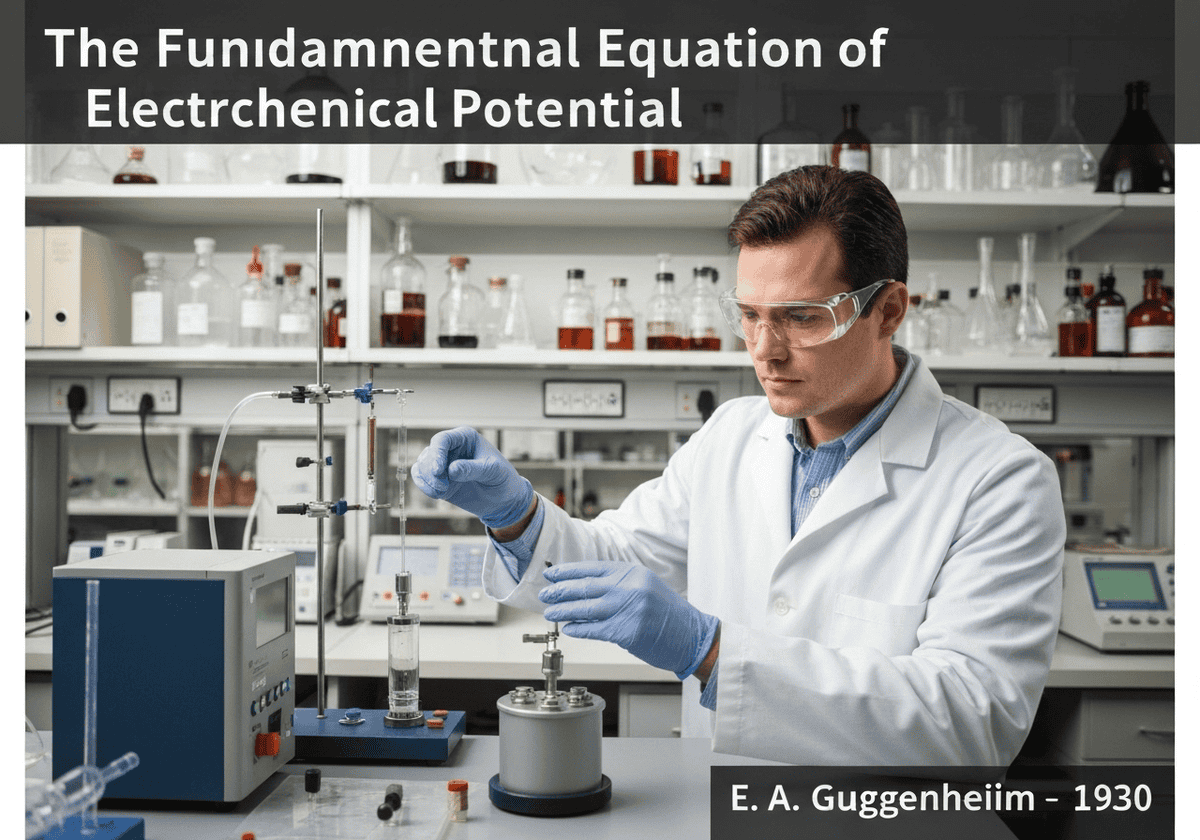
Electrochemical potential, [latex]\bar{\mu}_i[/latex], quantifies the total energy of a charged species `i` in a system. It combines the chemical potential, [latex]\mu_i[/latex], which accounts for concentration and intrinsic properties, with the electrostatic potential energy, [latex]z_i F \phi[/latex]. The formula is [latex]\bar{\mu}_i = \mu_i + z_i F \phi[/latex], where [latex]z_i[/latex] is the ion’s charge, [latex]F[/latex] is the Faraday constant, and [latex]phi[/latex] is the local electric potential.
The concept of electrochemical potential is a cornerstone of physical chemistry, extending the idea of chemical potential to systems involving charged species and electrical fields. The governing equation, [latex]\bar{\mu}_i = \mu_i + z_i F \phi[/latex], elegantly merges chemical and electrical driving forces into a single الديناميكية الحرارية quantity. The first term, [latex]\mu_i[/latex], is the chemical potential, representing the energy change associated with adding a mole of species `i` to a system, considering factors like concentration, temperature, and pressure. It is the driving force for diffusion from high to low concentration.
The second term, [latex]z_i F \phi[/latex], represents the molar electrostatic potential energy. Here, [latex]z_i[/latex] is the dimensionless integer charge of the ion (e.g., +2 for [latex]Ca^{2+}[/latex]), [latex]F[/latex] is the Faraday constant (approximately 96,485 C/mol), which is the charge of one mole of electrons, and [latex]\phi[/latex] is the local electric potential (Galvani potential). This term quantifies the work required to move a mole of ions against the local electric field.
Fundamentally, the electrochemical potential is the partial molar Gibbs free energy of the species `i`, expressed as [latex]\bar{mu}_i = (\frac{\partial G}{\partial n_i})_{T,P,n_{j\neq i}}[/latex]. This means it represents the total work that can be extracted when one mole of the species is added to the system. The difference in electrochemical potential between two points dictates the direction of spontaneous movement for that ion, encompassing both diffusion down a concentration gradient and drift along an electric field.
UNESCO Nomenclature: 2209
– Physical chemistry
الاستخدام
استخدام واسع النطاق
مقدمات
- Josiah Willard Gibbs’s work on chemical potential and Gibbs free energy
- Michael Faraday’s laws of التحليل الكهربائي and the concept of the faraday constant
- Walther Nernst’s development of the Nernst equation
- تطور الديناميكا الحرارية الكلاسيكية والكهرباء الساكنة
التطبيقات
- البطاريات وخلايا الوقود
- علم الطلاء الكهربائي والتآكل
- فيزياء أشباه الموصلات (مستوى فيرمي)
- علم الأعصاب (النبضات العصبية)
- الطاقة الحيوية الخلوية (تخليق ATP)
أفكار ابتكارية محتملة
- أغشية ذكية انتقائية للأيونات لتنقية المياه المستهدفة
- أجهزة استشعار متكاملة بيولوجيًا تقيس النشاط الأيضي من خلال تتبع تدفق الأيونات في الوقت الفعلي
- المواد ذاتية الشفاء التي تستخدم تدرجات الجهد الكهروكيميائي لتوجيه الأيونات الترميمية إلى مواقع الضرر
- energy harvesting devices that capture potential differences across atmospheric layers
- neuromorphic computing chips that use ion gradients instead of electron flow
- أنظمة توصيل الأدوية المتقدمة التي تطلق الدواء بناءً على التغيرات في إمكانات الغشاء الخلوي
- استخراج الطاقة الحرارية الأرضية المعزز من خلال التلاعب بتدرجات الأيونات تحت السطحية
- أنظمة التقاط ثاني أكسيد الكربون الجوي المباشر التي تعتمد على اختلافات الجهد الكهروكيميائية الهندسية
Related to: electrochemical potential, chemical potential, electrostatic potential, Faraday constant, Gibbs free energy, Nernst equation, electrochemistry, ion.