Product Design, Manufacturing & Innovation Resources
بيت » Quantum Tunneling

Quantum Tunneling

1927
  • Friedrich Hund
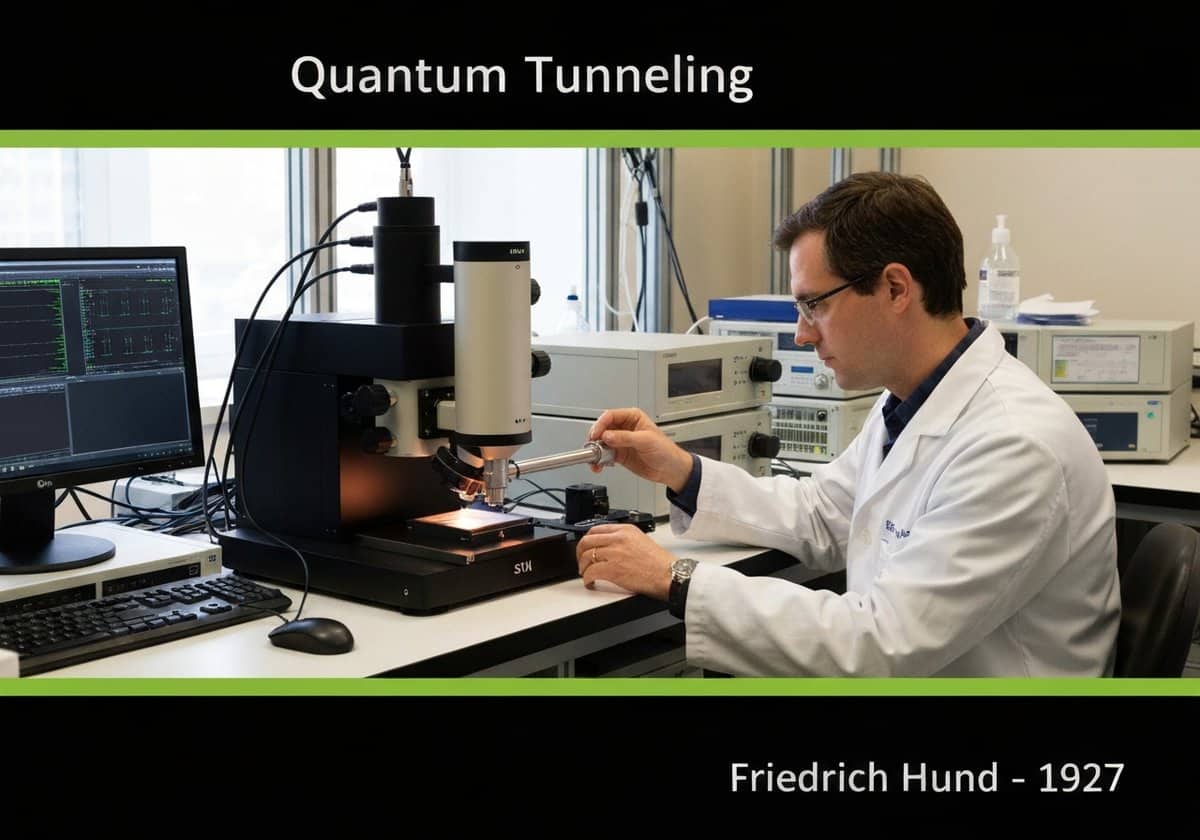
Scanning tunneling microscope in a laboratory setting demonstrating quantum tunneling principles.

(صورة توضيحية فقط)

A quantum mechanical phenomenon where a wavefunction can propagate through a potential energy barrier. Classically, a particle lacking sufficient energy to surmount a barrier would be reflected. However, due to the wave-like nature of particles, there is a non-zero probability that the particle can appear on the other side of the barrier, effectively ‘tunneling’ through it.

Quantum tunneling is a direct consequence of the Heisenberg uncertainty principle and the probabilistic nature of a particle’s location described by its wavefunction. When a particle’s wavefunction encounters a potential barrier, it does not abruptly drop to zero. Instead, it decays exponentially inside the barrier. If the barrier is thin enough, the wavefunction can have a small but non-zero amplitude on the other side. Since the probability of finding the particle is related to the square of the wavefunction’s amplitude, there is a finite probability of the particle being detected on the far side of the barrier.

The probability of tunneling decreases exponentially with the thickness of the barrier and the square root of the barrier’s height and the particle’s mass. This is why tunneling is significant for microscopic particles like electrons but negligible for macroscopic objects. For example, in nuclear fusion within the Sun, protons do not have enough thermal energy to overcome their mutual electrostatic repulsion (the Coulomb barrier). Fusion is only possible because the protons can tunnel through this barrier, allowing the strong nuclear force to bind them together. Similarly, the scanning tunneling microscope (STM) works by measuring the tunneling current of electrons between a sharp metallic tip and a sample surface, allowing for imaging with atomic resolution.

UNESCO Nomenclature: 2210
– Quantum Physics

يكتب

نظام مجرد

خلل

Substantial

الاستخدام

استخدام واسع النطاق

مقدمات

  • شرودنجر equation (1926)
  • Wave-particle duality
  • Studies of radioactivity (alpha decay)
  • Heisenberg uncertainty principle (1927)

التطبيقات

  • scanning tunneling microscope (STM)
  • tunnel diodes in electronics
  • flash memory (floating-gate transistors)
  • nuclear fusion in stars
  • alpha decay of atomic nuclei

براءات الاختراع:

NA

أفكار ابتكارية محتملة

  • tunneling-based dna sequencing technology
  • ultra-low power electronics using tunnel field-effect transistors (TFETs)
  • quantum-tunneling-based chemical sensors for detecting single molecules
  • energy harvesting devices based on electron tunneling
  • next-generation non-volatile memory with higher density and speed
  • controlled initiation of chemical reactions by tunneling
  • terahertz frequency oscillators
  • quantum-dot solar cells with enhanced efficiency via tunneling
Related to: quantum tunneling, wavefunction, potential barrier, scanning tunneling microscope, nuclear fusion, alpha decay, quantum mechanics, probability.

السياق التاريخي

Quantum Tunneling

1925
1926
1927
1927
1930
1930
1930
1925
1926
1926
1927
1927
1930
1930
1930

(إذا كان التاريخ غير معروف أو غير ذي صلة، على سبيل المثال "ميكانيكا الموائع"، يتم توفير تقدير تقريبي لظهوره الملحوظ)

أحدث الإضافات

أهم المنشورات والمقالات

أفضل الأدوات الأصلية

السنة العاشرة عيد

الصور والتنزيلات بالحجم الكامل متاحة فقط، ومجانية تمامًا، للأعضاء المسجلين.