Product Design, Manufacturing & Innovation Resources
بيت » Combinational and Sequential Logic Circuits

Combinational and Sequential Logic Circuits

1950
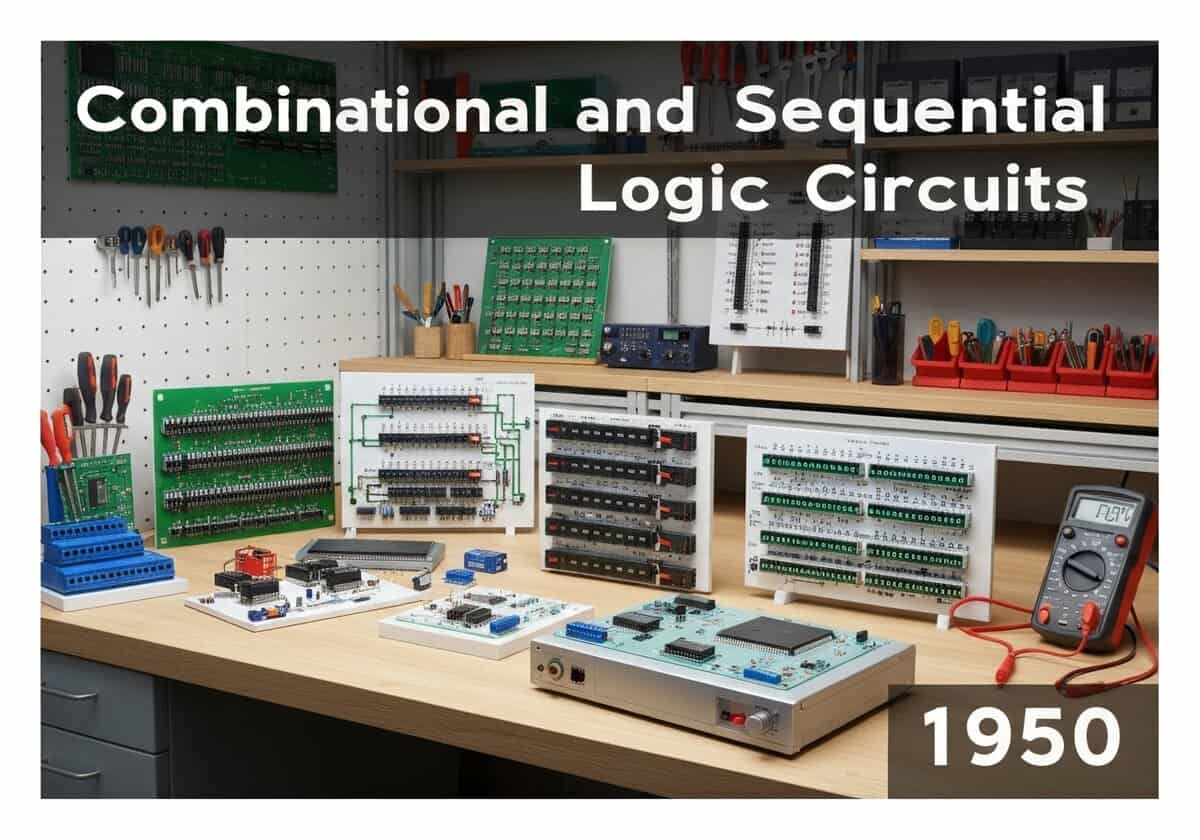
Combinational and sequential logic circuits in a modern electronics lab.

(صورة توضيحية فقط)

Digital circuits are categorized into two main types: combinational and sequential logic. In combinational logic, the output is a pure function of the present input values only (e.g., an adder). In sequential logic, the output depends not only on the current inputs but also on the past sequence of inputs, as these circuits have memory elements (e.g., a flip-flop).


Combinational logic circuits are memory-less. Their output at any given time is determined solely by the combination of input values at that same instant. They are implemented using basic logic gates like AND, OR, NOT, NAND, and NOR. Examples include adders, subtractors, comparators, multiplexers (which select one of several input signals), and demultiplexers (which send an input signal to one of many outputs). The relationship between inputs and outputs can be described by a truth table or a set of Boolean functions.

Sequential logic circuits, in contrast, incorporate memory. Their state, stored in memory elements like flip-flops or latches, is a summary of the history of past inputs. The output is a function of both the current inputs and the current state. This memory capability allows them to perform tasks that combinational circuits cannot, such as counting or storing data. Sequential circuits are further divided into synchronous and asynchronous types. Synchronous circuits use a clock signal to update their state at discrete time intervals, ensuring orderly operation. Asynchronous circuits update their state in response to changes in the input signals, which can be faster but are more complex to design and analyze correctly.

UNESCO Nomenclature: 2205
– Electronics

يكتب

نظام مجرد

خلل

أساسيات

الاستخدام

استخدام واسع النطاق

مقدمات

  • Boolean algebra
  • Invention of the flip-flop circuit (Eccles-Jordan trigger circuit)
  • Alan Turing’s concept of a state machine (Turing machine)
  • Development of relay-based switching circuits

التطبيقات

  • arithmetic logic units (alus) use combinational logic
  • data multiplexers and decoders use combinational logic
  • flip-flops and latches (memory) use sequential logic
  • state machines and counters use sequential logic
  • microprocessor control units use a combination of both

براءات الاختراع:

NA

أفكار ابتكارية محتملة

  • asynchronous sequential logic for clockless, low-power processors
  • reversible logic circuits for quantum and low-energy computing
  • hardware neural networks implementing sequential logic for temporal pattern recognition
  • stochastic computing circuits that use probabilistic sequential logic
  • fpga architectures that can dynamically switch between combinational and sequential functions
  • secure logic circuits that obscure their internal state to prevent side-channel attacks
  • in-memory computing where logic and memory are merged in sequential cells
  • optical sequential circuits for light-based data processing
Related to: combinational logic, sequential logic, logic circuits, flip-flop, state machine, memory, clock signal, digital design.

السياق التاريخي

Combinational and Sequential Logic Circuits

1937
1940
1947
1950
1950
1950
1950
1936-01-01
1938
1940
1950
1950
1950
1950
1950

(إذا كان التاريخ غير معروف أو غير ذي صلة، على سبيل المثال "ميكانيكا الموائع"، يتم توفير تقدير تقريبي لظهوره الملحوظ)

أحدث الإضافات

أهم المنشورات والمقالات

أفضل الأدوات الأصلية

السنة العاشرة عيد

الصور والتنزيلات بالحجم الكامل متاحة فقط، ومجانية تمامًا، للأعضاء المسجلين.