Product Design, Manufacturing & Innovation Resources
» 电化学势基本方程

电化学势基本方程

1930
  • E. A. Guggenheim
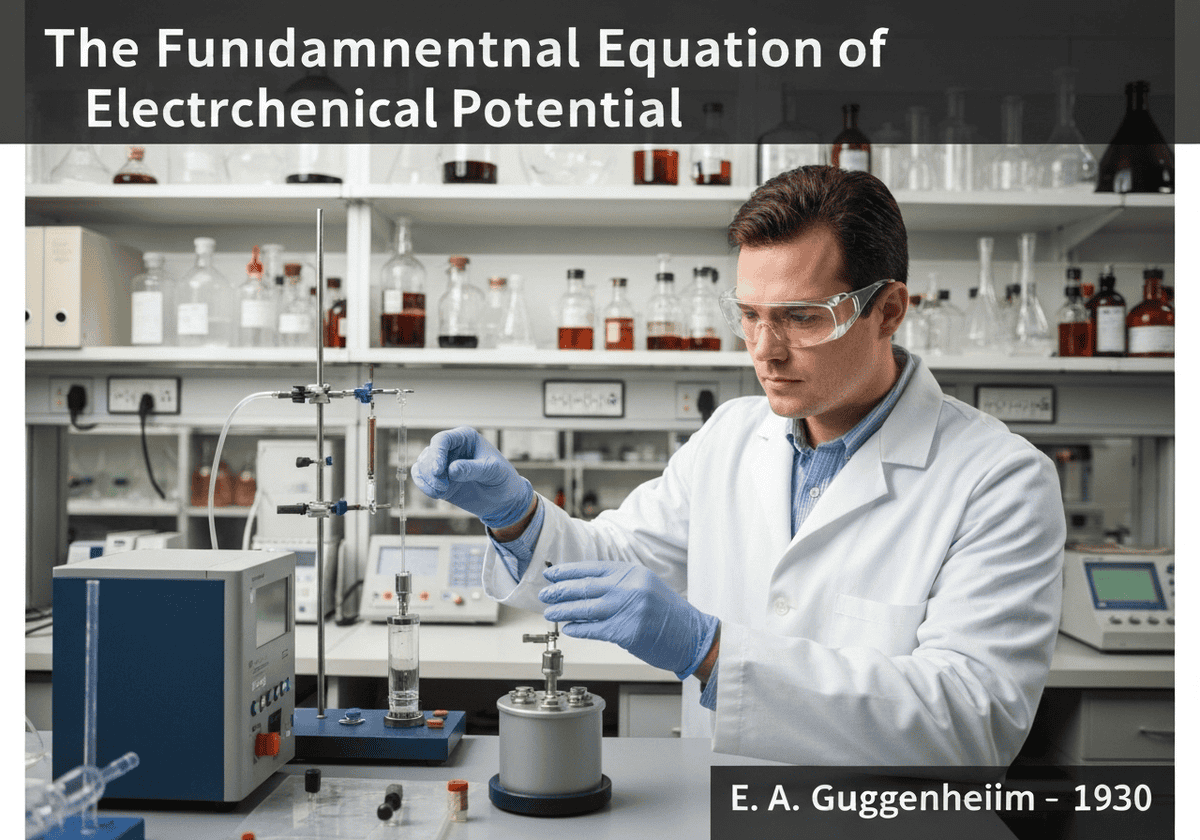
物理化学中测量电化学势的实验室实验。

(图片仅供参考)

电化学势,[latex]\bar{\mu}_i[/latex],用于量化系统中带电物种`i`的总能量。它将化学势,[latex]\mu_i[/latex](考虑浓度和固有性质)与静电势能,[latex]z_i F \phi[/latex]相结合。 其计算公式为:[latex]\bar{\mu}_i = \mu_i + z_i F \phi[/latex],其中[latex]z_i[/latex]为离子的电荷量,[latex]F[/latex]为法拉第常数,[latex]phi[/latex]为局部电势。.


The concept of electrochemical potential is a cornerstone of physical chemistry, extending the idea of chemical potential to systems involving charged species and electrical fields. The governing equation, [latex]\bar{\mu}_i = \mu_i + z_i F \phi[/latex], elegantly merges chemical and electrical driving forces into a single thermodynamic quantity. The first term, [latex]\mu_i[/latex], is the chemical potential, representing the energy change associated with adding a mole of species `i` to a system, considering factors like concentration, temperature, and pressure. It is the driving force for diffusion from high to low concentration.

第二项[latex]z_i F \phi[/latex]代表摩尔静电势能。其中,[latex]z_i[/latex]是离子的无量纲整数电荷(例如[latex]Ca^{2+}[/latex]为+2), [latex]F[/latex]为法拉第常数(约96,485 C/mol),即一摩尔电子的电荷量,[latex]\phi[/latex]为局部电势(伽伐尼电势)。该项量化了在局部电场中移动一摩尔离子所需的功。.

从根本上讲,电化学势是物种`i`的偏摩尔吉布斯自由能,可表示为[latex]\bar{mu}_i = (\frac{\partial G}{\partial n_i})_{T,P,n_{j\neq i}}[/latex]。这意味着它代表当向系统添加一摩尔该物种时可提取的总功。 两点间的电化学势差决定了该离子的自发运动方向,涵盖沿浓度梯度扩散与沿电场漂移两种机制。.

UNESCO Nomenclature: 2209
- 物理化学

类型

抽象系统

中断

基础

用法

广泛使用

前体

  • 约西亚·威拉德·吉布斯关于化学势与吉布斯自由能的研究
  • 迈克尔·法拉第的电解定律与法拉第常数的概念
  • Walther Nernst’s development of the Nernst equation
  • 经典热力学和静电学的发展

应用程序

  • 电池和燃料电池
  • 电镀与腐蚀科学
  • 半导体物理学(费米能级)
  • 神经科学(神经冲动)
  • 细胞生物能量学(ATP合成)

专利:

NA

潜在创新理念

由于机器人流量被拦截(目前每天超过 4 万),此内容仅限社区成员查看。
> 登录 > 或者 > 注册 < (100% 免费)即可访问此内容,以及所有其他受限内容和工具。

相关概念:电化学势、化学势、静电势、法拉第常数、吉布斯自由能、能斯特方程、电化学、离子。.

历史背景

电化学势基本方程

1926
1927
1927
1930
1930
1930
1931
1926
1926
1927
1930
1930
1930
1931
1932

(如果日期未知或不相关,例如“流体力学”,则提供其显著出现的近似估计)

只有注册会员才能免费获得 100% 的全尺寸图片和下载。.

> 登录 <